Health & WellnessS


Cow

'Rare Variant' of Mad Cow Disease Discovered in California, One of Many Mysterious Cases This Year

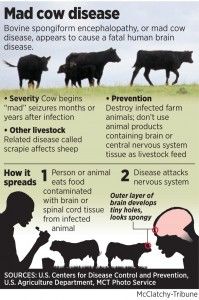
mad cow graphic
© McClatchy-Tribune
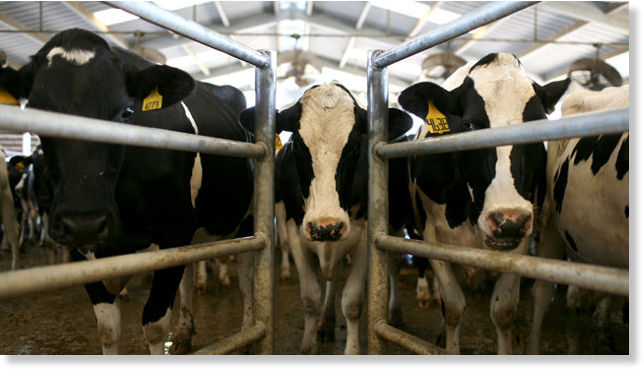
For the first time since 2006, it has been announced that an American dairy cow in California has been found to be infected with mad cow disease, formally known as bovine spongiform encephalopathy (BSE).

The form of BSE found was a 'rare variant' which The Washington Post reports is "not generally associated with an animal consuming infected feed." While unrelated to mad cow disease, there have been a number of mysterious viruses which have emerged this year including an incurable hand, foot and mouth disease strain (HFMD) in Vietnam which has already killed 19 children and a new mystery virus has resulted in the deaths of thousands of heads of livestock in Europe.

Similarly, an unidentified disease has killed over 20,000 chickens in Nepal and horses and cattle are dying in Maury County, Tennessee due to causes of death which "cannot be determined at this time."

Detective Terry Chandler of the Maury County Sheriff's Department said, "It is a mystery. We don't know what happened."

As previously mentioned these cases are not cases of BSE or linked in any way to the aforementioned California case as far as we know, however the sheer number of cases of mysterious diseases across the world over the past few months is odd indeed.

Please understand, I am not intending to draw spurious links for no reason, I am just pointing out that we are seeing a great deal of these strange deadly diseases spring up seemingly out of nowhere in locales across the globe.

Attention

Exposing Kashi Cereal For The Poison That It Is

Kashi Brand
© Prevent Disease
There is an established misconception among consumers that natural or even organic labeling means more nutritious and less toxic ingredients. This is not always the case and breakfast cereals are no exception. The Kashi brand is owned by Kellogg Company, one of the largest breakfast cereal makers in the world.

The ownership base of Kashi is still not widely recognized or common knowledge, especially since the Kashi website continues to paint a picture of being a small company. Investigations into Kashi cereals show deceiving claims after their breakfast products were found to be riddled with genetically modified (GM) and pesticide loaded ingredients.

The deception at Kashi runs deep, especially when it comes to its association with Kellogg which is kept very discreet from the public.

"We are a small (after 25 years, still fewer than 70 of us) band of passionate people," it says, despite being owned by the nation's largest cereal manufacturer. Kellogg does not include its name on Kashi packaging.

The Cornucopia Institute's "Cereal Crimes" investigation uncovered some disturbing facts about this supposed natural breakfast cereal. The investigations found that Kashi brand cereals contain "high levels" of genetically engineered ingredients. These include soy and corn based ingredients.

For non-organic "natural" products making "non-GMO" claims, results showed that these claims cannot always be trusted.

Most companies do not share detailed standards for "natural" foods with the public. Kashi would likely be uncomfortable sharing with theircustomers that their "natural" foods contain hexane-extracted and genetically engineered soy ingredients.

On August 31, 2011, a class action lawsuit was filed against Kashi for allegedly misleading consumers with its "natural" claims. One Kashiproduct in particular, GoLean Shakes, is composed almost entirely of synthetic and unnaturally processed ingredients, according to the plaintiff.

Ambulance

Anti-depressants 'May Do More Harm Than Good'

Image
Anti-depressants are designed to relieve the symptoms of depression by increasing the levels of serotonin in the brain, where it regulates mood.
Common anti-depressants could be doing patients more harm than good, according to researchers examined the impact of the medications on the whole body.

A team from McMaster University examined previous patient studies into the effects of anti-depressants and determined that the benefits of most anti-depressants compare poorly to the risks, which include premature death in elderly patients.

'We need to be much more cautious about the widespread use of these drugs,' said study leader and evolutionary biologist Paul Andrews.

'It's important because millions of people are prescribed anti-depressants each year, and the conventional wisdom about these drugs is that they're safe and effective.'

Comment: Biologist Paul Andrews is not the only researcher suggesting that 'antidepressants do more harm than good' read the following articles for a more in depth look at Big Pharma's Shady Ploy to Sell Depression Drugs That People May Not Need:

Why Antidepressants Don't Work for Treating Depression
Here's some depressing recent medical news: Antidepressants don't work. What's even more depressing is that the pharmaceutical industry and Food and Drug Administration (FDA) have deliberately deceived us into believing that they DO work. As a physician, this is frightening to me. Depression is among the most common problems seen in primary-care medicine and soon will be the second leading cause of disability in this country.

The study I'm talking about was published in The New England Journal of Medicine. It found that drug companies selectively publish studies on antidepressants. They have published nearly all the studies that show benefit - but almost none of the studies that show these drugs are ineffective.
Antidepressants: The Emperor's New Drugs?
Antidepressants are supposed to be the magic bullet for curing depression. But are they? I used to think so. As a clinical psychologist, I used to refer depressed clients to psychiatric colleagues to have them prescribed. But over the past decade, researchers have uncovered mounting evidence that they are not. It seems that we have been misled. Depression is not a brain disease, and chemicals don't cure it.
Antidepressants Proven to be Useless, Pushed on Public Anyway
Why Antidepressants Cause Brain Damage, Breast Cancer, and Early Mortality
New Antidepressants Can Increase Risks for Elderly, Study Suggests
Why antidepressants are simply a confidence trick: A leading psychologist claims taking sugar pills would work just as well


Health

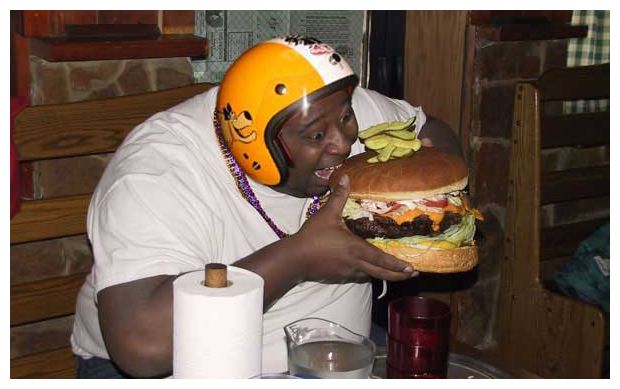
Heart Attack Burger Inexplicably Makes People Sick

Burger
© Minyanville
Sometimes, the names of things are self-explanatory. Snakes on a Plane is a movie about snakes on a plane; theKFC Double Down is kind of gross, etc.

In these cases, titles serve as a warning of what's to come and it is the consumer's responsibility to heed these warnings. To return to Snakes on a Plane, anyone renting that movie shouldn't be surprised to see Samuel L. Jackson fighting to get snakes off of a plane.

Initially, Las Vegas's Heart Attack Grill seems like a more complicated case. After all, the owners can't really be implying that their food causes heart attacks. That would be bad business.

Except...

Last Saturday a woman collapsed after eating the restaurant's "Double Bypass Burger," a high calorie option. In fairness, the Global Post points out that she had also been smoking and drinking.

This marks the second collapse at the restaurant in the last few months. Back in February, a man was taken to the emergency room after eating the "Triple Bypass Burger."

Light Sabers

Chelation-Bashing: Removing Heavy Metals Like Mercury from the Body Is "Dangerous"?

Image
© Alliance for Natural Health
Not only are doctors being advised to reject chelation therapy - they're being asked to report on their colleagues who practice it.

The American College of Medical Toxicology held a conference at the US Centers for Disease Control and Prevention (CDC) this past February about the "use and misuse" of chelation therapy - a misleading title suggesting some semblance of scientific objectivity, which was nowhere in evidence. The conference was more like a Salem witch hunt in which chelators played the role of the accused witches and warlocks.

Why is chelation so threatening to mainstream medicine? There is no disputing that heavy metals are extremely toxic. The human body is engineered to remove small amounts daily, but not the large amounts we often pick up from modern sources. One of those sources has of course been vaccines, which have used mercury as a preservative (it is still used in the US flu shot). Another source has been dental "silver" amalgam, which also contains mercury. This may be part of the reason for the hostility to chelation.

Bulb

Study: Stress Contributes to Cancer

Image
© Unknown
There are many things that drive cancer. Poor diet, chemical and radiation exposures, and certain infections, figure prominently in the process. Stress, however, is a major contributing factor that is often completely overlooked.

New research, however, sheds light on just how critically important the physiological consequences of stress are on cancer cell progression.

Cow

Top US Vet Rushes to Soothe Mad Cow Fears

cows
© ABC NewsMad Cow Disease Found in U.S. Cow
US - Hours after confirming to reporters that the United States had found its fourth-ever case of mad cow disease, John Clifford was ready to answer the world's questions about the safety of U.S. beef.

Clifford, the government's chief veterinary officer at the agriculture department, had quickly called his counterparts in Mexico and Canada, the first and second-largest buyers of U.S. beef, to tell them about a California cow found to have an "atypical" type of the brain-wasting disease.

Having taken up his post in May 2004, just six months after the first U.S. case of Bovine Spongiform Encephalopathy was discovered, he knows that sharing information quickly during the next 24 hours -- and in the weeks ahead -- will be vital for reassuring consumers, both domestic and foreign.

"It's critically important for the trust and continuing of the trade between those countries," Clifford said in an interview, trying to pre-empt concerns about the nation's herd that could send the multi-billion U.S. industry into another tailspin.

The first case of mad cow at the end of 2003 caused a $3 billion plunge in beef export revenues. Foreign trade did not fully recover until 2011.

Smoking

Smoking, but Not Nicotine, Reduces Risk for Rare Tumor

smoking
© unknown
New research confirms an association between smoking and a reduced risk for a rare benign tumor near the brain, but the addition of smokeless tobacco to the analysis suggests nicotine is not the protective substance.

The study using Swedish data suggests that men who currently smoke are almost 60 percent less likely than people who have never smoked to develop this tumor, called an acoustic neuroma. But men in the study who used snuff, which produces roughly the same amount of nicotine in the blood as smoking, had no reduced risk of tumor development.

"We see this effect with current smokers but don't see it with current snuff users, so we think that maybe the protective effect has something to do with the combustion process or one of the other chemicals in cigarettes that are not in snuff," said Sadie Palmisano, a doctoral student in epidemiology at Ohio State University and lead author of the study. "We learned something from exclusion."

Acoustic neuroma is a tumor that grows on the vestibular cochlear nerve connecting the ear to the brain. It is not cancer, but it can cause nerve damage as well as symptoms that include vertigo, ringing in the ears and hearing loss. The only treatment for these slow-growing tumors is surgical removal or high-powered radiation that reduces their size. About one in 100,000 people per year develops these growths, which account for approximately 8 percent of all primary tumors inside the skull in the United States.

Comment: Actually there are a number of benefits from smoking that the PTB rarely acknowledge, here are a few!

Study finds smoking wards off Parkinson's disease
Nicotine helps Alzheimer's and Parkinson's Patients
Nicotine Found To Protect Against Parkinson's-like Brain Damage
Nicotine Lessens Symptoms Of Depression In Nonsmokers
Scientists Identify Brain Regions Where Nicotine Improves Attention, Other Cognitive Skills
Can Smoking be GOOD for SOME People?


Heart - Black

Breast Cancer Cell Growth Becomes Aggressive with Cadmium Exposure

Image
© naturalnews.com
Studies by researchers at Dominican University of California show that breast cancer cells become increasingly aggressive the longer they are exposed to small concentrations of cadmium, a heavy metal commonly found in cosmetics, food, water and air particles.

The study by Maggie Louie, associate professor of biochemistry, shows exposure to cadmium for prolonged periods of time can cause the progression of breast cancer to become more aggressive. Her findings were presented April 23, at the annual meeting of the American Society for Biochemistry and Molecular Biology, held in conjunction with the Experimental Biology 2012 conference in San Diego.

Breast cancer results from the abnormal growth of the cells in the mammary gland. The normal growth of mammary gland epithelial cells is modulated by the circulating levels of estrogen, a hormone produced by the ovaries. The activity of estrogen is stimulated by the estrogen receptor (ER). Heavy metals such as cadmium can act as endocrine disruptors and mimic estrogen, thereby disrupting the hormone dependent pathways.

Comment: Knowledge of the sources of heavy metals helps to limit exposure and detoxification procedures can help to remove heavy metals:
New Study Finds Major Toxins in Many Cosmetics
Throw Away Kid's Jewelry From China
Natural Ways to Remove Heavy Metals


Wine

Drinking Alcohol Is Linked to Breast Cancer

Image
© cbsnews.com
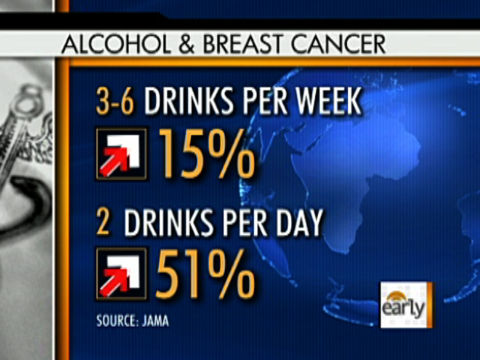
A research team presented findings that they say may finally explain the link between alcohol consumption and breast cancer.

"Cells have different mechanisms to remove toxic substances, such as ethanol, the chemical name for alcohol, that represent a potential risk to them," explains María de Lourdes Rodríguez-Fragoso, professor of pharmacology and toxicology at the Universidad Autonoma del Estado de Morelos in Mexico. "Unfortunately, sometimes these mechanisms produce other toxic substances, including some that are associated with the development of different types of cancer."

Rodríguez-Fragoso presented her group's work at the annual meeting of the American Society for Biochemistry and Molecular Biology, held in conjunction with the Experimental Biology 2012 conference in San Diego on April 23.

Alcohol consumption has long been established as a risk factor for breast cancer. But finding the direct link that makes it so has so far proved elusive. Now, Rodríguez-Fragoso and her collaborators think that they have found the answer, a protein called CYP2E1.