Welcome to Sott.net
Sat, 16 Oct 2021
The World for People who Think

Earth Changes
Map

Red Flag

Mt. Sinabung eruption triggers red alert in Indonesia

CCTV image shows Mount Sinabung
© PVMBG
CCTV image shows Mount Sinabung in North Sumatra spewing ashes into the sky on Tuesday morning.
Mount Sinabung in Karo district, North Sumatra, erupted on Tuesday morning. The volcano spewed columns of ash 2,000 meters into the sky after nearly 11 months of being relatively dormant.

The first eruption happened at 7.48 a.m. and lasted for more than 40 minutes.

The Volcanic and Geological Disaster Mitigation Center (PVMBG) said thick, gray volcanic ash spewing out of Sinabung's crater had moved eastward and southeastward this morning.


Attention

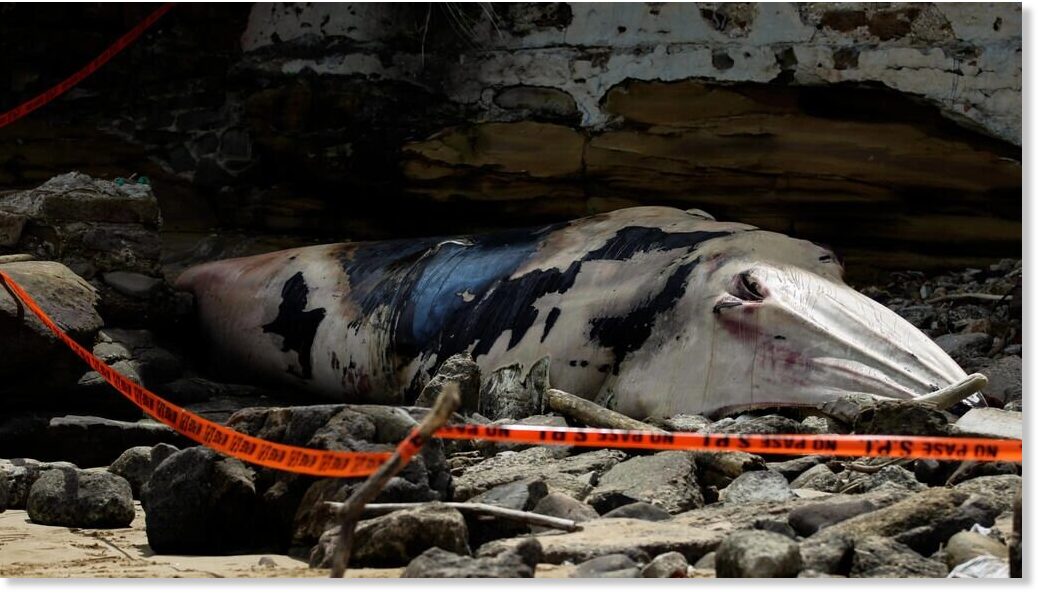
Ninth dead gray whale found in San Francisco Bay Area since March

Waves roll into a dead whale at Ocean Beach in San Francisco, Monday, May 6, 2019.
© AP/Jeff Chiu
Waves roll into a dead whale at Ocean Beach in San Francisco, Monday, May 6, 2019.
Marine mammal experts are concerned about the death of a gray whale that washed ashore in San Francisco.

The whale found Monday on Ocean Beach was the ninth discovered in the San Francisco Bay Area since March.

The Marine Mammal Center plans a necropsy to determine what killed the animal.


Snowflake

Early snowfall hits Australia

snow

Mt Hotham snow overnight.
It is snowing in Australia a month ahead of the start of the Australian ski season.

Most of the country's leading ski areas have been reporting snowfalls which are expected to intensify over the next 48-72 hours with the heaviest snow for most coming on Thursday-Friday.

Up to 50cm of snow is expected from the Antarctic front although it may not last on the ground as warmer weather is expected to arrive next week.

"2-3cm of fresh snow fell in the village this morning. We are expecting 40-50cm Thursday and Friday. Bring on the 2019 snow season!" said a Falls Creek spokesperson.


Arrow Down

Avalanche kills 7 climbers in Altai Mountains, Mongolia

Valeria Odarenko and the South Chuya mountain ridge where the climbers were hit by the avalanche

Valeria Odarenko and the South Chuya mountain ridge where the climbers were hit by the avalanche
A group of nine tourists - some reportedly from Siberia's largest university - hit by tragedy on the South Chuya mountain ridge.

The group was struck by an avalanche two days ago, 11 am on 6 May, but the two female survivors did not have the means to report the tragic accident.

The news only broke when the two young women met another group of mountain climbers who contacted local rescuers.

The climbers, some of them postgraduate students from the Novosibirsk State University - left a village of Kosh Agach on 1 May, aiming to spend two weeks in the wild.

The tourists were registered with the local Ministry of Emergencies as 'Group 37'.

Eight rescuers are flying to the avalanche site now.

Snowflake Cold

Cold May weather in France breaks 50-year records

Cold temps in France

Temperatures across France reached new lows for May this week, with some areas well into minus figures
Cold weather in France has broken 50-year records for the month of May this week, from the Oise to Corsica, Météo France has said.

A forecaster spokesperson said that from May 4-6, "a mass of cold polar air directly from the Arctic [hit, leading to] frosts over lowlands to the foothills of the Pyrenees, often in the range of 0°C to -2°C. Some records, some more than 50 years old, were broken."

Among the longest-standing records broken were those registered at Barcelonnette, in the Alpes-de-Haute-Provence (-7.4°C), a weather station that had been open since 1959, which previously had a cold record for May dating back to 1979.

The coldest temperature of -10°C was recorded at a weather station in Alpe-d'Huez (Isère) on Monday night (May 6), with the same station recording -7.7°C later that day, less than its lowest ever May temperature of 7.5°C, which was recorded on May 8, 1997.

A station in Beauvais (Oise) - which has been keeping track since 1944 - broke its own 1957 record when the temperature dropped to -2.4°C, while La Rochelle (Charente-Maritime) broke a 1951 record with 1.94°C.

Brest (Finistère) - whose station dates back to 1945 - broke its record of 0°C in May 1945 and 1979, with a new low of -0.2 °C.

Records were also broken in Auch (Gers), Vic-en-Bigorre (Hautes-Pyrénées) and Biscarosse (Landes).

Comment: Ravers get hypothermia at snow-hit French techno festival

Unseasonable and often record cold temperatures and snow have hit many other countries in Europe this week including: See also: Professor Valentina Zharkova explains and confirms why a "Super" Grand Solar Minimum is upon us


Cow Skull

More than 500,000 at risk in drought-hit Namibia

Namibia drought
© AFP
Livestock and wild animals are also at risk from the drought

Namibia is facing a "natural disaster" because of poor rains, President Hage Geingob says.

He has declared a state of emergency - the second in three years - over the situation, mobilising all government agencies to respond to the drought.

The lack of rain has already left 500,000 people - one in five Namibians - without access to enough food, the government says.

The sparsely-populated country has seen a succession of droughts since 2013.

The government had set aside $40m (£30m) to buy food and water tanks, and to transport livestock to and from grazing areas.

Prime Minister Saara Kuugongelwa-Amadhila has appealed for international help.

"We... call on all Namibians and development partners to assist in any way possible, so that we provide to our people who are affected, as well as the livestock," she said in the national assembly.

At least 60,000 domestic animals have died in the past six months.

Comment: Erratic seasons and extreme weather devastating crops around the world

Crop and cattle losses are on the rise everywhere, whether it is due to extensive drought, massive hail, epic flooding, huge dust storms, unexpected frosts, and even epidemics. See also:


Windsock

Huge dust storm blankets Mildura, Australia, turning daylight to midnight in minutes

Mildura dust storm
© Michael Moodie
Mildura residents said the dust storm looked like a thick wall.

Pictures and video show vast clouds of dust towering over the town in north-western Victoria, Australia


A huge dust storm blanketed the north-west Victorian town of Mildura on Tuesday afternoon, turning daylight to midnight in a matter of minutes as the front blew in from the west.

Tanvi Mor, who was at the airport when the storm came in about 5pm, said "it seemed to be swallowing Mildura".

Mor said it was Mildura's worst dust storm in 40 years. Pictures and video posted on social media showed vast clouds of dust towering over the town.

The North Star Mildura Motors salesman Shaun Blythman said the dealership was scrambling to clean 100 cars coated in a chocolate brown film on Wednesday morning.


Info

Ice Age Farmer Report: Zharkova Warns: PREPARE for Grand Solar Minimum (SC25/26)

snow
Cold, wet conditions prevail across the Northern Hemisphere, preventing farmers from planting. As Valentina Zharkova warns in a recent interview: prepare now for the cooling ahead, particularly the minimum between solar cycles 25 and 26 (if we make it that long!). Start growing, and spread the word.


Sources

Seismograph

7.2 magnitude earthquake hits Papua New Guinea [Update]

PNG quake
© USGS
The 7.2-magnitude earthquake was reported by USGS

Quake strikes eastern edge of mountainous country


A 7.2 magnitude earthquake has struck near Papua New Guinea, the United States Geological Survey (USGS) has said.

The quake struck 33km north west of the town of Bulolo in the early hours of Tuesday morning.

The epicentre of the strong quake was 127 km (79 miles) below the surface, the USGS said, in a region at the eastern edge of the mountainous country.

Comment: More information on the quake:
Its epicentre was 33 kilometers from the town of Bulolo at 2119 GMT according to the agency. It has a population of some 16,000. The nearest population centre is Lae, Morobe, 66km from the epicentre, with 76,000 residents.

The fire department in Lae said no one had yet called in to report damage or injuries so far following the quake. Social media photos out of Lae show stock strewn over the floors of supermarkets and clinics, though there appears to be little structural damage.

The Moresby-based National Disaster Management office said there had been no immediate reports of damage but news from the quake zone could take time to trickle in.

"We are awaiting assessments," a spokesman told AFP.


Christopher Lam was in Lae, about 100km north of Bulolo, said the rumble was audible.

"It was big. You can hear it. Got stuff thrown around in the house and the power is now cut off," he tweeted, alongside a video that showed his home rattling.

The PNG Power Ltd has issued a statement saying several of its power plants in the area of Ramu and Baiune had been knocked offline due to moving machinery, minor damage to power houses and damaged transformers.

The USGS automated assessment predicts a 65 per cent chance of zero fatalities, and just 4 per cent odds for there being up to one hundred. Economic losses are expected to be minimal.

But a similar 7.5 earthquake last year buried homes under landslides, killing some 125 people. It took several days for news of the tragedy to trickle out of PNG's remote countryside.

According to the Richter Scale, a 7-magnitude quake is equivalent to the detonation of 20 billion kilograms of dynamite and can cause serious damage to building foundations and underground pipes.


Snowflake

May snowfall in Croatia

Photo taken on May 6, 2019 shows snow-covered Biokovo Mountain by the Adriatic coast near Zagvozd, Croatia
© Xinhua/Ivo Cagalj
Photo taken on May 6, 2019 shows snow-covered Biokovo Mountain by the Adriatic coast near Zagvozd, Croatia
Did you know that snow is actually falling in Croatia? May can be a spring month as much as it likes, the tiny white bits of frost can still manage to reach the soil from white clouds. Although not very usual, small outbursts of winter weather can still happen in Central Europe during this time of the year. One such situation has happened last week. Just when people began to experiment with short sleeves in Croatia, a drop in temperature led to winter coats being retaken from the closets.

You didn't have to travel in the highlands of Lika to enjoy the frozen layer. If being in Capital, all you had to do is make a short climb to Medvednica Mountain. Our photo reporter Marko Todorov did precisely that, leading to the footage you can view below: