Earth ChangesS


Cloud Lightning

US: Missouri River states brace for floods

Omaha
Image
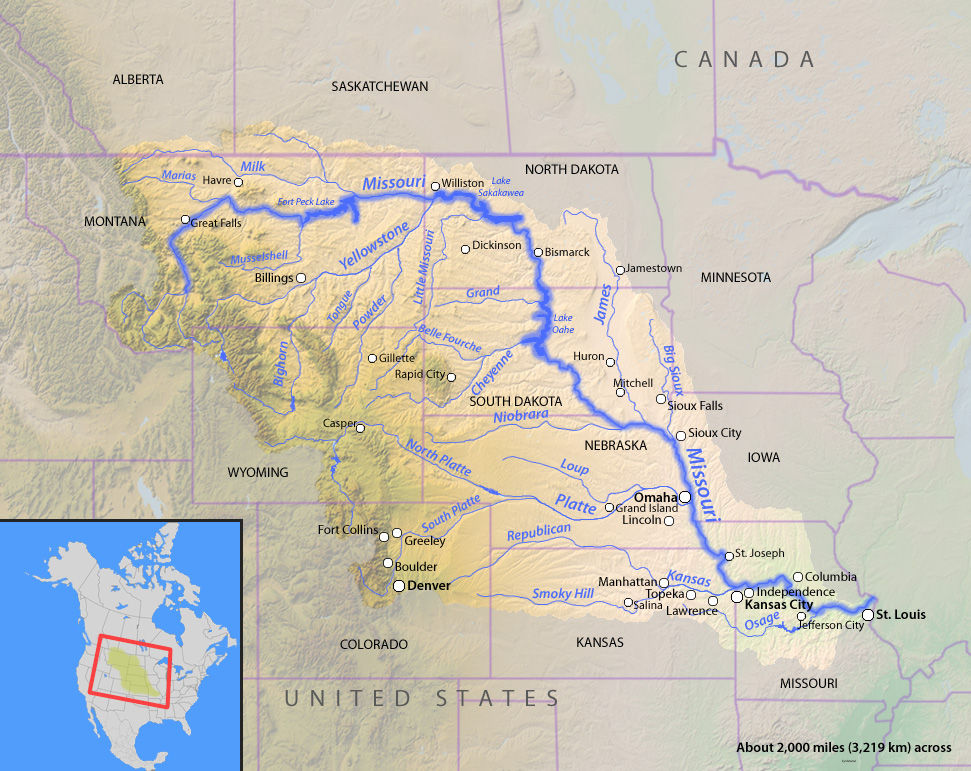
© UnknownStates Along/Bordering the Missouri River.
- The scramble is nearly over to fill thousands of sandbags and construct last-minute levees to heights that have not been needed in decades, but those preparations were only the first round of what is likely to be a summerlong battle against the bloated Missouri River.

Peak flows are expected to arrive early in the week in riverfront communities in Iowa, Kansas, Missouri, and Nebraska as the Army Corps of Engineers completes a gradual increase of releases from dams upstream. The surge through the lower half of the river this week will expose any weaknesses in the flood protections.

"They're going to be as prepared as they can be,'' said John Benson, spokesman for Iowa's Department of Homeland Security and Emergency Management Division.

The Corps said this summer's Missouri River flooding could rival the record years of 1952 and 1993 in some places. Tomorrow, officials will increase releases from five of the river's dams to 150,000 cubic feet of water per second - more than twice the previous record releases.

As a result, the river will rise 5 to 7 feet above flood stage in most of Nebraska and Iowa before moving into Missouri, where it may rise 10 feet above flood stage in several places.

Bizarro Earth

US: Fires and Floods Threaten Parts of Colorado

High-country residents may nervously watch snow melt and rivers rise this week, as smoke from distant fires continues to choke parts of Colorado, authorities said Sunday.

Cooler temperatures this weekend slowed the melt of a still-abundant snowpack, according to the National Weather Service. However, temperatures are on their way up again.

"As temperatures continue to be above normal, mountain snowmelt is expected to accelerate again," the National Weather Service said Sunday. "Mountain streams will continue to see high streamflows through the end of the week."

Jackson County is under a flood warning until 1:30 p.m. Tuesday, and Grand County is under a flood advisory until noon Tuesday.

Colorado's snowmelt usually peaks by mid-June, but only about 45 percent of snowpack in some areas has melted this year, forecasters said.

Smoke continues to suffocate other parts of Colorado.

Cloud Lightning

India: Strong Winds Forecast in South Gujarat

Image
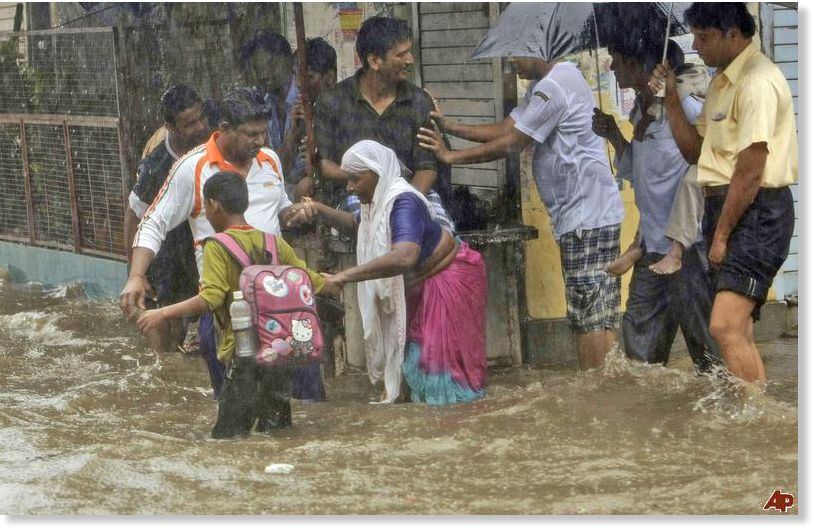
© The Associated Press / Rajanish KakadeA boy helps an elderly woman cross a waterlogged street as it rains in Mumbai, India, Saturday, June 11, 2011. Heavy rains continued to lash the city for the third consecutive day Saturday, causing waterlogging in several parts of the city.
India Meteorological Department (IMD) has advised fishermen not to venture into sea during the next 24 hours and asked the ports in south Gujarat to hoist local coastal signal (LCS) III, indicating rough weather and strong winds.

In Junagadh, lightning killed three people, including two children in the Uparkot, as Saurashtra experienced heavy rains on Saturday and Sunday. Junagadh district received maximum rains.

Heavy rains also lashed Rajkot city, uprooting electric poles and trees. Areas like Shubhashnagar, Astron chowk and Kotharia Road remained water logged.

Strong winds with speed of 45-55 km/h and reaching occasionally up to 65 km/h will continue along and off Maharashtra and south Gujarat coasts.

"Sea condition will be rough. Fishermen are advised not to venture into the sea during next 24 hours," the IMD said. Heavy to very heavy rains are expected in few places in Saurashtra, Kutch and Diu in the next 24 hours.

Cloud Lightning

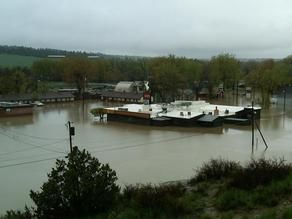
US: Flooding, Heavy Rain Delays Planting for Hundreds of Thousands of Acres

Image
© Montana News
For years, Gordon Stoner's rule for keeping the rain-soaked Northeast Montana soil from swallowing his tractor was to "turn when the ducks fly," meaning nothing short of a pond would cause him to turn the wheel.

Then the record rains of 2011 turned his fields to soup and kept his tractor in the barn for all but 41 hours over a three-week stretch in May. When he finally got into the field, his tractor's heavy wheels flattened the fooded groundhog tunnels below. Water shot like geysers from the prairie dog holes.

"I have never entertained the thought of not getting a crop in," Stoner said. "You eat an elephant one bite at a time. You just gnaw away at it, but we've got rain in the forecast and if we get much more, I don't know."

It takes a lot to get a Montana farmer to curse the rain, but some are beginning to. Hundreds of thousands of acres have gone unplanted due to unprecedented rains and the number of growing days needed to produce a crop is quickly dwindling. In addition, federal officials now estimate 1.4 million Montana acres-an area slightly larger than Glacier National Park-has been hit by flooding.

Cloud Lightning

US: The Last 'Big One': Remembering the Flood of '52

Image
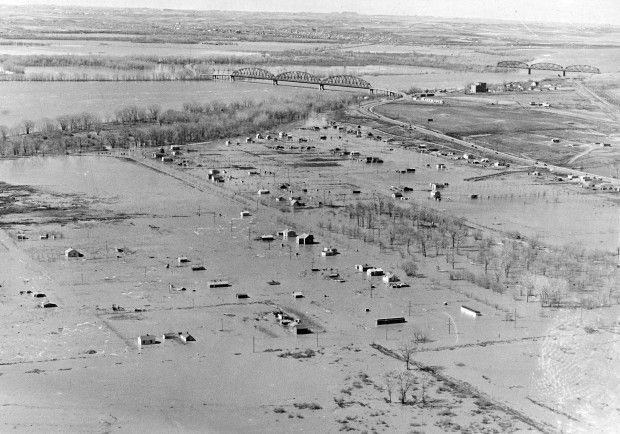
© TRIBUNE filesFlooded south Bismarck in April of 1952.
The 2011 Missouri River flood certainly will go down as "the big one" in many respects. But major flood events on the river in Bismarck and Mandan are not unprecedented

In 2009, an ice jam in the river caused water to back up. In 1952, a similar scenario played out, hitting the cities hard and fast with no warning.

There was no Garrison Dam in 1952. The only dam on the Missouri River system then was the Fort Peck Dam in Montana but downstream, the Milk River and other tributaries had no dams to hold back the water.

The 1952 flood hit Bismarck and Mandan on April 6, a Sunday morning when many people had yet to return home from church services.

Jim Davis, head of reference of the state archives at the State Historical Society of North Dakota, compiled some data from Bismarck Tribune files and other sources on that flood.

The latest projection for the Missouri River is to crest somewhere between 19 and 19.6 feet.

In 1952, the river hit 27.8 feet. Similar to 2009, an ice jam caused that flood, leaving the water with nowhere to go except into neighborhoods on both sides of the river.

Bizarro Earth

Eritrean volcanic ash cloud heading toward Israel

volcanic ash cloud
© AP
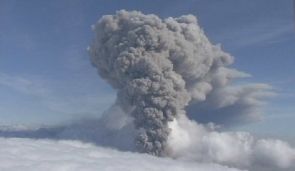
A volcanic ash cloud created after a volcano erupted in the northern African country of Eritrea is heading toward Israel, the Israel Meteorological Service confirmed on Tuesday.

It is not yet certain whether the cloud will disrupt flights in the area.

According to current estimations, the ash cloud is moving high in the atmosphere, and will probably remain too high to cause any travel disruptions or changes in the quality of air.

Attention

US: Windsor, Pennsylvania, Tornadoes did hit on Sunday

windsor PA tornado
After spending the weekend in Wildwood Crest, New Jersey, Kris and Luanne McNew returned to their Windsor Township home Sunday night to downed trees and power lines along their wooded property.

More than three decades ago, they opted to build their two-story home in the 600 block of Bahns Mill Road, which is surrounded by woods, said Luanne McNew.

And during all their years spent in the home, a tree never fell onto their home or property, said McNew.

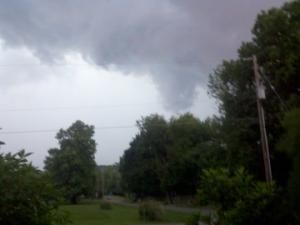
That changed Sunday, after a tornado touched down in Windsor Township.

Sun

Sun's Fading Spots Signal Big Drop in Solar Activity

Sun Spot
© The Royal Swedish Academy of Sciences, V.M.J. Henriques (sunspot), NASA Apollo 17 (Earth)A photo of a sunspot taken in May 2010, with Earth shown to scale. The image has been colorized for aesthetic reasons. This image with 0.1 arcsecond resolution from the Swedish 1-m Solar Telescope represents the limit of what is currently possible in terms of spatial resolution.

Some unusual solar readings, including fading sunspots and weakening magnetic activity near the poles, could be indications that our sun is preparing to be less active in the coming years.

The results of three separate studies seem to show that even as the current sunspot cycle swells toward the solar maximum, the sun could be heading into a more-dormant period, with activity during the next 11-year sunspot cycle greatly reduced or even eliminated.

The results of the new studies were announced today (June 14) at the annual meeting of the solar physics division of the American Astronomical Society, which is being held this week at New Mexico State University in Las Cruces.

The studies looked at a missing jet stream in the solar interior, fading sunspots on the sun's visible surface, and changes in the corona and near the poles.

"This is highly unusual and unexpected," said Frank Hill, associate director of the National Solar Observatory's Solar Synoptic Network. "But the fact that three completely different views of the sun point in the same direction is a powerful indicator that the sunspot cycle may be going into hibernation."

Attention

US: New Hidden Quake Fault Found in California

New Fault Line
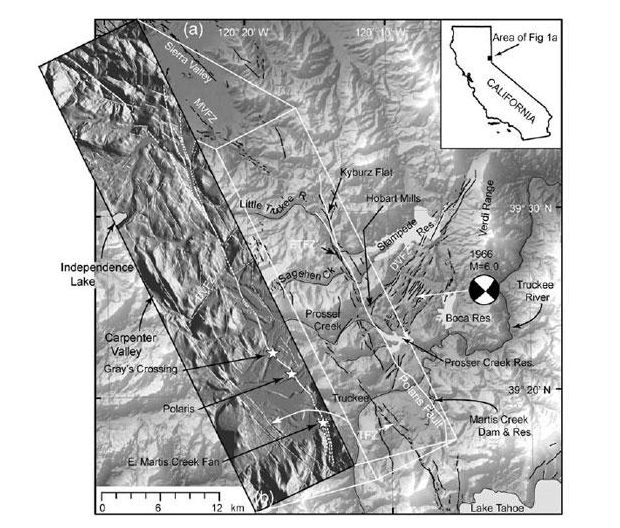
© BSSA/USGS/USACERegional map showing location of the Polaris fault and selected regional faults from the U.S. Geological Survey (USGS). The inset topographic map shows high-resolution airborne LiDAR imagery, with the Polaris fault shown as a bold white line.

You'd think in a seismically active area like California that every potentially earthquake-producing fault to be found would've been identified. It turns out there are plenty of such faults hiding in the ground, and one of them has just been found.

And this fault holds the potential of producing more than just an earthquake - it could also release a flood from a nearby dam.

Scientists with the U.S. Army Corps of Engineers were inspecting the Martis Creek Dam, which sits just outside Truckee, Calif., and about 35 miles upstream from Reno. It is one of 10 dams in the United States that has "urgent and compelling" safety concerns, according to the Corps, which owns the dam. Data from the most recent evaluation revealed that, not only does the dam have significant leakage, it also lies in close proximity to not two, but three fault zones.

The newly discovered, active, 22-mile-long strike-slip fault is named Polaris for the old mining town it runs through (by contrast, the San Andreas Fault is more than 800 miles long).

The Polaris Fault was discovered using laser imaging technology known as LiDAR, which was used as part of the U.S. Army Corps of Engineers' evaluation of the dam. LiDAR emits laser pulses down toward the ground from an airplane - even through dense vegetation - to get high-resolution topology maps. Once researchers stripped off the heavy pine tree layer from the maps, they found evidence of the fault sitting just 200 meters from the dam.

"We weren't expecting it at all," said Lewis Hunter, a senior geologist for the U.S. Army Corps of Engineers Sacramento District.

Better Earth

US: Race to raise town's flood wall after levee breaches

Secondary levee is being raised by 3 feet as Missouri River waters approach
Image
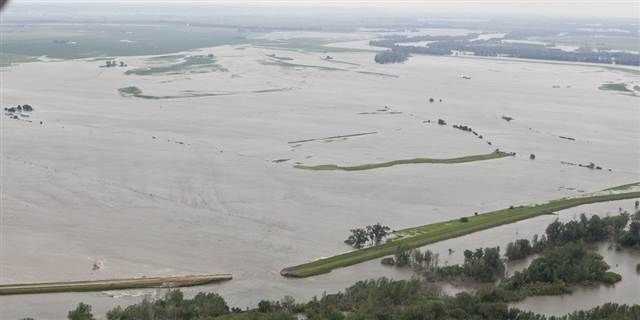
© Nati Harnik/APThe breached Missouri River levee near Hamburg, Iowa, is seen at bottom letting water into farmland on Monday.
Hamburg, Iowa - Crews are trying to beat floodwaters expected to arrive in this Missouri River town on Tuesday by building up a secondary barrier to protect it from a massive hole in the main levee.

The river ruptured two levees in northwest Missouri on Monday, sending torrents of water over rural farmland toward Hamburg in southwest Iowa and a Missouri resort community downriver.

By Wednesday, water spilling through a nearly 300-foot hole in the levee near Hamburg, population 1,100, was expected to top a secondary levee started last week to protect the town.

The Army Corps of Engineers said crews are working to increase that wall's height by 3 feet. If it breaks, parts of Hamburg could be under as much as 10 feet of standing water, officials said.

"For right now, we believe we'll be able to get that elevation raised in the time available as that water flows across in the next 48 hours," Col. Bob Ruch, the corps' Omaha District commander, said Monday evening. "We've had excellent working conditions."