Earth ChangesS


Nuke

US: More Concerns Over San Onofre Nuclear Plant Safety

San Onofre Nuke plant
© n/a
Concerns about safety and the durability of components at San Onofre Nuclear Generating Station are continuing to surface as the plant approaches a full week of complete shutdown. The plant's Unit 3 reactor was taken out of commission after a radioactive water leak was discovered on January 31, while Unit 2 was already down for scheduled maintenance. The Unit 1 reactor was taken offline permanently in 1992.

In the immediate aftermath of the detection of a leak in the piping of a recently installed steam generator, officials downplayed any potential threat, noting that the amount of radiation leaked was so small that Nuclear Regulatory Commission rules did not call for a mandatory shutdown. Later it was disclosed that radioactive gas from the leak had been vented to an auxiliary building that did not have the same safety seals to prevent radiation from being released into the atmosphere as are found on the reactor.

Once the Unit 2 reactor was shut down, it was discovered that hundreds of tubes on the generator, replaced in 2009 as part of a $670 million-plus overhaul using components supplied by Japan-based Mitsubishi Heavy Industries, had suffered significant deterioration over their relatively short service lives. Aside from the one tube known to have failed at Unit 3, two tubes at Unit 2 were found to have more than a third of their thickness worn away, requiring them to be plugged and incrementally increasing the burden on the remainder of the 9,700 tubes in the system. While only these two were worn to the point of needing to be taken offline as a safety precaution, 69 other tubes showed deterioration of at least 20 percent, and more than 800 had thinned by 10 percent or more.
Nuke

Japan: TEPCO Struggles to Cool Fukushima Plant's No. 2 Reactor

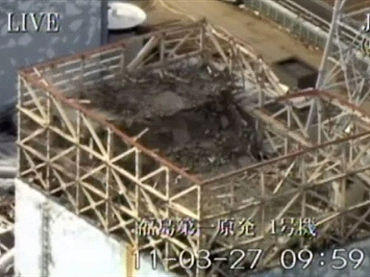
Fukushima reactor 2
© n/aFukushima reactor 2
Tokyo Electric Power Co. is taking steps to prevent a possible self-sustaining nuclear chain reaction at the crippled Fukushima No. 1 nuclear power plant.

Readings from a thermometer at the bottom of the No. 2 reactor's pressure vessel rose from 50.8 degrees at 5 a.m. on Feb. 1 to 73.3 degrees at 7 a.m. on Feb. 6.

Melted fuel is believed to have accumulated at the bottom of the reactor, but high radiation levels have prevented workers from checking the exact situation within the reactor.

After the flow of cooling water was increased to 10.6 tons per hour on Feb. 6, up from 8.6 tons two days earlier, the temperature fell to 69.2 degrees at 5 p.m. on Feb. 6. That night, TEPCO injected boric acid into the reactor to prevent criticality, the point at which a nuclear fission reaction becomes self-sustaining. Boric acid absorbs neutrons, which induce nuclear fission.

The Nuclear and Industrial Safety Agency (NISA) instructed the company to consider injecting boric acid earlier in the day.

Bizarro Earth

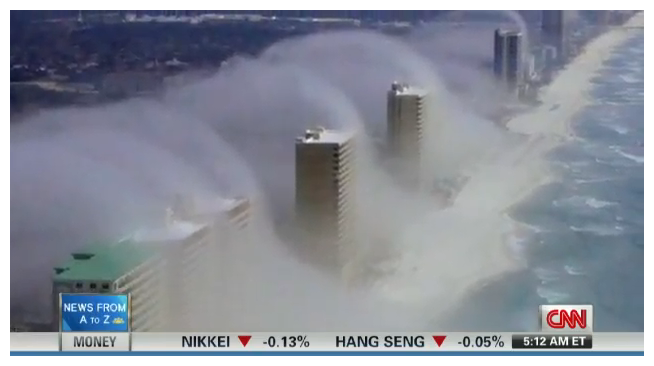
US: Strange Clouds Form Over Florida Beach

Strange Clouds
© CNN

Throughout the year, amazing photos of natural occurrences make their way to the Internet and even sometimes, make the headlines. That's the case for a recent photo of low-lying clouds.

A man flying a helicopter snapped the latest phenomenal photo making its rounds. The amazing shot shows low-lying clouds hugging buildings in a Panama City beach.

Dr. Greg Forbes of Weather.com gave a detailed description of the clouds in a recent report, saying, "You see the clouds forming off shore, as the winds from south to north push them toward and then up over the high rises as the air rises and reaches its crest."

"And then sinks back down and lowers the relative humidity and the clouds dissipate," Forbes of Weather.com explained.

Bug

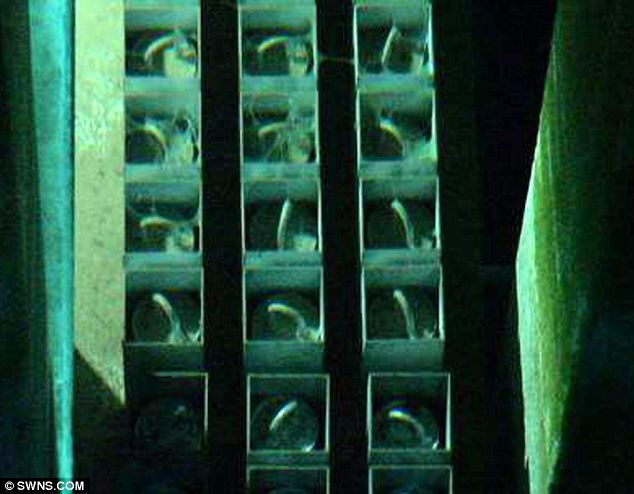
Bizarre White Cobweb Found on Nuclear Waste

top of nuke fuel rods
© SWNS.comThe top of the uranium fuel assembly where a white cobweb like material has been found.
Scientists are investigating a bizarre white cobweb found on nuclear waste - amid fears it could have been made by a 'mutant' spider.

In a freakish echo of the Spider-Man comic strip, workers at a U.S nuclear waste facility discovered the growth on uranium last month.

The white 'string-like' material - never seen before on nuclear waste - was found among thousands of spent fuel assemblies submerged in deep pools.

Experts from Savannah River National Laboratory collected a small sample of the mystery material to run tests.

A report filed by the Defense Nuclear Facilities Safety Board - a federal oversight panel - concluded: 'The growth, which resembles a spider web, has yet to be characterised, but may be biological in nature.'

Stop

UF report: 2011 shark attacks remain steady, deaths highest since 1993

Shark attacks in the U.S. declined in 2011, but worldwide fatalities reached a two-decade high, according to the University of Florida's International Shark Attack File report released today.


While the U.S. and Florida saw a five-year downturn in the number of reported unprovoked attacks, the 12 fatalities - which all occurred outside the U.S. - may show tourists are venturing to more remote places, said ichthyologist George Burgess, director of the file housed at the Florida Museum of Natural History on the UF campus.

"We had a number of fatalities in essentially out-of the way places, where there's not the same quantity and quality of medical attention readily available," Burgess said. "They also don't have histories of shark attacks in these regions, so there are not contingency plans in effect like there are in places such as Florida."

Igloo

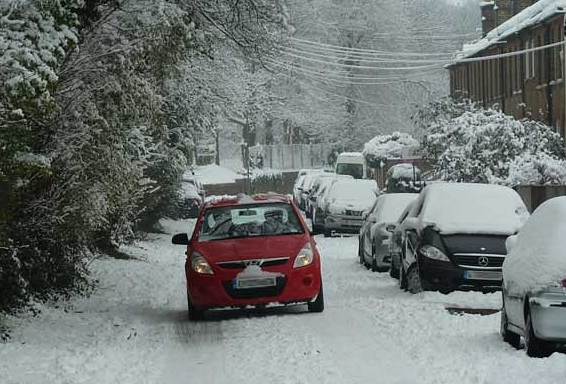
Snow to return as freezing temperatures split Britain

UK snow scene
© ReutersForecasters warned that travelling conditions would remain "difficult" across much of Britain as many parts still recover from the weekend's snowfalls.
Snow is set to return to much of southern Britain by Thursday as the country battles with freezing weather and transport chaos.

On Thursday much of the south, including Heathrow airport, which was ground to a halt at the weekend, will be hit by a mixture of potentially treacherous snow, sleet and rain.

Temperatures throughout southern areas expected to remain close to freezing. The north will remain significantly warmer with temperatures as high as 8C.

The Met Office said overnight temperatures in some areas could fall to as low as -13C. It remains unclear how much snow will fall, as an Atlantic weather system pushes across the country from the west.

Snowflake

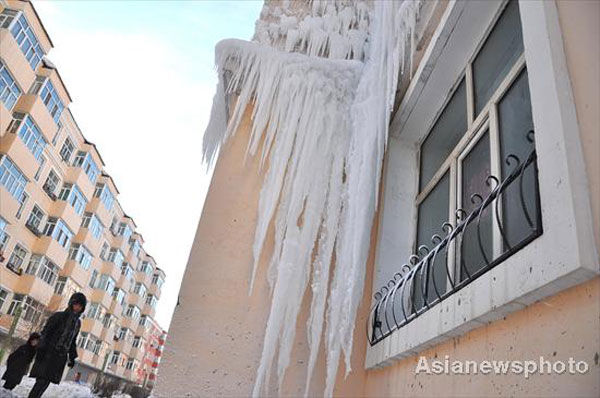
Cold Spell Affects 40,000 in North China

Image
© AsianewsphotoA resident watches ice cascade outside a building in North China's Inner Mongolia autonomous region. Temperatures plummeted to minus 50.7 Celsius after a cold front hit the city last Friday.
A month-long cold front has persisted in north China's Inner Mongolia autonomous region and caused havoc for more than 40,000 people, said local authorities Tuesday.

Over 1,600 heads of livestock were killed and cracks appeared on walls in over 8,000 homes due to the freezing weather in the city of Hulunbuir, located in the region's northeast, according to a spokesman with the regional civil affairs department.

The extreme weather has inflicted direct economic losses and apartment renovation costs of 13 million yuan (2.1 million U.S. dollars), said the spokesman, adding that no casualties have been reported.

The cold front began to plague Hulunbuir in late December last year and has tightened its grip on the area since the Chinese Lunar New Year holiday in late January.

Chenbaerhu Banner, administered by Hulunbuir, registered the lowest temperature to date this winter in Inner Mongolia, 51.9 minus degrees Celsius, said the spokesman.

In addition, five banners and cities administered by Hulunbuir have seen their new record low temperatures during the past month and a half, compared with the same period of previous years, he said.

Cloud Lightning

Australia Flooded New South Wales towns face weeks of isolation

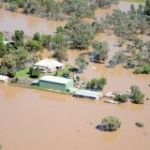
NSW Australia floods
Many properties, such as this one near Wee Waa, could remain isolated for weeks.
Thousands of people in northern New South Wales are facing weeks of isolation, as record floodwaters from Queensland cross the border into already swollen waterways.

The State Emergency Services says about 7,000 people are currently isolated around the state, including 2,000 at Wee Waa.

Around 1,700 people in Walgett could be stranded for up to a fortnight, while several hundred people living in Goodooga may be cut off for as long as eight weeks.

The towns of Lightning Ridge, Mundindi, Collarenebri and Bourke are also likely to be affected, along with many farms.

SES spokesman Phil Campbell says communities are stocking up and there will be helicopter support to fly in more supplies to the thousands who are stranded.

Boat

Deadly Floods Follow in Iced-Over Europe

'Next two weeks will be very difficult' due to snow melt, European official says

Image
© ReutersFlooding from a burst dam in Bisser, Bulgaria, destroyed much of the town and killed at least eight people.
Sofia, Bulgaria - Much of Europe is still covered in snow and ice, but some areas are already seeing deadly flooding amid concerns that it will get worse before it gets better.

Swollen rivers in Greece and Bulgaria burst their banks Tuesday, leaving dozens of homes underwater, as Bulgarian officials declared a day of mourning for eight people confirmed killed after a dam collapse nearly washed away their village.

Bulgaria's civil defense agency warned that two other, bigger dams were also on the brink of spilling over and residents were urged to prepare for an evacuation. Authorities have started a controlled release of water from the dams to prevent overflow.

Europeans across the continent have been battling more than a week of extreme weather. Thousands are still trapped by snow in remote, mountain villages in the Balkans. Hundreds - most of them homeless - have died after temperatures hit as low as minus 33 Fahrenheit; and authorities now face flooding caused by melting snow.

A day after the dam burst, the Bulgarian government declared a day of mourning, and streets in the village of Bisser were covered with sticky mud as people returned to their water-logged homes.

Snowflake

Europe's weather brings continent to a halt

Amsterdam snow
© Peter Dejong/APSnow covers typical Dutch scenery in the center of Amsterdam
The frigid temperatures and snowfall that began in Eastern Europe last week have reached Western Europe, snarling airport traffic in Britain and turning Rome white.

It finally got really cold in Europe. Rome and the Netherlands recorded the lowest temperatures in 27 years and kids were making snowmen outside the Vatican. But the sudden arctic freezing last week in Ukraine, Hungary, and the Balkan states that steadily crept up the continent also took a toll, with 131 reported dead in Ukraine alone.