Earth ChangesS


Bizarro Earth

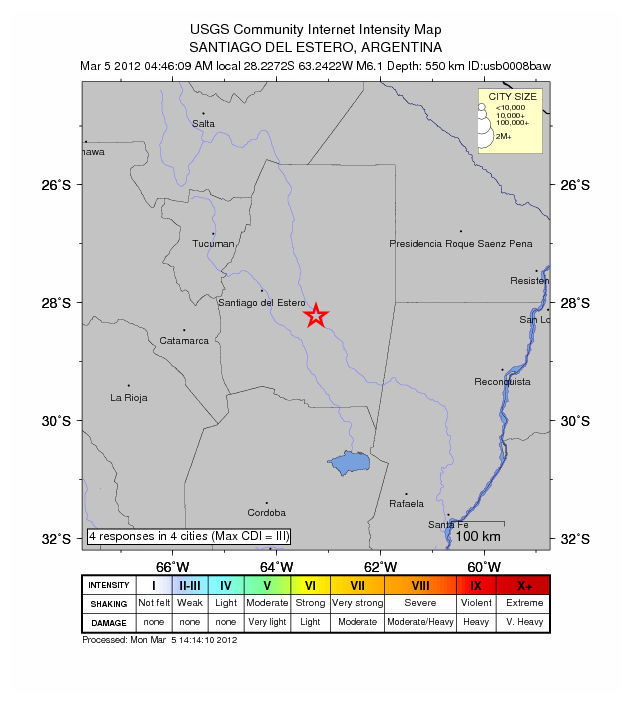
USGS: Santiago Del Estero, Argentina - Earthquake Magnitude 6.1

Argentina Quake_050312
© USGSEarthquake Location
Date-Time
Monday, March 05, 2012 at 07:46:09 UTC

Monday, March 05, 2012 at 04:46:09 AM at epicenter

Time of Earthquake in other Time Zones

Location
28.227°S, 63.242°W

Depth
550 km (341.8 miles)

Region
SANTIAGO DEL ESTERO, ARGENTINA

Distances
47 km (29 miles) WNW of Anatuya, Santiago del Estero, Argentina

112 km (69 miles) ESE of Santiago del Estero, Argentina

250 km (155 miles) SE of San Miguel de Tucuman, Tuc., Argentina

828 km (514 miles) NNW of BUENOS AIRES, D.F., Argentina

Snowflake

Ice dam collapses at Argentine glacier


An ice dam at Argentina's Perito Moreno glacier collapsed early Sunday, creating an impressive spectacle not seen since July 2008, although few tourists were actually awake to experience the moment.

Several tons of ice fell off the 60-meter (200 foot) ice dam into Lago Argentina at the national park in southern Santa Cruz province.

Some 5,000 tourists had been in the park Saturday awaiting the ice show, park rangers said, but the slight movement of ice which began Wednesday turned into an avalanche at around 4:00 am (0700 GMT), leaving visitors disappointed.

Only a group of rangers witnessed the collapse, which created a crash heard several kilometers away, accelerated by heavy rainfall overnight.

"The noise was very great, it was coming down in buckets," said park ranger Carlos Corvalan.

Perito Moreno, one of the biggest tourist attractions in Argentina, is one of the largest glaciers on the Patagonian ice cap.

The glacier has a travel speed of 1.7 meters (5.5 feet) per day in its central part and periodically creates an ice dam which collapses from the pressure of the advancing glacier.

The glacier was named after one of the first explorers in Argentine Patagonia.

Bizarro Earth

Entire Month's Worth of Tornadoes Strike in One Day

Severe Weather
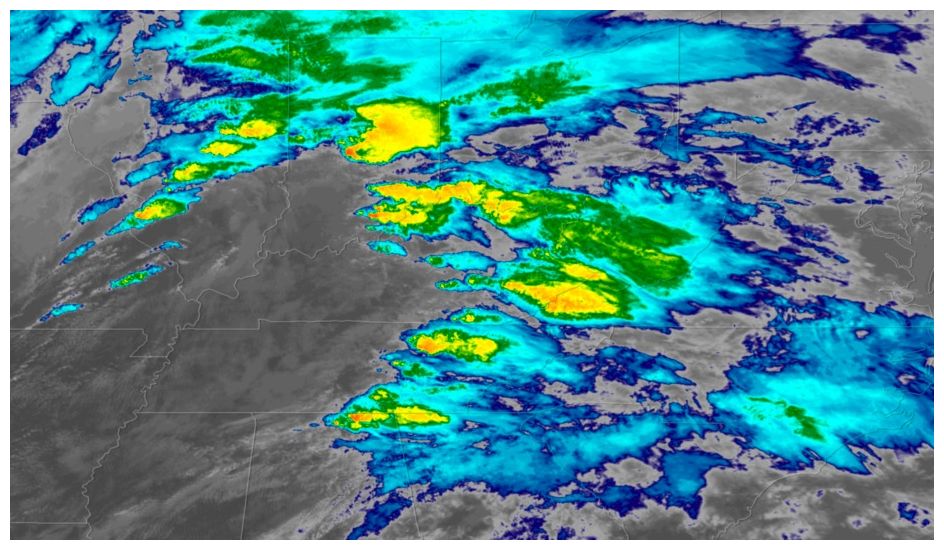
© NOAAThis high resolution infrared imagery of the severe weather outbreak was taken around noon on March 2, 2012. Yellow, orange, and red areas indicate the coldest, highest cloud tops. By pairing precise color scales with this high resolution imagery, meteorologists can weed out the extraneous cloud information and focus on the most threatening features in this massive storm system. Major connective storm outbreaks can be seen dotting the Midwest in this image.
In what may be the biggest daily tornado outbreak on record for March, an entire month's worth of twisters struck in a single day.

The nation's Storm Prediction Center received 81 reports of tornadoes yesterday (March 2), according to data filtered to remove duplicate reports of tornadoes. For the entire month of March, the 10-year average number of tornadoes is 87, according to the Weather Channel's severe weather expert Greg Forbes. The National Weather Service's storm survey teams have not yet confirmed the tornado reports, so these numbers could change. But if the numbers hold, the outbreak could go down as the largest single-day outbreak in March history.

But today, the focus is on recovery efforts, said Craig Fugate, the director of the Federal Emergency Management Agency. Figuring out where this outbreak ranks among other huge outbreaks will wait for another day.

At least 33 people died during yesterday's severe weather, according to news reports. In Kentucky, at least 17 people died. A suspected EF-4 twister, the second highest strength on the tornado damage scale, hit Indiana, where at least 14 died.

Cloud Lightning

Storms Demolish Small Towns in Indiana, Kentucky; 38 Dead

Image
© unknownWreckage left behind by one of the Indiana tornadoes
US: Kentucky, West Liberty - Across the South and Midwest, survivors emerged Saturday to find blue sky and splinters where homes once stood, cars flung into buildings and communications crippled after dozens of tornadoes chainsawed through a region of millions, leveling small towns along the way.

At least 38 people were killed in five states, but a 2-year-old girl was somehow found alive and alone in a field near her Indiana home. Her family did not survive. A couple that fled their home for the safety of a restaurant basement made it, even after the storms threw a school bus into their makeshift shelter.

Saturday was a day filled with such stories, told as emergency officials trudged with search dogs past knocked-down cellphone towers and ruined homes looking for survivors in rural Kentucky and Indiana, marking searched roads and homes with orange paint. President Barack Obama offered federal assistance, and Ohio Gov. John Kasich declared an emergency Saturday.

The worst damage appeared centered in the small towns of southern Indiana and eastern Kentucky's Appalachian foothills. No building was untouched and few were recognizable in West Liberty, Ky., about 90 miles from Lexington, where two white police cruisers were picked up and tossed into City Hall.

Beaker

Un-Earthed: Is Monsanto's glyphosate destroying the soil?

plant in barren soil
© Shutterstock
The nation that destroys its soil, destroys itself. -- Franklin Delano Roosevelt

In light of this quote, had Monsanto been around during Roosevelt's time, he would not have taken too kindly to their business strategy. After all, in 2007, 176 million lbs of an extremely toxic herbicide known as glyphosate,1 first created by Monsanto, was sprayed onto the soil (and everything standing between it) in this country, with untold environmental and human health fallout.

Untold, that is, until now...

Roundup (Glyphosate): The Science Vs. Marketing

2011 was a watershed year, as far as scientific revelations into the nature and extent of the damage associated with glyphosate-based herbicide usage and exposure is concerned.

An accumulating body of peer-reviewed and published research now indicates glyphosate may be contributing to several dozen adverse health effects in exposed populations.

Nuke

Tokyo Bay Radioactive Cesium Deposits Now Over 10 Inches Deep

Scientists measuring Fukushima nuclear fallout in Japan report radioactive cesium deposits in Tokyo bay are now up to 26 centimeters deep

Map of Tokyo Bay Cesium Radiation Levels
© n/aMap of Tokyo Bay Cesium Radiation Levels
The Fukushima Diary reports a survey of Tokyo Bay being performed by Kinki University scientists shows level of radioactive contaminates on the bottom of Tokyo bay is steadily.

In samples of mud take 5 centimeters deep at 36 different points the latest survey showed 511 Bq/Kg of average Cesium contamination.

That represents a sharp increase from a survey taken last August which averaged 308 Bq/Kg and another taken in October which measured 476 Bq/Kg.

Bizarro Earth

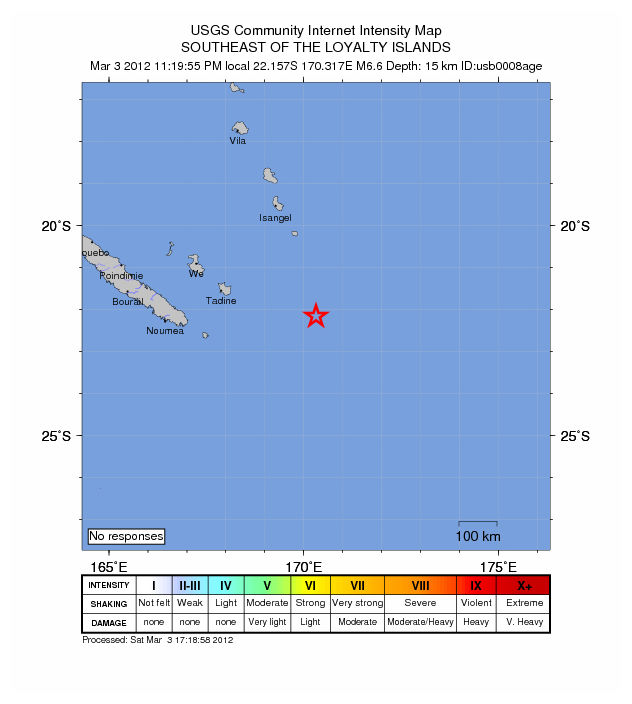
Southeast of the Loyalty Islands - Earthquake Magnitude 6.6

Loyalty Quake_030312
© USGSEarthquake Location
Date-Time
Saturday, March 03, 2012 at 12:19:55 UTC

Saturday, March 03, 2012 at 11:19:55 PM at epicenter

Time of Earthquake in other Time Zones

Location
22.157°S, 170.317°E

Depth
15.2 km (9.4 miles)

Region
SOUTHEAST OF THE LOYALTY ISLANDS

Distances
180 km (111 miles) W of Ile Hunter, Loyalty Isl., New Caledonia

260 km (161 miles) ESE of Tadine, Loyalty Islands, New Caledonia

399 km (247 miles) E of NOUMEA, New Caledonia

1686 km (1047 miles) NNW of Auckland, New Zealand

Arrow Down

Professor Criticized for Course Denying Climate Change Caused by Human Emissions

Image
© stuartpilbrow on Flickr
Tom Harris dismisses 142 "corrections"

A group of scientists has released a report condemning a Carleton University professor who taught a course centred on the idea that climate change is not caused by human emissions.

Tom Harris taught Climate Change: An Earth Sciences Perspective to mostly second-year non-science students between 2009 and 2011.

The Committee for the Advancement of Scientific Skepticism says in its report entitled Climate Change Denial in the Classroom that Harris hosted speakers who argued that climate change is not caused by humans but hosted "no scientist speaking to the generally accepted consensus."

The authors note that the Intergovernmental Panel on Climate Change has fingered green-house gas emissions as the "unequivocal" cause of global warming observed since the 1950s.

Comment: It is quite ironic that this committee calls itself "The Committee for the Advancement of Scientific Skepticism while it attacks a scientist to defend a belief in a "consensus.

For a more informative perspective on the global warming debate and what is really coming our way see: Forget About Global Warming: We're One Step From Extinction!


Evil Rays

Mysterious Rumble: Windsor Hum Raised by MP on Washington Trip

Image
© CBCZug Island on the Detroit River
Ontario, Canada: The strange humming sound that has raised the ire of residents in the Windsor, Ont., area has made its way to the U.S. capital.

Windsor-West MP Brian Masse brought up the issue during a business trip in Washington, D.C., this week, where he met with Michigan Congressman John Dingell.

The noise, which sounds like an idling semi truck, started in February 2011.

Government officials and a consultant hired by the city of River Rouge, Mich., admitted late last year the rumbles and vibrations are an airborne sound wave originating from the vicinity of Zug Island, which is home to several industries on the U.S. side of the Detroit River.

Comment: Read The Cs Hit List 06: Let's Do the Planetary Twist to the Tune of the Brothers Heliopolis to learn more about the mysterious noises all over the world.


Snowman

Heavy snow fall in Jerusalem for the first time in four years

Image
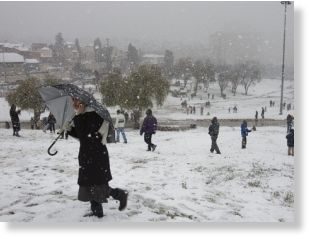
© Olivier Fitoussi Snow falling in Jerusalem's Sacher Park, March 2, 2012
3 centimeters of snow fell, with snowfall reported in Ramot, Givat Ze'ev and Har Gilo; Egged bus company halts all lines to the capital.

Israel- Heavy snow fell in the Jerusalem area on Friday, and for the first time in four years, parts of Jerusalem were white with snow.

Snow fell in Ramot, Givat Ze'ev and Har Gilo, and three centimeters of snow fall were reported.

The Jerusalem municipality, which had prepared for the weather conditions in recent days, was due to clear snow from the streets of Jerusalem on Friday.

Snow also fell in the Golan Heights in the early hours of Friday morning, and classes were canceled in the Golan and in the area around Safad because of the weather. Safad area residents were also asked not to drive by the municipality, and there was no public transport in the area.

Cold and stormy weather swept through Israel since Tuesday, and Friday was expected to be the coldest day of the year.