Earth ChangesS


Bizarro Earth

City investigates fish kill in southeast Austin, Texas


  • Something strange is going on in a southeast Austin neighborhood. Hundreds of fish went belly up in a local pond. Tuesday, the city and a local business are trying to figure out what happened.

    The city of Austin says more than 200 fish were found dead in a pond near the Onion Creek Golf Club. They're running tests to see what happened. In the meantime, residents there are frustrated by what they see and smell.

    When Jean Tarcz walked outside to the retention pond behind her home near Onion Creek Golf Course Monday she couldn't believe her eyes.

    "I saw all these huge fish out there floating...dead." Tarcz said.

    She says she feels the owner of the retention pond, onion creek club, neglected to care for the pond.

    "If you keep the water this low, the aerators cannot work and they just become clogged," Tarcz said.


    Question

    Mystery disease killing Ohio dogs

    New Virus
    © Ljiljana Jankovic | ShutterstockSeveral dogs in Ohio have been sickened, and four have died, from a disease that may be caused by a newly discovered virus.
    Veterinarians, health officials and dog owners are alarmed by the mysterious recent deaths of four dogs in Ohio. Some experts suspect that the dogs may have died a few days after exposure to a virus that's normally found in pigs.

    Three dogs in the Cincinnati area and a fourth dog near Akron died in August after exhibiting symptoms that included vomiting, bloody diarrhea, weight loss and lethargy, according to the Columbus Dispatch.

    "We feel obligated to make sure pet owners are aware this is happening," Erica Hawkins, communications director for the Ohio Department of Agriculture, told the Dispatch. "Supportive therapies can be helpful if started early enough."

    The three dogs from Cincinnati died last month after staying in the same kennel. The Akron dog that died was one of several in the Akron-Canton area that showed the same symptoms. A stool sample from the Akron dog tested positive for canine circovirus, a recently isolated virus.

    Cloud Lightning

    Tropical storm Gabrielle fizzles: Why has hurricane season been so calm?

    Tropical storm Gabrielle was the seventh Atlantic tropical cyclone this season, but no hurricanes have yet formed, which is unusual. Another 10 hurricane-free days would set a record.

    The weather system that had become tropical storm Gabrielle overnight Wednesday has abruptly lost strength and was demoted to tropical-depression status with sustained winds of only 35 miles per hour at 11 a.m. Thursday.

    Forecasters at the National Hurricane Center in Miami have lifted tropical-storm watches and warnings they had issued for Puerto Rico. The government of the Dominican Republic has done likewise for areas along its coast that would have been affected.

    Forecasters note that Gabrielle encountered one of the banes of tropical cyclones: wind shear, a sudden change in wind speed or direction with altitude. The mountains of Puerto Rico and the Dominican Republic also disrupted the storm, preventing it from becoming more organized.

    X

    3,000 saiga antelopes die in Kazakhstan

    Image
    © AFP
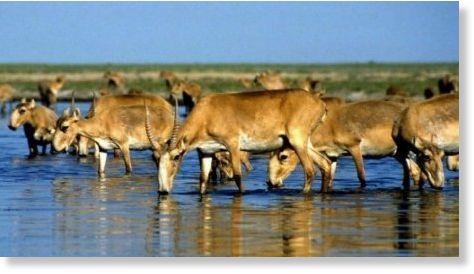
    Mortality of 3 thousand saiga antelopes has been registered in Akmola and Karaganda oblasts in central Kazakhstan, Tengrinews.kz reports citing the press-service of the Ministry of Environment Protection of Kazakhstan.

    About 1.5 thousand carcases of betpakdalinski saiga antelopes were found at southern, western and northern shores of Tengiz Lake. This type of saiga antelopes also inhabits lowlands and steppes.

    All the involved national and local authorities were informed about the animals' die-off. The Ministry's subordinate Committee of Forestry and Hunting in cooperation with the Research Institute for Biological Safety Problems and Veterinary Service of Karaganda Oblast are investigating the die-off site. Measures to find out the scale and causes of the mortality are being taken.

    Question

    Massive starfish die-off baffles scientists in British Columbia, Canada

    The waters off British Columbia, Canada, are littered with dead starfish, and researchers have no idea what's causing the deaths.

    Image
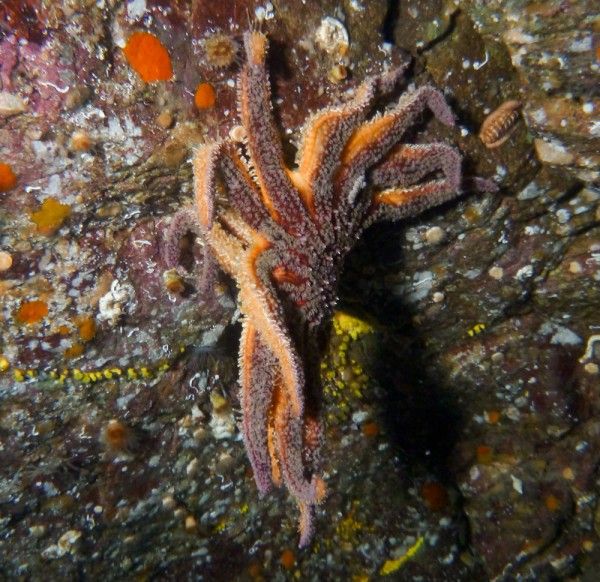
    © Jonathan MartinA decomposing P. helianthoides starfish still clinging to a rock.
    At the end of August, marine biologist and scuba enthusiast Jonathan Martin was out on his usual Saturday dive with some friends when he noticed something unusual.

    "We just started noticing dead starfish that looked like they had their arms chopped off," Martin said.

    They were sunflower starfish (Pycnopodia helianthoides), a major marine predator in the area that feeds mostly on sea urchins and snails. Like most starfish, the sunflower starfish can regenerate lost limbs - it can have up to 20 - and can grow to be up to three feet (a meter) across. (Related pictures: "5 Animals That Regrow Body Parts.")

    Since Martin was diving in an area frequented by crabbers, at first he thought the sunflower starfish had gotten caught in some of the crab traps and had lost limbs escaping. But Martin kept seeing large numbers of dead starfish as he and his friends swam to a marine park where such crab fishing is illegal. Martin knew then it wasn't the traps that were causing the starfish deaths.

    After returning from the dive, he visited friends at a local dive shop who were active in marine conservation. Without any definitive answer, he shared photos on Flickr and videos on YouTube - taken at Lion's Bay and Whytecliff Park in Vancouver - to try to get ideas from others about what was going on.

    "It really struck a chord in other divers who were seeing it on Facebook and social media, both locally and as far away as California, who had been seeing similar things," Martin said.

    Question

    Mysterious elk deaths plague New Mexico

    Elk
    © LiveScience
    Officials with the New Mexico Department of Game and Fish are puzzling over the mysterious deaths of more than 100 elk, apparently all within a 24-hour period, in rural New Mexico.

    The elk were found Aug. 27 on a 75,000-acre ranch north of the city of Las Vegas.

    Livestock deaths, by themselves, are not unusual - there are many things that can fell large animals, including predators, poachers, a natural or man-made toxin, disease, drought, heat, starvation, and even lightning.

    But so far wildlife officials have seemingly ruled out most of these possibilities: The elk weren't shot (nor taken from the area), so it was not poachers.

    Tests have come back negative for anthrax, a bacteria that exists naturally in the region and can kill large animals. There seems to be no evidence of any heavy pesticide use in the area that might have played a role in the die-off.

    Though lightning strikes are not uncommon in the Southwest and in New Mexico specifically, killing over 100 animals at one time would be an incredibly rare event. It might be an as-yet unidentified disease, though killing so many at once - and so quickly - would be very unusual. Another possibility is some sort of contamination of the well or water tanks, but so far no toxins have been identified.

    Cloud Lightning

    Freak lightning bolt strikes 14th-century lighthouse

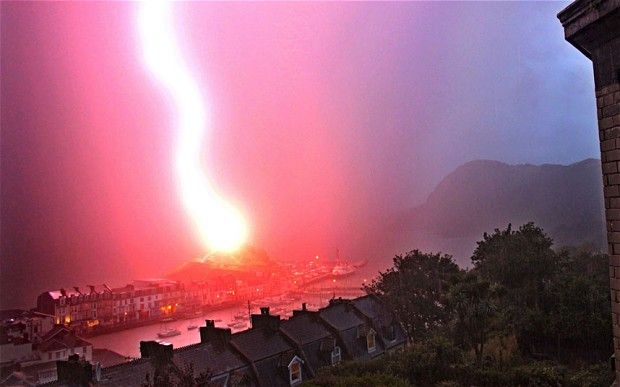
    A freak bolt of lightning has been photographed as it struck a 14th-century lighthouse, smashing three of the dome's glass panels.

    Image
    © Jason Twist/ApexJason Twist's photo of a bolt of lightning striking the ancient chapel lighthouse in Ilfracombe, Devon
    The fork of light lit up the night sky as it hit the spire of St Nicholas Chapel in Ilfracombe, Devon.

    The dome of the grade I-listed building suffered three shattered glass panels and its electrics were frazzled by the surging charge on Friday night.

    However, the damage was only minor and the chapel's navigation light was quickly replaced and switched back on.

    The extraordinary scene was captured by local resident Jason Twist, who said: "The storm was very impressive, so I grabbed my camera and started snapping.

    Ice Cube

    Wrong again! Siberian Arctic is not warming after all - July temperatures hardly different from those thousands of years ago!

    Tundra in Siberia
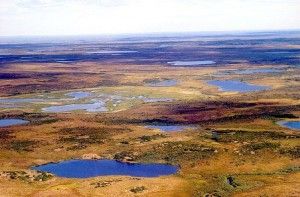
    © Dr. Andreas Hugentobler / Creative Commons 2.0 GermanySiberian Arctic in summer.
    Sebastian Lüning's and Fritz Vahrenholt's Die kalte Sonne site today writes about a new peer-reviewed study that shows that the Arctic is not warming quickly after all. For years alarmist scientists have told us that nowhere is warming happening faster than in the Arctic. Wrong again!

    A study by an international team of scientists led by Germany's Potsdam-based Alfred Wegener Institute was published in September in the journal Palaeogeography, Palaeoclimatology, Palaeoecology. It's a temperature reconstruction from the Siberian Arctic. By examining pollen, the scientists were able to determine the July temperatures for the transition zone between tundra and taiga over the last 12,000, i.e. the Holocene.

    Snowflake Cold

    Meteorologists point to signs of another upcoming "nasty winter for Europe" - Would make spectacular six in a row!

    Joe Bastardi
    © WeatherbellJoe Bastardi
    It started with the Farmer's Almanac. We've been hearing lots of talk about another brutal winter being in store.

    Although seasonal forecasts are speculative at best, meteorology indeed has advanced to a point where it is possible to get an idea of what direction the upcoming season is tending towards. Farmers have been doing this successfully for centuries.

    Meteorologist Joe Bastardi in his Saturday Summary at the 7-minute mark looks at the latest NCEP NCAR global winter forecast for 2013/14. The charts point to another "brutal winter for Europe". The forecast sees blocking and a negative NAO. Joe also tweeted that "SST analog package combined with low solar, and climate cycle (similar to early 50s) argue for nasty Euro Winter".

    Question

    Strange sounds in the sky in Surbiton, United Kingdom 8th/Sep/2013

    Strange sounds outside in Surbiton,United Kingdom, about 2:30 in the morning 8/9/2013. It lasted for about 20 minutes. It was very loud. This is the last 2 minutes, so it is not as loud.