Earth ChangesS


Attention

'Unprecedented' sea star disease epidemic on Oregon coast

Sea star dieoff
© SeaStarWasting.orgA sea star with wasting syndrome.
Just in the past two weeks, the incidence of sea star wasting syndrome has exploded along the Oregon coast and created an epidemic of historic magnitude, one that threatens to decimate Oregon's entire population of purple ochre sea stars, experts said Wednesday.

Prior to this, Oregon had been the only part of the West Coast that had been largely spared this devastating disease.

The ochre sea star, which is the species most heavily affected by the disease in the intertidal zone, may be headed toward localized extinction in Oregon, according to researchers at Oregon State University who have been monitoring the outbreak.

As a "keystone" predator, its loss could disrupt the entire marine intertidal ecosystem.


Attention

Drastic fall in baby brown pelicans: Blame El Niño?

Image
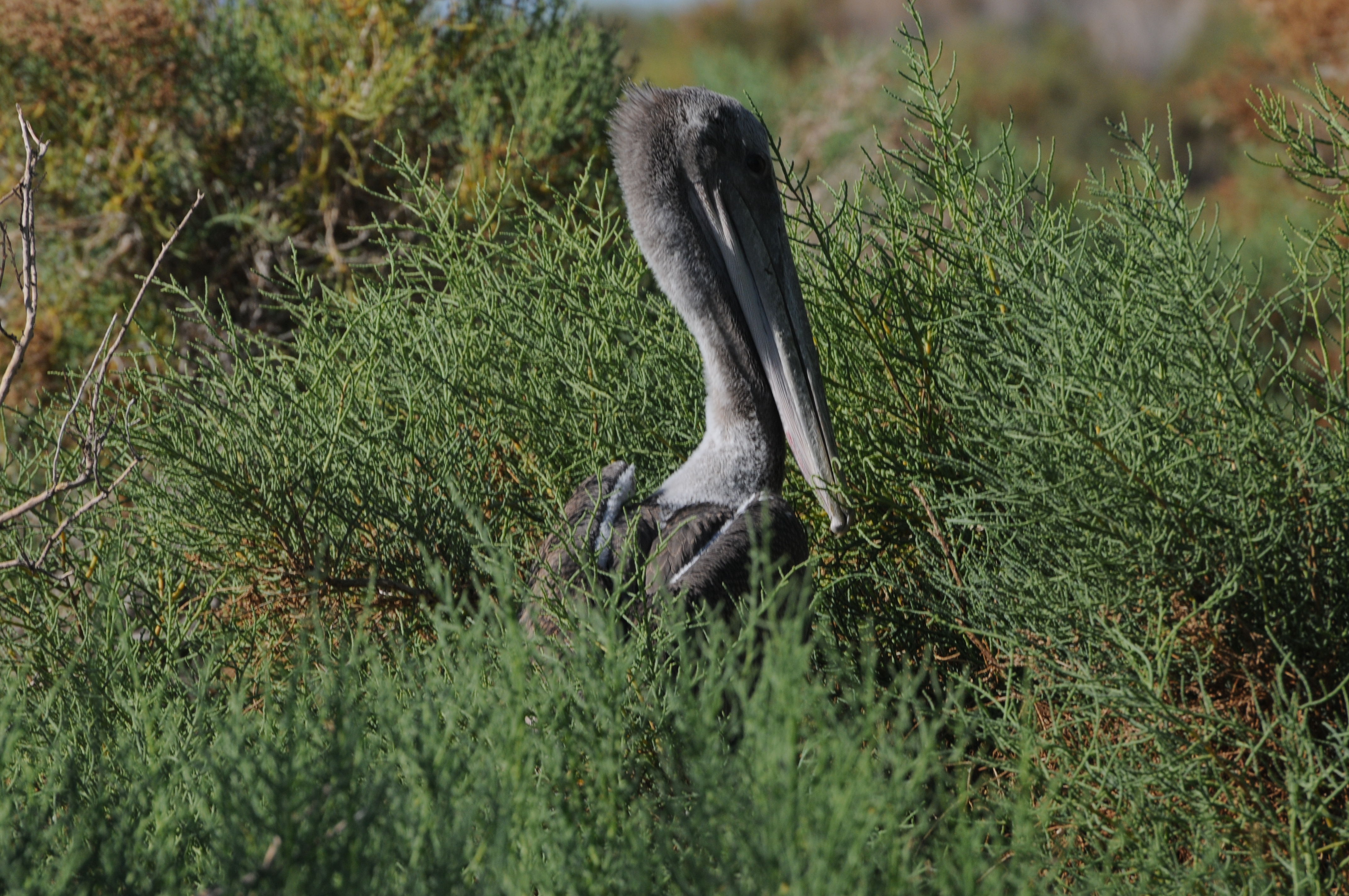
© Dan Anderson, UC DavisOne of two baby brown pelican chicks found on Isla San Luis in Mexico during a 2014 UC Davis survey.
An endangered species success story is suffering this year, perhaps because of El Niño.

California brown pelicans almost completely failed to breed at their nesting sites in Mexico this year, surveys have found. Scientists are reluctant to blame any one cause for the drastic decline in fuzzy-headed baby pelicans, but a similar drop in breeding numbers struck during previous El Niño events.

"Over the years, we've seen that during an El Niño, their breeding effort goes way down," said Daniel Anderson, a University of California, Davis wildlife biologist who has monitored California brown pelicans for 46 years. Overfishing of sardines and habitat loss could also be hurting the pelican population, Anderson said.

Comment: Concerning the lack of sardine food and its effects on other species, see also: 650 emaciated sea lion pups wash up on the California coast over last 2 months

As to a more expansive explanation other than El Niño, see: Creatures from the deep signal major Earth Changes: Is anyone paying attention?


Snowflake

Global warming? - Still no warming for 17 years 9 months

Image
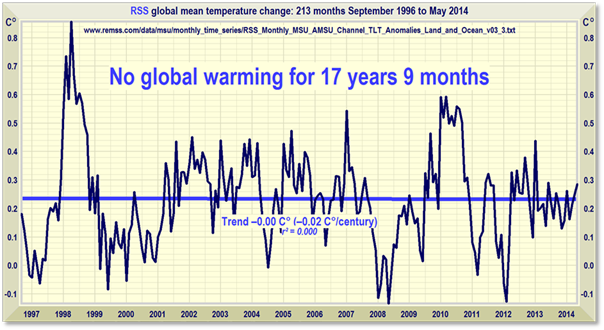
Figure 1. RSS monthly global mean lower-troposphere temperature anomalies (dark blue) and trend (thick bright blue line), September 1996 to May 2014, showing no trend for 17 years 9 months.
According to the RSS satellite data, whose value for May 2014 has just been published, the global warming trend in the 17 years 9 years since September 1996 is zero (Fig. 1). The 213 months without global warming represent more than half the 425-month satellite data record since January 1979. No one now in high school has lived through global warming.

The hiatus period of 17 years 9 months is the farthest back one can go in the RSS satellite temperature record and still show a zero trend. But the length of the pause in global warming, significant though it now is, is of less importance than the ever-growing discrepancy between the temperature trends predicted by models and the less exciting real-world temperature change that has been observed.

Comment: When ice ages come, they come fast and with very little mercy. So while mainstream science is busy selling global warming, it's recommended you throw a couple sweaters in your shopping cart:

Ice Ages start and end so suddenly, "it's like a button was pressed," say scientists


Bizarro Earth

Colorado: Spring flood cuts off road to Montezuma

Montezuma Road in Summit County, Colorado.
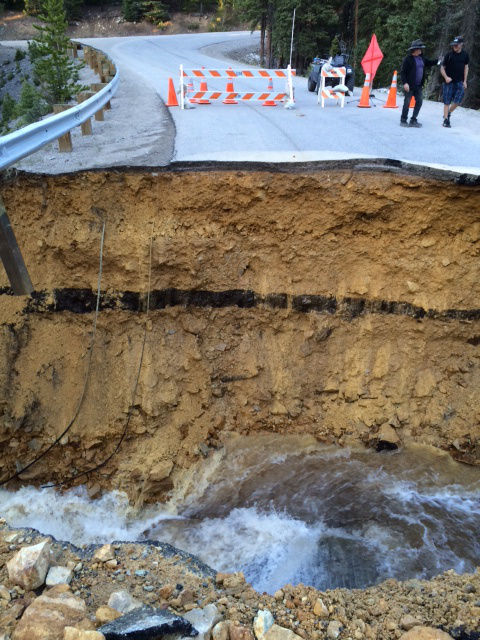
© Photo courtesy Summit County Road and BridgeFlood waters caused a major washout of Montezuma Road in Summit County, Colorado.
High runoff taking a toll on roads

Frisco - Spring runoff is starting to take a toll on high country roads, with a major washout reported along Montezuma Road and minor flooding in other areas, including a partial washout on the Meadow Creek trailhead road in Frisco.

East of Keystone, Summit County officials reported a 45-washout of Montezuma Road, leaving Montezuma residents with out vehicular access. According to the county, the road is washed out 15-feet deep near the Peru Creek trailhead.

Summit County Road and Bridge Department currently has a team in Jackson County retrieving a temporary bridge, with no definite schedule for its arrival. The road and bridge team onsite is also working on alternate solutions if the bridge cannot restore access.

Currently, the only access to and from the Town of Montezuma by Montezuma residents is by foot. The hike is about 30 minutes long. Montezuma currently has power and limited Internet access. Excel Energy is onsite and monitoring the situation.

On Tuesday afternoon at 2:15 pm the Summit County Sheriff's Office ordered a voluntary evacuation of the Town of Montezuma. An estimated 10 - 12 people have evacuated from the town. Approximately 20 people have chosen to stay in Montezuma.

Bizarro Earth

Ethiopian volcano spews stunning but deadly blue sulphuric gas

Image
© Olivier Grunewald
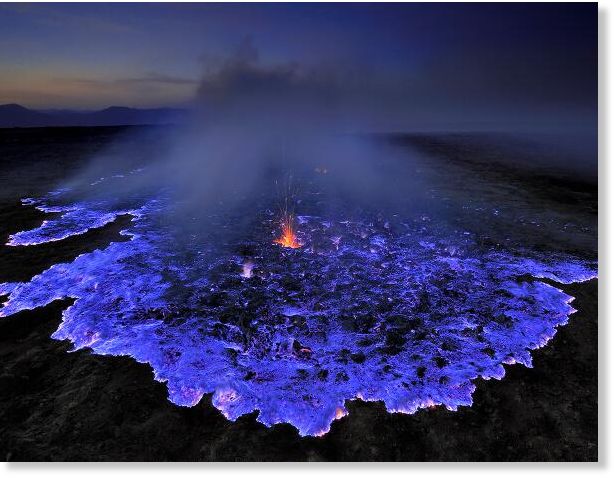
It's a volcano, but not as we know it. This cerulean eruption takes place in the Danakil Depression, a low-lying plain in Ethiopia. The volcano's lava is the usual orange-red - the blue comes from flames produced when escaping sulphuric gases burn.

French photographer Olivier Grunewald creates such images without using colour filters or digital enhancement, which is no simple task. To get this shot he had to wait until dusk, when the electric blue flames were visible, but before all the daylight had ebbed away. Then the wind had to be blowing away from him so he could get close enough. Photographing the similarly sulphurous Kawah Ijen volcano in Indonesia, where he worked inside the crater, was even more treacherous. "We have to take care when the winds push the flames close to us," he says. "In Danakil it is easier to escape as the land is flat."

Grunewald works in a gas mask to avoid breathing in the deadly fumes - but photographing Kawah Ijen still left him with peeling skin and clothes smelling of rotten eggs for weeks afterwards.

Another drawback of Grunewald's subject matter is that the acidic gases don't agree with his cameras. But it's worth it, he says. "The phenomenon is so uncommon - we really feel like we are on another planet."

Cloud Lightning

Tornadoes tear through Britain as freak weather starts to smash into UK

Image
© STU MORANT/MERCURY PRESSA tornado sweeps through the midlands today as freak weather starts to hit Britain
Tornadoes began smashing into Britain today amid fresh warnings the country faces a weekend of weather hell.

As these terrifying pictures show, a series of fearsome twisters ripped through Lincolnshire this afternoon as experts insisted 'much worse' is to come over the next few days.

Geoff Hill, 54, who works near Market Rasen, photographed the tornadoes as the skies suddenly darkened around 3pm.

He said: "It was spotted by one of our store staff working outside looking up at the sky. Somebody rushed in and said there's a tornado.

"We rushed outside and I grabbed my camera and took a picture. I actually caught it on the second go because it had formed for five minutes before and then disappeared.

"Then it formed again and appeared for another five minutes."

Elsewhere, photographer Stu Morant caught amazing images of a rampaging tornado on camera near Crowle, near Scunthorpe, North Lincs, around 4.30pm.

Image
© GEOFF HILL/MERCURY PRESSThis tornado was caught on camera this afternoon as it raged through the Lincolnshire countryside

Arrow Down

Rocks made of plastic found on Hawaiian beach

Plastiglomerate
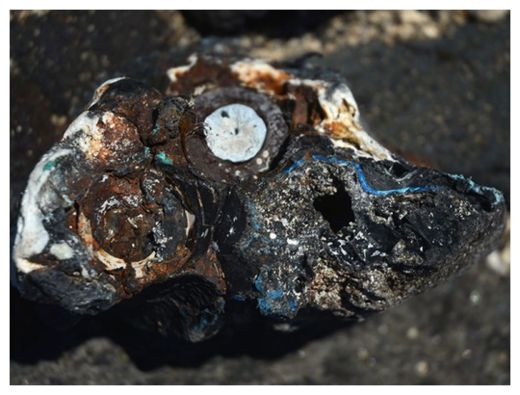
© Patricia CorcoranLeft behind. A sample of plastiglomerate, collected on Kamilo Beach in Hawaii.

Plastic may be with us a lot longer than we thought. In addition to clogging up landfills and becoming trapped in Arctic ice, some of it is turning into stone. Scientists say a new type of rock cobbled together from plastic, volcanic rock, beach sand, seashells, and corals has begun forming on the shores of Hawaii.

"The article is intriguing and fascinating," says geophysicist Douglas Jerolmack of the University of Pennsylvania, who was not involved in the work. "If these things can be preserved, then they might be a nice marker around the world of when humans came to dominate the globe and leave behind their refuse in mass quantities."

Geologist Patricia Corcoran of the University of Western Ontario in London, Canada, and Charles Moore, captain of the oceanographic research vessel Alguita, stumbled upon the new rocks on a beach on the Big Island of Hawaii.

These stones, which they've dubbed "plastiglomerates," most likely formed from melting plastic in fires lit by humans who were camping or fishing, the team reports this month in GSA Today. Although anywhere there is a heat source, such as forest fires or lava flows, and "abundant plastic debris," Corcoran says, "there is the potential for the formation of plastiglomerate." When the plastic melts, it cements rock fragments, sand, and shell debris together, or the plastic can flow into larger rocks and fill in cracks and bubbles to form a kind of junkyard Frankenstein.


Bug

Madagascar once again struck by locust plague

Image
© RIJASOLO/AFP/Getty ImagesA farmer protects his rice field from locusts by chasing away them with reeds at Amparihibe village in Tsiroanomandidy, western Madagascar.
Farmers in Madagascar have once again had to witness their crops be destroyed by an annual plague of migratory locusts, which threatens the livelihoods of 13 million people.

Since April 2012, the creatures have descended on the land where nine million of the country's agriculture workers try to make their living.

The threat lies in the insects' voracious appetite, with one locust able to consume its body weight - about 2 grams - in a day. During plague season, billions of locusts swarm to the east African nation.

Photos of this year's ambush show the insects appear as vast clouds in the sky, while farmers attempt try and fail to protect their land with fire and makeshift battons.

Image
A farmer protects his rice field from locusts by chasing away them with reeds at Amparihibe village. A Food and Agriculture Organization of the United Nations (FAO) mission is to fight the locust's swarm with an insecticide.
What began as an upsurge in 2010 became a plague because campaigns to tackle the insects between 2010 and 2012 were underfunded, according to the Food and Agriculture Organisation of the United Nation (FAO).

In September 2013, the Ministry of Agriculture and FAO sought to tackle the problem and launched a Three-year emergency Programme, which aims to control locust populations and thereby protect millions of vulnerable people.

To protect Madagascar's naturally diverse ecosystem, control operations are carried out using bio pesticides.

Image
A swarm of the Red Locusts 20 kilometres north of the town of Sakaraha, south west Madagascar

Arrow Down

Gigantic sinkhole near Eden Prairie, Minnesota home forces demolition

Image
© KAREThe Eden Prairie City Council has ordered the demolition of a home that sits on the edge of a huge sinkhole that was caused by Sunday's massive downpours.
Sunday's epic rain event will force the demolition of a home in Eden Prairie that is now perched on the edge of a gigantic sinkhole.

The Eden Prairie City Council voted in an emergency meeting early Monday to adopt a resolution ordering the demolition and removal of the structure located at 11201 Burr Ridge Lane. The emergency meeting was called after the residence was declared uninhabitable due to the imminent risk of failure and collapse from damage sustained during yesterday's rain event.

"It's pretty surreal," says homeowner Revie Zurn. "It's all of a sudden we're moving out stuff out and trying to start somewhere else."

Heavy rains caused the land between homes at 11201 and 11211 Burr Ridge Lane to give way and slide down into the Purgatory Creek valley. Prior to this event, the City of Eden Prairie had contracted with SEH (Short Elliott Hendrickson, Inc.) and NWA (Northwest Asphalt) to repair the stormwater sewer system serving the neighborhood, a project that was still in progress when the downpours struck. .


Cloud Precipitation

Images of heavy flooding in China

Image
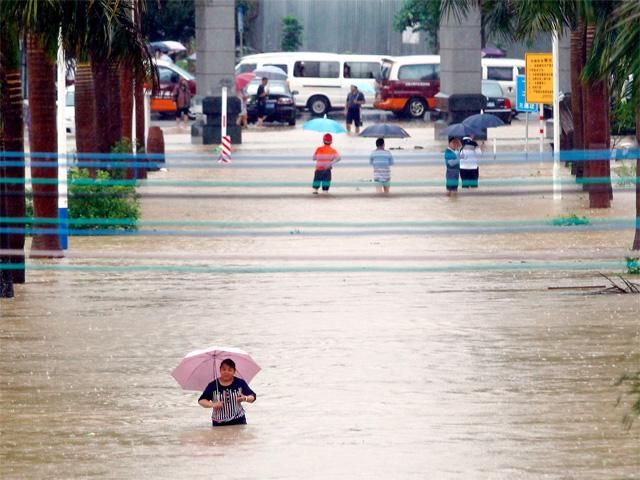
Residents wade through flood water along a street amid heavy rainfalls in Zengcheng, Guangdong province on May 23, 2014.

Flooding in China over the past week has left many dead and many more missing, leaving almost half a million people homeless. The seasonal rains have fallen especially hard on the country's manufacturing hub of Guangdong province near Hong Kong and more recently, on southwest China's Images of heavy flooding in China.

China's worst floods in recent history were in 1998, when 4,150 people died, most of them along the Yangtze River, China's mightiest.

Here is a medley of some of the most astounding images from the floods that has swept southern China.

Image
Commuters and a pedestrian manoevering their way through floods water in Liling, central China's Hunan province after heavy storms hit the city on May 25, 2014.

Image
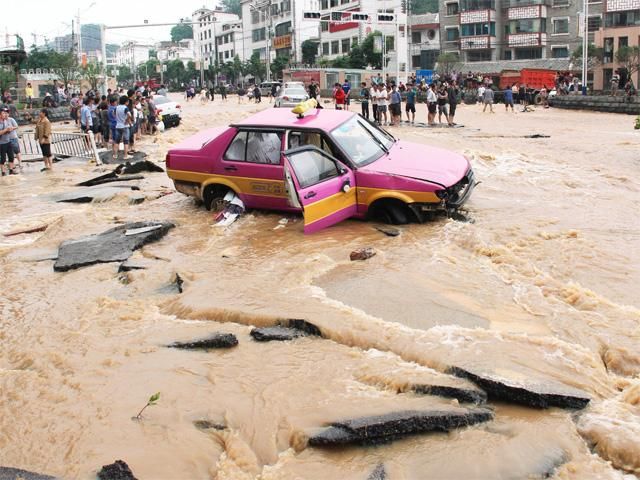
A taxi is trapped by flood water that washed away parts of a road in Pingba county in southwest China's Guizhou province on June 3, 2014.