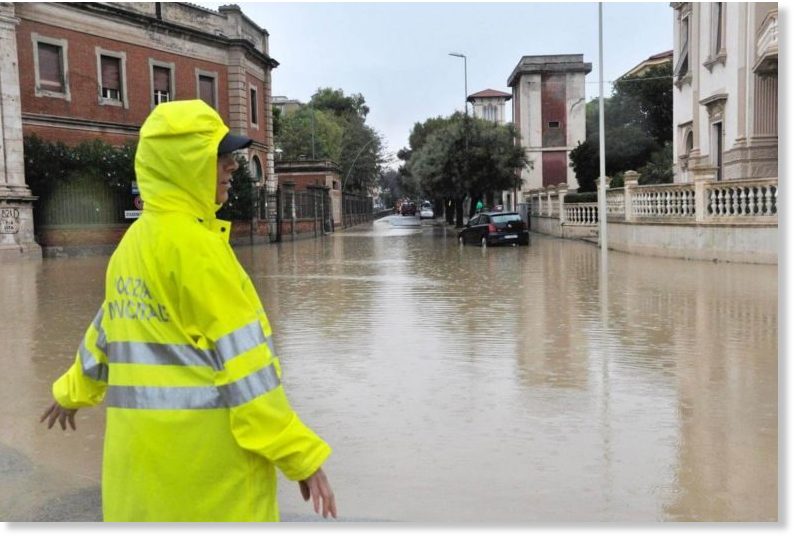
At least six people have died in violent rainstorms sweeping across Italy on Sunday (Sept 10), with the Tuscan city of Livorno taking the brunt of the flooding, fire services said.
Four people from the same family were found dead in a flooded house in the city, where 40cm of rainfall in four hours transformed streets into rivers and washed away cars.
The Corriere della Sera daily said the dead were a little girl, her parents and a grandparent.
A fifth body was found in an area devastated by landslides. Three other people were missing, the fire brigade said.
"The situation is very difficult, it's critical. We fear a disaster," Livorno mayor Filippo Nogarin said.
Italy's civil protection service issued a code orange alert for Florence as the storms, which began in northern Italy overnight, swept down the country towards the south.
A surfer has been described as "the luckiest man on earth" after a shark snapped his board in half before biting his hip on the NSW north coast this morning
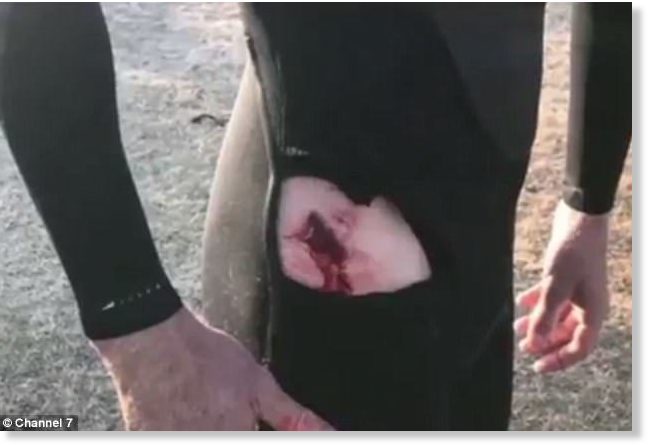
Byron Bay local Abe McGrath, 35, was lying on his board off Main Beach, about 300m north of the Illuka Wall, just after 6am when a shark "latched" its jaws onto his surfboard.
Fellow surfer Bryce Cameron, 34, said the shark, believed to be a 3.5m juvenile white pointer — also known as a great white shark — came up from underneath Mr McGrath, snapping his board in half then piercing his hip.
"He was laying on his board and he got attacked from below really aggressively, the force of the attack snapped his board," Mr Cameron, who was on the beach and about to head into the water when the attack occurred, said.
A deadly flesh-eating fungus responsible for decimating fire salamander populations in Europe is spreading in Germany, according to researchers.
The Batrachochytrium salamandrivorans fungus first arrived in Europe from Southeast Asia in 2010, wiping out fire salamander populations in Belgium and resulting in severe declines in the Netherlands.
It was first detected in western Germany's Eifel region in 2015, but has recently been found in Essen, nearly 100 kilometers away (60 miles).
"This is a rapid spread and it can occur throughout the country," Sebastian Steinfartz, a researcher at TU Braunschweig's Zoological Institute, told news agency DPA.
The black-and-yellow spotted fire salamander is one of the best-known species in Europe.
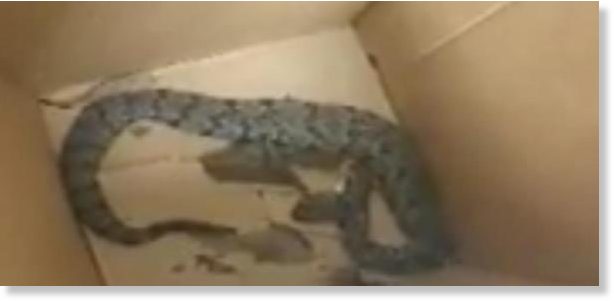
While inspecting a home Wednesday, an electric worker in Arkansas found an oddity he had never seen beyond magazines and TV: a two-headed snake.
Rodney Kelso, who works as the operations director at Woodruff Electric in Forrest City, said the snake was sunning itself when he found it outside a home on Arkansas 248.
"Fifty years on the ridge and never have seen such," Kelso said by phone Friday morning.
He put on a pair of gloves and eased the snake into a box.
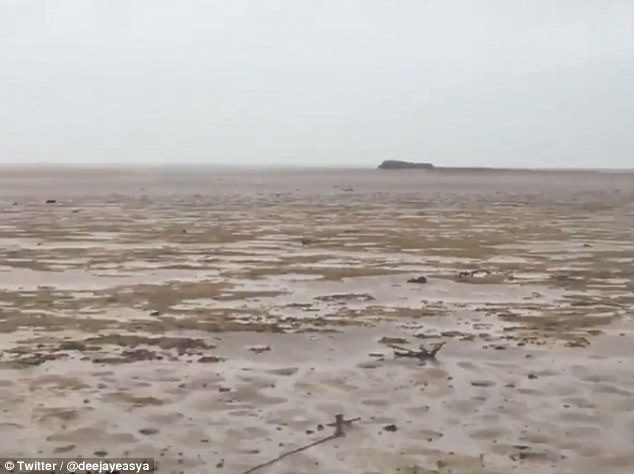
Extraordinary footage from the Bahamas show the shoreline receded much farther than normal, exposing what is usually the ocean floor.
Twitter user @Kaydi_K from Long Island, Bahamas wrote on Friday: 'I am in disbelief right now... This is Long Island, Bahamas and the ocean water is missing!!! That's as far as they see #HurricaneIrma.'
The strange video shows her walking on the exposed ocean floor which is dry and covered in large shells. Another Twitter user tweeted a photo of the exposed beach at a different beach in the Bahamas and showed it was back to normal within less than a day.
Hurricane Irma, which hit the Bahamas on Friday, is so powerful that it has altered the shape of the ocean in Long Island, but it will likely be back to normal by Sunday afternoon.
Pressure in a hurricane's center is low and Irma is so strong that it is pulling water into its core, sucking it away from the ocean, according to the Washington Post.
Comment: Last month the Atlantic Ocean dramatically receded off the coasts of Uruguay and Brazil. See also:
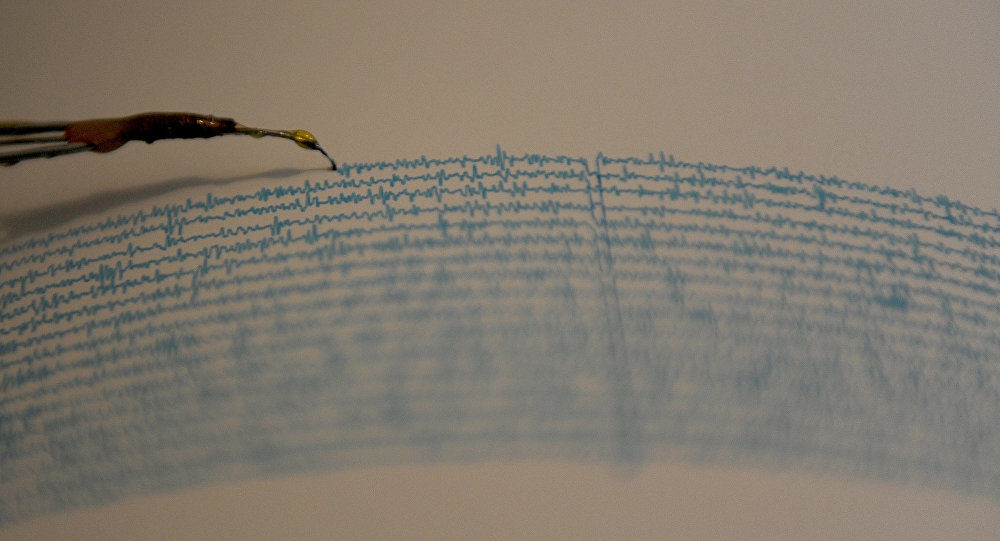
A 5.7 magnitude earthquake occurred in waters off Mexico's Isthmus of Tehuantepec, the US Geological Survey (USGS) reported Sunday.
Quakes have been registered at 22:07 on Saturday local time (03:07 GMT on Sunday). The epicenter is located 80 kilometers (49) to southwest of the town of Paredon at the depth of 33 kilometers (about 32 miles).
Images of the devastating impact of Hurricane Irma have filled social media, showing how the deadly storm system has reduced tranquil Caribbean island paradises to ruins.
More than 20 people died as extreme weather barrelled across the Caribbean bringing winds of up to 150mph. Whole neighborhoods have been turned-upside down on islands such as Barbuda, St Barts and the Virgin Islands.
Irma continues to travel west towards Florida, and the US Oceanic and Atmospheric Administration has warned that it will bring "life-threatening wind, storm surge and rainfall hazards".
As islanders struggle to come to terms with the natural disaster, and as MSM coverage continues to focus on Florida, here is the latest on the worst-hit Caribbean regions.
With four big hurricanes, a powerful earthquake and wildfires, it seems that nature recently has just gone nuts.
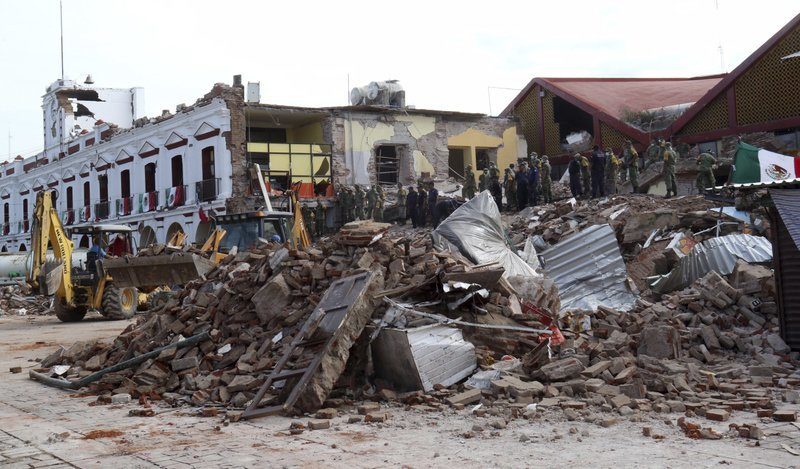
Some of these disasters, like Friday's earthquake in Mexico, are natural. Others may end up having a mix of natural and man-made ingredients after scientists examine them. We also always tend to look for patterns and order in chaos, even when they aren't there, psychologists say.
"Nature's gone crazy," mused Jeff Masters, meteorology director at the private service Weather Underground. "Welcome to the future. Extreme weather like this is going to be occurring simultaneously more often because of global warming."
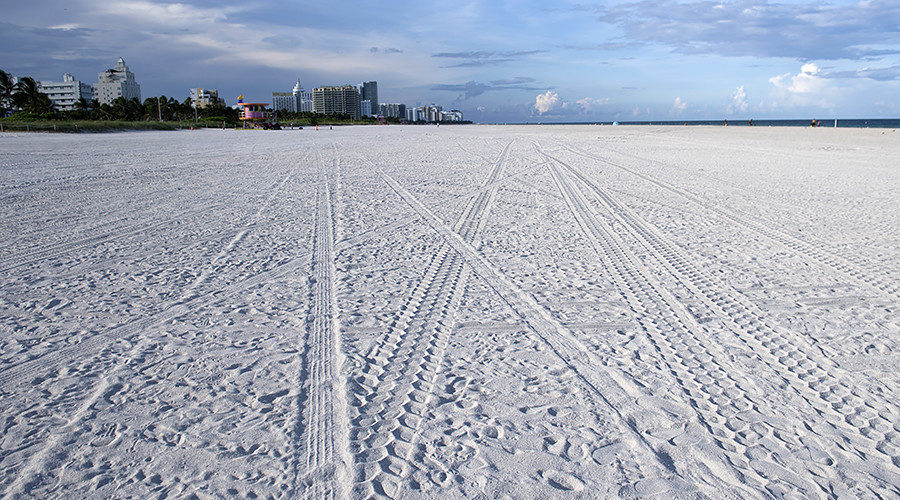
Eerie footage and images of southwest Florida reveal deserted beaches and cities in areas usually thronging with crowds as residents flee the region ahead of Hurricane Irma making US landfall.
Seven million citizens have now been ordered to evacuate and at least 51,000 people are staying in shelters in southeastern Florida, according to Florida emergency management officials.
The National Weather Service has warned residents that nowhere in the Florida Keys will be safe when Irma hits, while Florida Governor Rick Scott urged any hold-out citizens Friday night to leave immediately.
Looking at footage from the scene, it appears many have heeded the warnings, as bustling tourist hotspots like Miami seem all but abandoned.












Comment: Last month the Atlantic Ocean dramatically receded off the coasts of Uruguay and Brazil. See also:
Meteotsunami? Ocean dramatically recedes on South American Atlantic coast as huge waves batter the Pacific side