Earth ChangesS


Wolf

Woman aged 64 dies after being savaged by dog at home in Cardiff, Wales

Image
Tragic: Tributes have been left at the home where the woman was attacked in Cardiff
Police were called to a house at around 10pm on Friday night - despite efforts to save the woman, she later died from her injuries in hospital

A grandmother has died after being mauled at her home by a bullmastiff-type dog, police have said.

The victim, named locally as mum-of-four Rhona Greve, 64, died in hospital after suffering neck and face ­injuries in the terrifying attack

Police were called to a house in Crossways Road, Ely, shortly after 10pm on Friday to reports a woman had been attacked by a dog.

Binoculars

50% decline in songbirds across Canada in the last 50 years

Image
Songbirds, like this tree swallow, are in serious decline across North America.
It's a sure sign of spring when the chorus of songbirds once again returns to our region. Recent mornings, I've awoken to the sounds of robins chirping, the tune of a white-throated sparrow and the gentle cooing of morning doves. The silence of the winter has broken.

Imagine for moment if that winter silence continued into spring and summer. Unfortunately, it's a scenario that could very well unfold as we've seen sharp declines in the number of songbirds over the past few decades.

Birdsong that has graced the Earth for millions of years, and for all of human history, could soon be stilled in a human-made perfect-storm of negligence and unintended consequences.

A film that was shown on CBC-TV last week, Song Bird SOS, shines light on the ever-growing decline of songbirds, and outlines some of the potential causes. You can view the documentary at cbc.ca.

Directed by Su Rynard, the film is the artfully shot story of the mass depletion of songbirds in the Americas, an alarming thinning of populations that has seen declines of many species since the 1960s. According to international birding expert Dr. Bridget Stutchbury, who is featured in the documentary, we may have lost almost half the songbirds that filled the skies 50 years ago.

Bizarro Earth

Rainbow lorikeets eating meat leaves bird experts astonished

Lorikeets Eating Meat_5
© Matt WatsonTwo rainbow lorikeets tuck into pets mince in a backyard feeder in Elimbah.
The behaviour of a population of rainbow lorikeets who frequent a backyard feeding station on a property north of Brisbane has left bird experts baffled. The lorikeets are eating meat and Griffith University's Professor Darryl Jones is shocked.

Professor Jones, who is researching the impact of backyard feeding on bird populations, said lorikeets usually eat nectar and pollen which they obtain from native plants and shrubs.

"I have researched what birds feed on all around the world," Professor Jones said.

"I'm up to date with all the kinds of crazy things that birds are eating all over Australia.

"To see a lorikeet eating meat astonishes me completely. I have never heard of such a thing before."

For years, Bill, who owns the Elimbah property, has put out pets mince for magpies, currawongs and kookaburras. He also puts out seed for vegetarian birds like galahs, king parrots and the lorikeets.

He feeds about a dozen birds each day and knows they are spoilt for choice when it comes to food. Bill's property is home to native trees and shrubs, and there is untouched forest nearby. He is happy to offer a few scoops of mince and seed to the birds that come in for a free feed.

It was about seven years ago when Bill first noticed the lorikeets eating meat, and they have been eating it ever since.

"At first they went for the seed but then they started chasing the other birds away from the meat, which surprised me," he said.

Snowflake Cold

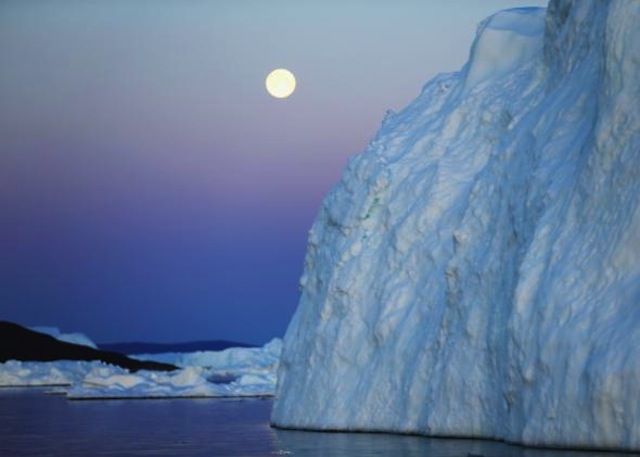
Ice age on the way: Gulf Stream is slowing down faster than ever, scientists say

Image
Gulf Stream stops Britain from freezing over in Winter
The Gulf Stream that helps to keep Britain from freezing over in winter is slowing down faster now than at any time in the past millennium according to a study suggesting that major changes are taking place to the ocean currents of the North Atlantic.

Scientists believe that the huge volumes of freshwater flowing into the North Atlantic from the rapidly melting ice cap of Greenland have slowed down the ocean "engine" that drives the Gulf Stream from the Caribbean towards north-west Europe, bringing heat equivalent to the output of a million power stations.

Comment: At least one of the reasons for the slow down in the gulf stream is man made, and is leading to an ice age:


The effects of the slow down are also discussed here: Britain faces big freeze as Gulf Stream loses strength


Gold Seal

"The Day After Tomorrow" just got one step closer to reality!

Image
© Joe Raedle/Getty Images
In the 2004 blockbuster The Day After Tomorrow, abrupt climate change plunges the world into chaos. According to new research published Monday, the idea that underpins the film's plot—that rapid Arctic ice melt could cause dramatic changes to the global climate system—just got one step closer to reality.

Of particular concern are the profound changes happening in the Greenland ice sheet: It appears that the massive amount of freshwater from melting Greenland glaciers has now begun to slow the ocean's circulating currents.

Monday's study, published in the journal Nature Climate Change, is as frightening as it is significant. Among its authors are some of the biggest names in climate science: Jason Box, a glaciologist at the Geological Survey of Denmark and Greenland, whose ongoing "Dark Snow" project is measuring the rapid melting of ice in Greenland; and Michael Mann, a meteorologist at Penn State University, whose famous 1999 "hockey stick" graph showed the sharp influence of human greenhouse gas emissions in context of 1,000 years of temperature data from ice cores and tree rings. Mann's graph was so powerful it became a lightning rod of climate denial.

Fresh water is less dense than saltwater. So when glacial melt from Greenland enters the ocean, it resists the natural sinking motion at the northern edge of the Gulf Stream and slows down the Atlantic's deep current—creating a ripple effect across the entire planet.

The study uses a library of ice cores, tree rings, coral, and sediments to generate a new reconstruction of the historical strength of the Atlantic's circulation based on temperature changes. The team found recent changes in ocean circulation are "unprecedented" since at least the year 900 A.D., about as far back as these proxy data can reliably go. According to the paper, the probability of a similar circulation slowdown caused by natural variability alone (with no influence from human-caused climate change) was less than 0.5 percent.

Comment: See also: Top scientist resigns from post - admits Global Warming is a scam


Cloud Lightning

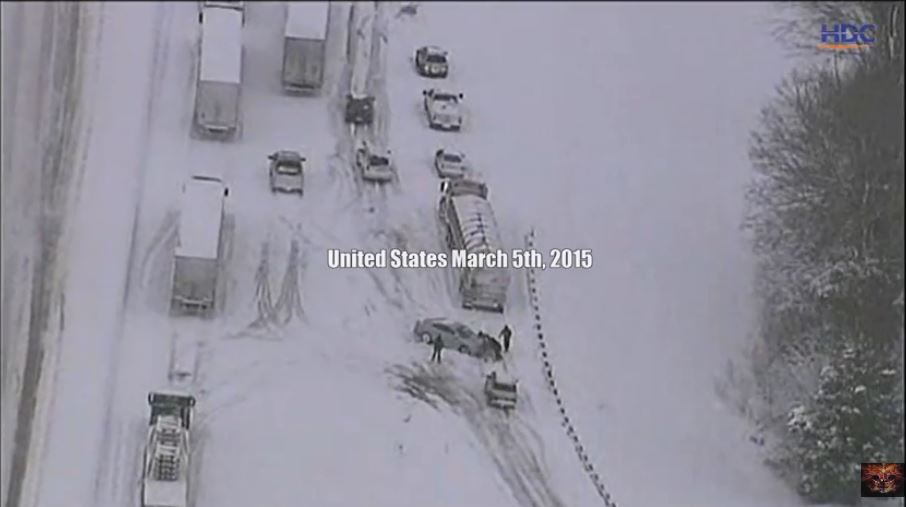
Best of the Web: Extreme weather, meteor fireballs, and Earth Changes in March 2015 (VIDEO)

Image
© HawkkeyDavisChannel
Earth changes have taken place the past few weeks or so. Animals are listed among the dead.

I've been working 50+ hours a week, sorry if there's any mistakes. Thanks for watching and stay safe..

This series does not mean the world is ending! These are documentaries of series of extreme weather events which are leading to bigger earth changes. If you're following the series, then you're seeing the signs. It's much more than one video!


Follow me on Facebook for much more

Attention

Second mahout to be killed by elephant within 5 days in Kerala, India

Image
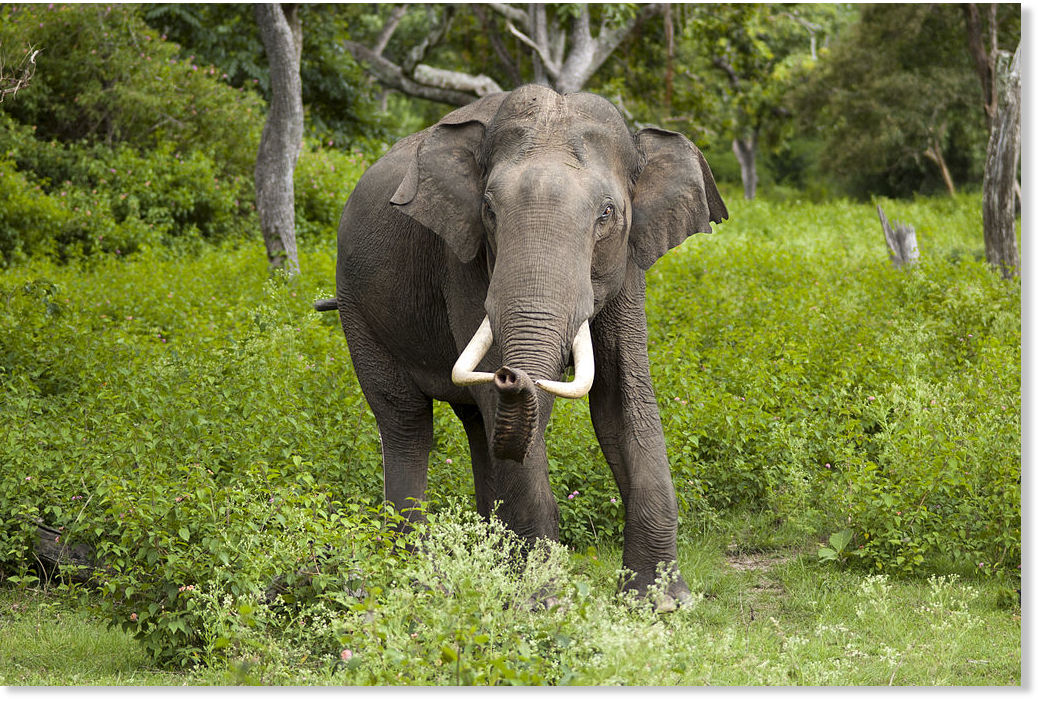
© Yathin S KrishnappaAsian elephant.
The district authorities have resolved to strictly enforce the prescribed norms for management of captive elephants in the wake of second incident within five days in which a man was killed by an elephant in Karuvatta, near Haripad.

In the latest-such case, a 52-year-old mahout was crushed to death by an elephant, named Chirakkadavu Thiruneelakandan, which was brought from Ponkunnam during a procession that was taken out in connection with a festival at the Thiruvilanjal Devi Temple on Sunday by around 10 p.m. The mahout, Unnikrishnan Nair, who hailed from Padeethathil house in Karuvatta, was knocked down and was trampled by the elephant. The animal could be brought under control only within two hours.

The incident came close on the heels of another in which a 72-year-old ex-serviceman was killed by an elephant. Which ran amok when being readied for the festival at the same temple at Karuvatta. The victim, who was reading a newspaper on his courtyard, was hit by the elephant's trunk and was killed on the spot. The pachyderm was brought under control, but not before it damaged several vehicles and other properties along the busy Karuvatta-Haripad stretch.

Bizarro Earth

Massive landslide buries parts of Peruvian town amid heavy rains

landslide peru
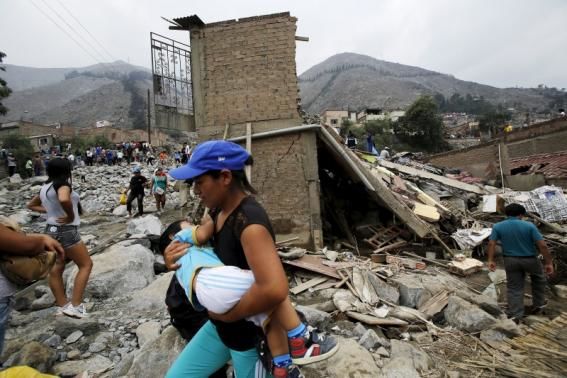
© REUTERS/ Mariana BazoA woman carries a baby as she walks past debris of houses after a massive landslide in Chosica, March 24, 2015.
Seven people were killed and more were feared dead in Peru after a massive landslide buried parts of a town amid heavy rains, authorities said on Tuesday.

Six were missing and 25 injured in the disaster in Chosica, some 30 kilometers (18.6 miles) east of Lima, said Alfredo Murgueytio, the head of the National Civil Defense Institute, Indeci.

"There are likely more dead bodies under the debris," Murgueytio said on local broadcaster RPP.

TV images showed water and mud rushing over the town's sloped streets and a distraught woman waving a picture of a missing girl.

The main road connecting Lima to the center of Peru, a top global producer of copper and gold, remained blocked since Monday, police said.

Comment: Peru has been plagued by heavy rains causing floods and landslides this year:


Bizarro Earth

Massive wildfires threaten ancient forests in Chile

wildfire chile
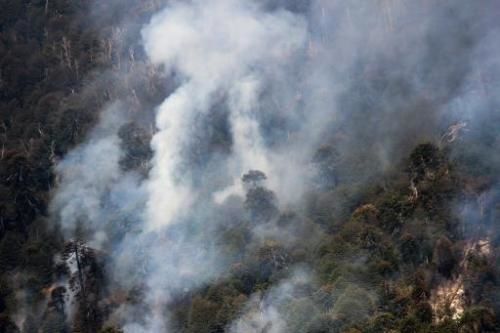
Aerial view of smoke columns are seen over mountains on the Conguillo National Park in Chile on March 22, 2015
Chile has declared a red alert for three national parks and reserves where massive wildfires are threatening forests that are thousands of years old, officials said Tuesday.

The fires have been raging for more than a week in the southern region of La Araucania, which has been hit by a severe drought.

The National Emergency Office (ONEMI) warned they would likely spread and intensify.

"It's going to be difficult to contain this fire today and tomorrow, but we hope that by Thursday we can effectively have it under control," said the vice minister of the interior, Madmuh Aleuy.

The head of national forest service CONAF, Aaron Cavieres, said firefighters were battling to keep the blaze away from populated areas.

"High temperatures and strong winds of more than 50 kilometers (30 miles) an hour are complicating our work to contain the fires," he said.

The fires are burning in three protected areas: China Muerta National Reserve, Nalca Lolco National Reserve and Conguillio National Park.

Attention

Massive sinkhole appears on N3 highway in Pietermaritzburg, South Africa

Image
© Jonathan Burton
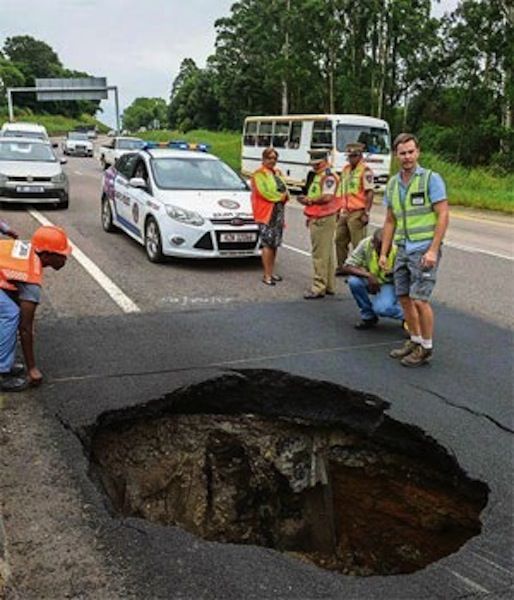
A massive sinkhole over two metres deep and three metres wide appeared on the N3 highway in Pietermaritzburg on Thursday, leading to the closure of one of the busy freeway's lanes.

The Durban-bound portion of the road near the Peter Brown offramp has been repaired numerous times, but it collapsed when a bus travelling over the sunken area collided with a truck in the early hours of Thursday.

Easter weekend

WBHO engineer Jacques Grobler, who has been contracted to repair the sinkhole, said he was hoping to fix the portion of road before the Easter weekend.

"We had a machine on site this morning to start excavating the bottom of the sinkhole and to investigate the problem."

He said once they identified the cause of the collapse, they would build up the hole layer by layer and "try to repair it before the Easter weekend".

Road Traffic Inspectorate spokesperson Zinhle Mngomezulu said the hole was 2.4 metres deep and would easily swallow the nose end of a car.

Photos of the sinkhole were plastered all over social media as local residents and travellers shared concerns over the collapsed portion of road.

Danger

Comments poured in on The Witness's Facebook page from locals who said they had hit the sunken patch of road days before it collapsed.

Local Andries Keyser said he hit the sunken patch of road on Monday whilst towing an empty bulk fuel trailer behind his bakkie.