Science of the SpiritS


Bulb

The real reason why you haven't healed your trauma, heartbreak, depression

Image
© scienceandnonduality.com
The prevailing psychological wisdom of our time tells you that your current dysfunctions are probably a result of your past experiences, e.g., your painful childhood, your stupid parents, your abusive first love, and the wars, famines, and hurricanes you were forced by fate to go through. If you're metaphysically inclined, you may even believe that your present pain has its roots in a past life, a past past life, a past past past life. (By the way, after talking to many who claim to have recovered memories from past lives, I can assure you that nobody on earth has ever had a great life in the past. Since there's nothing new under the Sun, it's safe to assume that a great life will not exist in the future, either. So you can stop looking now.)

You were told that healing from past pains would get you happiness. But if you're reading this, you probably have been on the "healing path" for a long time, under the assumption that once you heal your past, you'd finally find fulfillment and freedom. That was how I looked at my life, for a long time. I went from one healing modality to another, on a quest for the Holy Grail that would bestow bliss to eternity.

Such a quest is useful, until it is not. After years of professional counseling, shamanic sessions, cleansing retreats, and chocolate cake fixes, I realized that the healing journey simply would not end on its own. If you look for them, you can always find traumas in yourself, old and new, to be healed and cleansed. A completely healed human is a mythological construct. And the quest for healing can be a rat race that is easy to get on, but hard to step off.

You could never be fully healed because healing is a concept that only exists in a world of duality where experiences are dichotomized into good and bad, right and wrong, happy and sad. Light cannot be known without darkness. Similarly, you won't be able to define healing in yourself without also identifying trauma in yourself. As long as you live in a narrative of personal history, of how you came to be the way you are and how you're being fixed and improved from a state of brokenness, the story of your healing journey will continue just like time extends to infinity.

Comment: See also:


Fire

Appropriately channeled anger proves beneficial to health and relationships

anger maya angelou
According to society, anger rarely pays. That's partly true, but the unfortunate omission according to what is socially acceptable is the difference between the type of anger that leads us to spiraling out of control, and that which has a positive role in not only our individual growth, but the entire world's. Constructive anger can aid intimate relationships, work interactions and social expressions, including many types of responses that can change humanity.

"Don't you dare raise your voice in this house," says just about every parent in the modern world. Although anger directed at another human being can be hurtful and detrimental to our health, outward expressions of anger fueled to exercise or simply ease distress may help protect us from heart disease and stroke. Men with moderate levels of anger expression are less likely to have a stroke than those who rarely expressed anger.

Question

Thriving in uncertainty

Image
In the decades before WWI there were no serious wars. This left plenty of room for academics to theorize about how new technology might be used in war; in fact, WWI was possibly the most thoroughly planned war in history.

Yet from the first encounter, the theories unraveled in the face of situations that could never have been predicted. The most respected generals in the world were made to look like amateurs. Their faith in abstract planning blinded them to the reality of the situation. It took years of conflict before they began to really adapt to the reality of their situation.

These generals didn't realize that they were engaging in the world's first truly modern battles. These battles required the ability to improvise more than they required detailed plans.

The same transition is currently happening in business. A plethora of business books came out this summer building on the concept of The Lean Startup methodology introduced by Eric Ries. That is, it is cheaper in most cases to run an experiment than to create a plan. Even massive companies are starting to turn their focus towards quickly implementing a strategy on a small scale to test a concept before rolling out a massive change.

Comment: Prepping, as an example, entails great uncertainty. Though not mentioned specifically, the suggestions could prove useful.


Palette

Not just for kids: Coloring books can help adults relax too

crayons
© Thinkstock
Adult coloring has become a thing — and with good reason. Not only is the practice beneficial for people with specific conditions, like PTSD and those suffering the psychological side effects of cancer diagnosis and treatment, it's a good stress reliever for the general population.

It's also just plain fun.

So what makes coloring such an effective form of art therapy?

"The action involves both logic, by which we color forms, and creativity, when mixing and matching colors. This incorporates the areas of the cerebral cortex involved in vision and fine motor skills (coordination necessary to make small, precise movements)," psychologist Gloria Martinez Ayala told the Huffington Post. "The relaxation that it provides lowers the activity of the amygdala, a basic part of our brain involved in controlling emotion that is affected by stress."

Put another way: When we focus on coloring, it blocks our brains from focusing on our troubles.

"Because it's a centering activity, the amygdala, which is the part of the brain that is involved with our fear response, actually gets a bit, a little bit of a rest," psychologist Dr. Ben Michaelis told Fox News. "It ultimately has a really calming effect over time."

Take 2

The Damage is Done: Gabor Maté and Calgary performer team up to create play exploring trauma

Image
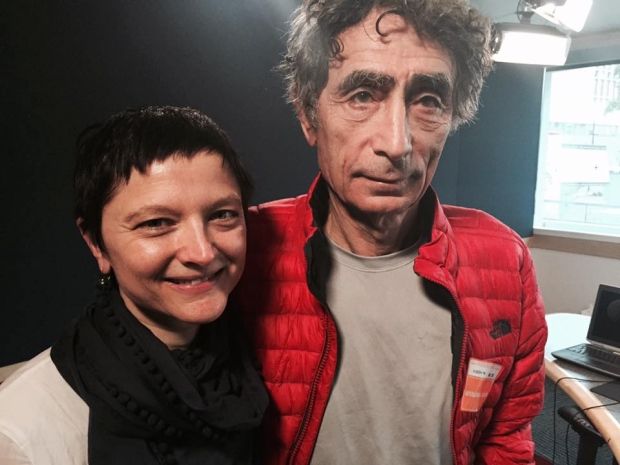
© Margaret Gallagher/CBCActor and therapist Rita Bozi and Dr. Gabor Maté explore how trauma is passed down through generations in their play at the Cultch.
Hungarian-Canadian performer Rita Bozi grew up in a family scarred by war.

Her older brother was born to her parents in Hungary just shortly before the Hungarian Revolution of 1956, a nationwide revolt against the government of the time which was largely controlled by the Soviet Union.

During the uprising, which was violently crushed by the Soviets, her father fled, leaving her mother alone for eight years before they finally reunited and came to Canada.

Life Preserver

Helping others can alleviate your own pain and depression

helping hand
Dr. Karl Menninger, the famous psychiatrist, was once asked following a lecture on mental health: "What would you advise a person to do, if that person felt a nervous breakdown coming on?"

Most people thought he would say: "Consult a psychiatrist."

But he didn't. He surprised everyone when he replied: "Leave your house, find someone in need, and do something to help that person."

I know this is going to upset folks. When I posted it on my Facebook page, the reviews weren't so nice. One woman said that hearing things like this makes her feel worse because it is as though Menninger is saying that she's depressed because she's self-absorbed.

Another person was angry at me because he thought that spreading this kind of horse poop online deepens and thickens the stigma that we have to work so hard against. I get that.

For six years I experienced suicidal thoughts. In that time, I helped many people stuck in the Black Hole of Bile (depression) and volunteered my time to various programs. But I still wanted to die. I would try my best to lift someone up, and then return home to Google "Easiest ways to get cancer."

However, this perspective — transcending your pain in loving acts of service — is also full of hope, if you can look at it that way.

Comment: The power of kindness


Butterfly

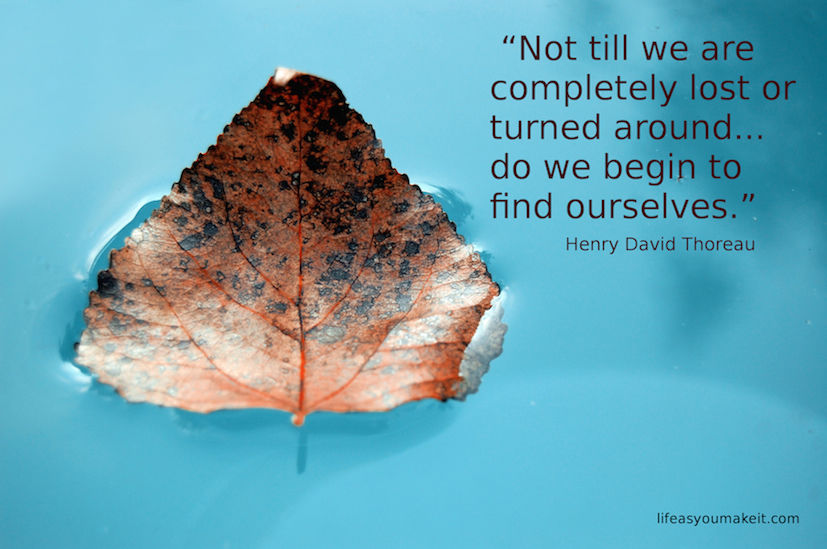
Positive and life-transforming changes can result from traumatic events

thoreau quote, life transformation, finding ourselves
There's a common misconception surrounding trauma. We assume that after someone experiences trauma, they might develop post-traumatic stress disorder (PTSD) or return to their old life.

But many individuals also experience something else: positive change. In fact, in 1996 psychologists Richard Tedeschi and Lawrence Calhoun coined the term "post-traumatic growth" to describe this phenomenon (in this paper).

In the book Upside: The New Science of Post-Traumatic Growth, journalist Jim Rendon writes: "In study after study, research shows that about half or more trauma survivors report positive changes as a result of their experience. Sometimes these are small changes — they feel that life has more meaning, that they are closer to their loved ones. For some the changes are life-altering, sending people on career and life paths they never would have considered before, transforming who they are and how they view the world."

In Upside, an inspiring, empowering and well-researched book, Rendon shares these transformative stories, along with the latest research on what fosters post-traumatic growth.

For instance, Rendon tells the story of Shane Mullins, who lives in Ireland. Ten years ago, Mullins suffered a traumatic brain injury after he ran his car off the road and a stone pillar struck his head. For months Mullins was on a feeding tube, confined to a wheelchair and had trouble saying what he wanted to say.

Roses

The neuroscience of gratitude: Small acts of generosity

Image
© KonstantinChristian/Shutterstock
Gratitude is defined as, "the quality of being thankful; readiness to show appreciation for and to return kindness." Millennia ago, Cicero proclaimed that gratitude was the 'mother of all virtues.' Seneca spoke of gratitude as being a fundamental motivational drive that was critical for building interpersonal relationships.

Recent studies have shown that generosity and gratitude go hand in hand both at a psychological and neurobiological level. Generosity and gratitude are separate sides of the same coin. They are symbiotic. Fortunately, each of us has the free will to kickstart the neurobiological feedback loop—and upward spiral of well-being—that is triggered by small acts of generosity and gratitude each and every day of our lives. Why not practice a small act of generosity today?

Comment: Innate tendency of humans to appreciate another's hospitality: Scholars study the evolution of human generosity


Bulb

Courage: Mastery of fear, not its absence

Image
© Helmut Hess
Our experience of the world is the most basic stuff of life. In other words, the most basic human reality is to live our lives in this world of experiences. Unlike the Earth, the world that we inter-subjectively share has been conceived, shaped and signified by our very own humanity. We are the creators of this world of fleeting delights and sorrows, momentary satisfactions and disappointments, transitory elation and desolation, ephemeral triumph and defeat. Moment by moment, each of us navigates the cultural fiber of this world in a complex landscape dominated by problems and difficulties, anxiety and despair, apprehension and pain. Faced with all of this, the human will is expected to stand courageously to confront the challenges and engage in the struggle.

People 2

5 red flags to watch for when you're starting a relationship

relationship red flag
© Unknown
It would be great if relationships could come with warning labels. You'd be able to head off problems before they materialize with partners who didn't turn out to be such good matches for you. Unfortunately, unlike the choices you have when you buy prescription drugs, cigarettes, or hazardous substances with their bold-faced risks and side effects, you're on your own when it comes to deciding on a relationship partner.

In the very rich area of relationship research, there's a surprisingly small sector of the literature that deals directly with warning signs. As reported by Kansas State University's Nathan Hardy and co-authors (2015), those warning signs form part of the equation in determining relationship risk. The bigger and brighter those red flags, the higher the risk. Adding to the red flags, additional risk factors include how compatible you are with your partner and how committed each of you seems to be.

It's particularly important to weigh relationship risk factors in the early stages of the game with a potential new partner. According to inertia theory (Stanley & Rhoades, 2009), the longer you're in a relationship, the greater the inertia factor that prevents you from leaving it when it becomes emotionally unfulfilling or perhaps even dangerous. The theory also suggests that you're best off making a conscious choice as you enter a new relationship. You'll work harder to keep that relationship strong the more effort you put into the decision to get involved with your partner in the first place. Even if you decide to disregard the red flags and go ahead anyhow with a commitment to the partner, you will be better prepared to handle the problems that may follow down the road.

Comment: Beginning a relationship is like taking a hormonal roller coaster ride. Those who are able to keep their heads on their shoulders while navigating these drug-like twists and turns are going to be able to learn who their partner really is. And that information can help both parties by either substantially enhancing a relationship, or ending one that is doomed from the beginning.

Also see: Romantic love can lead to growth or stagnation