Science of the SpiritS


Books

Stories developed to 'deal with complexity'

monks
© AP Photo/Ashwini Bhatia
Jordan Peterson, author of Maps of Meaning: The Architecture of Belief, argues people through centuries developed stories to deal with complexity in order to make action in the big, mysterious and dangerous world tractable. These stories were of three general types . Some simplified the known world and explained the individual's place in a complex society; others set out the relationship with the unknown, enabling us to face it without undue fear; and some provided a link between the known and the unknown.

Thus equipped man met challenge after challenge. Stories, myth and meaning served not to provide final truth but enough truth to enable mankind to write his next chapter. The species staggered through history like a kind of Scheherazade, making up stories that were hopefully, each a little bit truer than the last. Peterson writes:

Comment:


Footprints

The way you walk may provide insight into your personality

walking
Fast walkers are more likely to be extraverted, conscientious and open to new experiences.

Naturally, though, with age, people tend to walk more slowly.

However, those high in extraversion, conscientiousness and openness to new experience did not slow down as much as they got older.

The study's authors conclude:
"This study provides robust evidence that walking speed in adulthood reflects, in part, the individual's personality."

Blue Planet

The physiological & psychological benefits of nature are well documented

Nature on the brain
European research from the Max Planck Institute for Human Development in Germany suggests that city dwellers who live near nature experience positive effects on their brains compared to their purely urban counterparts, especially on the amygdala, the brain's integrative center for emotions, emotional behaviour, and motivation. When we think of stress or fear responses, we should be thinking of the amygdala.

This research should come as no surprise, since the physiological and psychological benefits of nature are well documented. In our article "How Walking In Nature Changes The Brain," we explored the study led by Gregory Bratman, which suggested that being in nature can potentially change our brains and positively impact our health:
Researchers conducted a study which asked randomly selected participants to spend 50 minutes walking in either a natural or urban setting, and to submit to a series of psychological assessments before and after the walk. They found that volunteers who walked through a lush, green portion of Stanford campus showed improve cognitive function and mood compared to those who walked near heavy traffic for the same period of time. However, while this study showed that nature could have a positive effect on mental well-being, it did not examine the neurological mechanisms underlying this change.

Comment: Read more about the benefits of nature and 'earthing':


Handcuffs

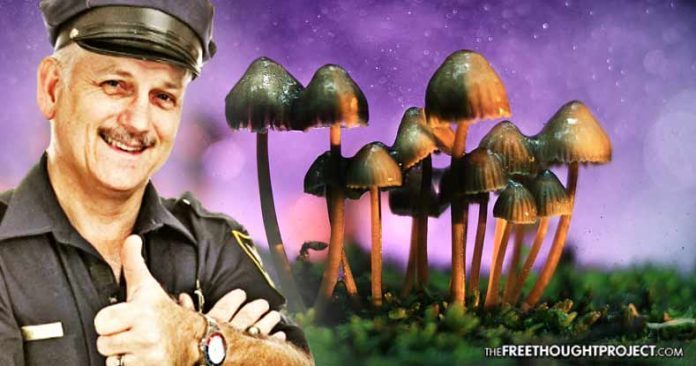
Psychedelics more effective at reducing crime than police, says new study

magic mushrooms
In recent years the U.S. has seen a dramatic resurgence of research into the medical use of psychedelics, after the drug war put a decades-long halt on scientific advancement. Despite psilocybin, LSD and other hallucinogens still being labeled as "Schedule 1" drugs, researchers are discovering the astounding benefits of their medical application.

Last December, pioneering clinical trials found that magic mushrooms heal mental illness like a "surgical intervention." Advanced cancer patients have "experienced immediate and dramatic reductions in anxiety and depression, improvements that were sustained for at least six months." Psychedelics can treat addiction, ADHD and PTSD, and can replace years of depression therapy. Alongside medical cannabis, psychedelics can arguably solve the opioid epidemic.

Now, research is showing the positive effects of psychedelic use on social dynamics-by reducing criminal behavior. Researchers surveyed 480,000 people to produce some eye-opening results.

Question

Can we ever know whether or not our universe is a simulation?

Universe with in
© Millennium Images, UK/Brighitta Moser-Clark
Are we living in a simulation? A flurry of headlines says no: we need no longer worry about our lives being mere software spawned by a highly advanced supercomputer.

These stories stem from a recent Science Advances paper about simulating quantum physics. One science magazine extrapolated from this to suggest that storing information about just a few hundred electrons needs a computer memory made up of more atoms than exist in the universe - thus, simulating the universe is impossible.

But the paper only claims that a specific, limited type of simulation won't work due to technical and hardware issues. It says that, within our current understanding of physical reality, there are certain quantum problems that cannot be simulated on a classical computer using a specific quantum algorithm, because it would require too much memory. The paper doesn't even mention electrons.

Comment: See also:


2 + 2 = 4

A glimpse of the other side and back

How a glimpse of the other side changes those who make it back.

life after death
On a sunny April afternoon in 2013, while my dad was driving home after work, a 26-year-old man in a Toyota Camry broadsided him. The impact sent my dad's Cadillac careening into a brick retaining wall. Paramedics had to saw off the door to extract him from the vehicle.

When I saw him several hours later, he was conscious but had no recollection of the crash. His blood pressure was so low doctors could barely detect a pulse. They thought they were losing him. Then something strange happened.

Comment:


Brain

Robert Sapolsky and the biological case for criminal justice reform: The "punishment mindset" must go

prison
Tell a woman the story of Christ's crucifixion, and if she doesn't cry, she's a witch. In the 1500s, women who failed this test were burned alive.

The test - clearly and painfully faulty - was not publicly questioned until Dutch physician Johann Weyer wrote "De Praestigiis Daemonum" (or "On the Tricks of Demons") in 1564. Weyer correctly argued that many older women couldn't cry due to atrophy of their lachrymal glands. Prosecutors were presented with a dilemma: reform the witch trial system or potentially kill innocent women. A paltry sum of sanity was brought to the system, and hundreds of potential deaths were prevented.

Stanford University neurobiology professor Robert Sapolsky believes that today's U.S. criminal justice system has similar biological blind spots. Just as witch prosecutors didn't know about the lachrymal glands' connection to tears, we don't fully understand an untold number of connections between DNA, the brain, hormones, and other dynamic aspects of the human body. In Sapolsky's latest book, Behave: The Biology of Humans at Our Best and Worst, he argues that our justice system falls into the same traps as the witch prosecutors of the fifteenth century - we send people to prison, even death, based on incomplete evidence.

For example, 351 people have been exonerated via DNA evidence by the Innocence Project - including 20 who sat on death row. They're lucky, but how many innocent lives have met unfortunate ends? Or consider the cruel fact that 2 million people with mental illness are booked into jails each year. Once inside, 83% of mentally ill inmates have no access to treatment, per the National Alliance on Mental Illness, likely keeping them in a cycle of recidivism.

"The current criminal justice system needs to be abolished and replaced with something that, while having some broad features in common with the current system, would have utterly different underpinnings," Sapolsky writes in Behave.

Comment: Sapolsky's idea is bound to be unpopular, for the very reason he states above: people love punishing (and then rationalize that it is necessary and virtuous). But what is better? The neurochemical rush of punishing evil-doers, while an as-yet-unknown number of innocent people bear the brunt of that punishment "high", and the effectiveness of the punishment is itself questionable? Or dispassionately tracking the cause and effect of those who do harm, separating them from society if necessary, and avoiding punishment of innocents? Seems like a no-brainer.


Heart

Ease the pain of rejection with soothing touch

hugging
© ShutterstockA soothing touch has the power to ease both physical pain and the sting of hurt feelings, say researchers.
The soothing power of touch eases both physical pain and the sting of hurt feelings, say researchers - a finding that may be increasingly important in our social-media-driven world.

When someone hurts an arm, they may brace and rub it to make it feel better. In the past 20 years, scientists have discovered that our hairy skin has cells that respond to a stroking touch. It's a trait we share with other mammals.

Now psychologists in England say their work shows, for the first time, that a gentle touch can be a buffer against social rejection, too.

In an experiment described in this week's issue of Scientific Reports, researchers recruited 84 healthy women and told them they were going to play a game of Cyberball, an online ball-tossing game.

What the women didn't know was that their "opponents" were computer-generated avatars.

Participants were told they could throw to anyone they wished, and they believed everyone would play fairly.

When participants reported feeling excluded by the other "players," receiving a slow-paced stroke reduced hurt feelings from the perceived rudeness compared with a faster stroke.

Comment: The Health & Wellness Show: Healing Hugs and Therapeutic Touch


Snakes in Suits

New study suggests psychopaths don't make successful hedge fund managers

wall street money
Maybe the secret to success on Wall Street is being nice.

In the world of high finance, it's been an article of faith among some that the only way to succeed - or even survive - is to be ruthless. But a new study in the latest issue of the Personality & Social Psychology Bulletin suggests those money makers at the top of the food chain, hedge fund managers, could benefit from being a little less mean. It turns out that people who exhibit what health professionals consider psychopathic traits actually perform worse than their peers over time.

Psychologists define a "psychopath" as someone who, among other things, lacks a conscience - an individual who often acts in a manipulative fashion for personal gain. While such traits aren't the best way to win friends and influence people outside of work, they are seen by the more mercenary as advantageous when it comes to climbing the career ladder or making money.

Heart

Your dog can smell your emotional state, and will adopt these feelings as their own

Dogs emotions
© Gary John Norman/Getty
Dog owners swear that their furry best friend is in tune with their emotions. Now it seems this feeling of interspecies connection is real: dogs can smell your emotional state, and adopt your emotions as their own.

Science had already shown that dogs can see and hear the signs of human emotions, says Biagio D'Aniello of the University of Naples "Federico II", Italy. But nobody had studied whether dogs could pick up on olfactory cues from humans.

"The role of the olfactory system has been largely underestimated, maybe because our own species is more focused on the visual system," says D'Aniello. However, dogs' sense of smell is far superior to ours.