Secret HistoryS


Pharoah

Pharaoh brutally killed in battle, analysis shows

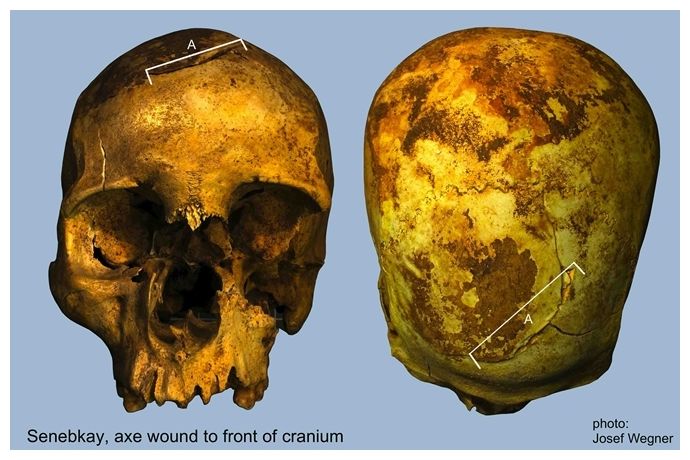
Senebkav Skull
© Josef WegnerAxe wounds to the front and back of the skull.
Pharaoh Senebkay, one of the earliest kings of a forgotten Abydos Dynasty, was brutally killed in battle more than 3,600 years ago, says a study that has reconstructed, blow by blow, the king's last moments.

The research identified 18 wounds on the pharaoh's bones. It also established that Senebkay is the earliest Egyptian pharaoh to have died in battle.

Woseribre Senebkay was unknown to history until last year, when a University of Pennsylvania expedition led by archaeologist Josef Wegner, working with Egypt's Supreme Council of Antiquities, found his remains in a four-chambered tomb at South Abydos in Sohag province, about 300 miles south of Cairo.

Texts in the burial, which dates to about 1650 B.C., during Egypt's Second Intermediate Period, identified the pharaoh as the "king of Upper and Lower Egypt, Woseribre, the son of Re, Senebkay."

Although ancient robbers had ripped apart the pharaoh's mummy, researchers led by Wegner, associate director of Egyptian archaeology at the University of Pennsylvania, were able to recover and reassemble his skeleton.

The team has now completed a full forensic analysis of the remains.

Target

Best of the Web: The Weight of Chains: US/NATO Destruction of Yugoslavia (Documentary)

weight of chains
Boris Malagurski's award-winning Canadian film "The Weight of Chains", dealing with the breakup of Yugoslavia from a different angle. If you thought you knew why Yugoslavia broke up, get ready for 2 hours of shocking facts that will shed a different light on Western intervention in the Balkans. Malagurski exposes the root causes of the Yugoslav wars and explains that the goal for the West to create economic and geopolitical colonies in that part of the world.

"The Weight Of Chains" presents a Canadian perspective on Western involvement in the division of the ethnic groups within Yugoslavia and show that the war was forced from outside - regular people wanted peace. However, extreme fractions on all sides, fuelled by their foreign mentors, outvoiced the moderates and even ten years after the last conflict - the hatred remains and people continue spreading myths of what really happened in the 1990s. Why did all this happen?


Comment: See also: The Rational Destruction of Yugoslavia by the Empire of Chaos


Eagle

How politicians, the media, and scholars lied about Milosevic's 1989 Kosovo speech

Image
A couple of months ago I chanced upon the Emperor's Clothes Website.

I noticed their startling claim that we have been systematically lied to about Yugoslavia, including Slobodan Milosevic. As they told it, he was not guilty of racist incitement and genocide; rather he advocated multiethnic peace. Since their views sharply contradicted my own, I started systematically checking their references by obtaining the relevant original documents. I have yet to find a single claim in error.

This was particularly surprising regarding the famous speech that Slobodan Milosevic delivered at Kosovo Field in 1989 at the 600th anniversary of the Battle of Kosovo. According to what I had read, this was an ultranationalist diatribe in which Milosevic manipulated memories of a famous defeat to stir mob hatred of Muslims, especially Albanians.

Emperor's Clothes posted what they claimed was the official U.S. government translation of that speech, which they attributed to the National Technical Information Service, a dependency of the Commerce Department.

The posted speech was certainly not hateful.

Comment: Will they ever get Putin to a showtrial then suicide him? It's unlikely, but no doubt they would love to.


Vader

NATO's full-spectrum war against Yugoslavia: Demonization of Serbs was key

Image
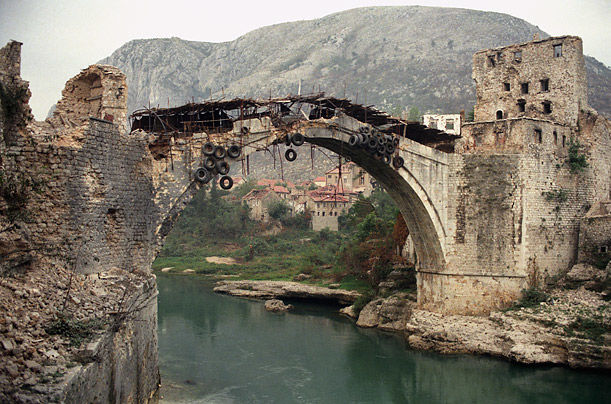
Mostar, a city destroyed by NATO's war against Yugoslavia
Many well-qualified observers of the Bosnia wars were appalled at the biased reporting and gullibility of mainstream journalists.

The successful demonization of the Serbs, making them largely responsible for the Yugoslav wars, and as unique and genocidal killers, was one of the great propaganda triumphs of our era. It was done so quickly, with such uniformity and uncritical zeal in the mainstream Western media, that disinformation had (and still has, after almost two decades) a field day.

The demonization flowed from the gullibility of Western interests and media (and intellectuals). With Yugoslavia no longer useful as an ally after the fall of the Soviet Union, and actually an obstacle as an independent state with a still social democratic bent, the NATO powers aimed at its dismantlement, and they actively supported the secession of Slovenia, Croatia, the Bosnian Muslims, and the Kosovo Albanians. That these were driven away by Serb actions and threats is untrue: they had their own nationalistic and economic motives for exit, stronger than those of the Serbs.

Milosevic's famous speeches of 1987 and 1989 weren't nationalistic — despite the lies to the contrary, both speeches called for tolerance of all "nations" within Yugoslavia. He also never sought a "Greater Serbia," but rather tried to maintain a unified Yugoslavia, and when this failed — with the active assistance of the NATO powers — he tried, only fitfully, to allow stranded Serb minorities to stay within Yugoslavia or join Serbia, a matter of obvious "self-determination" that NATO granted to Kosovo Albanians and everybody but Serbs (for documentation on these points, see this Monthly Review article I co-authored with David Peterson in October, 2007).

Attention

Forced socialization: The story of St. Michael's Residential School through the eyes and voice of a survivor - Demolished but not forgotten

Image
On Wednesday, Feb. 18 The Tyee's Katie Hyslop reported on the demolition of St. Michael's Indian Residential School in Alert Bay, British Columbia. A day-long ceremony honoured St. Michael's survivors with prayer, speeches and song.

Target

Truth and lies about the break-up of Yugoslavia: Forget Milosevic, this was a US operation from start to finish

clintons bosnia
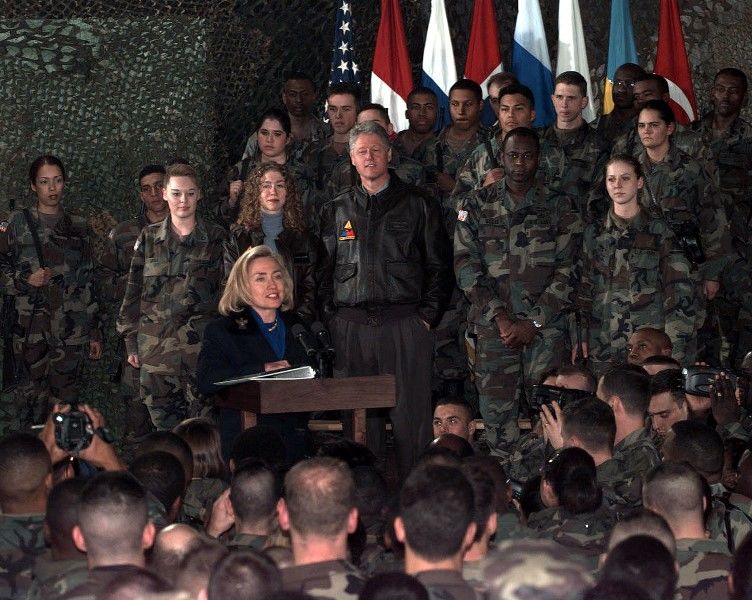
© US Army Staff Sgt. Johancharles V. BoersThen First Lady Hillary Rodham Clinton visiting US Army 'Eagle Base', Tuzla, Bosnia and Herzegovina, December 22, 1997.
It becomes a little less difficult to determine whether we have been informed correctly about Yugoslavia. Did they have a right to present the Nato war as "humanitarian"? Did the Great Powers have secret strategies? Were there media lies told and war propaganda spread?

We recommend that you take this brief Media test in order to have a clear view, and to test how your media is going to inform you in current and coming wars.

Media Quiz

How good is our information on the destruction of Yugoslavia?

1 Did the war begin in 1991 with the secessions of Slovenia and Croatia?
O Yes O No O Don't know

2 Did Germany deliberately provoke the civil war?
O Yes O No O Don't know

3 Did the US really remain 'passive and disinterested' during this war?
O Yes O No O Don't know

4 Did the World Bank and the IMF help destroying this country?
O Yes O No O Don't know

Flashlight

Ancient shrines discovered in Armenia likely used for divination

shrine Gegharot Armenia
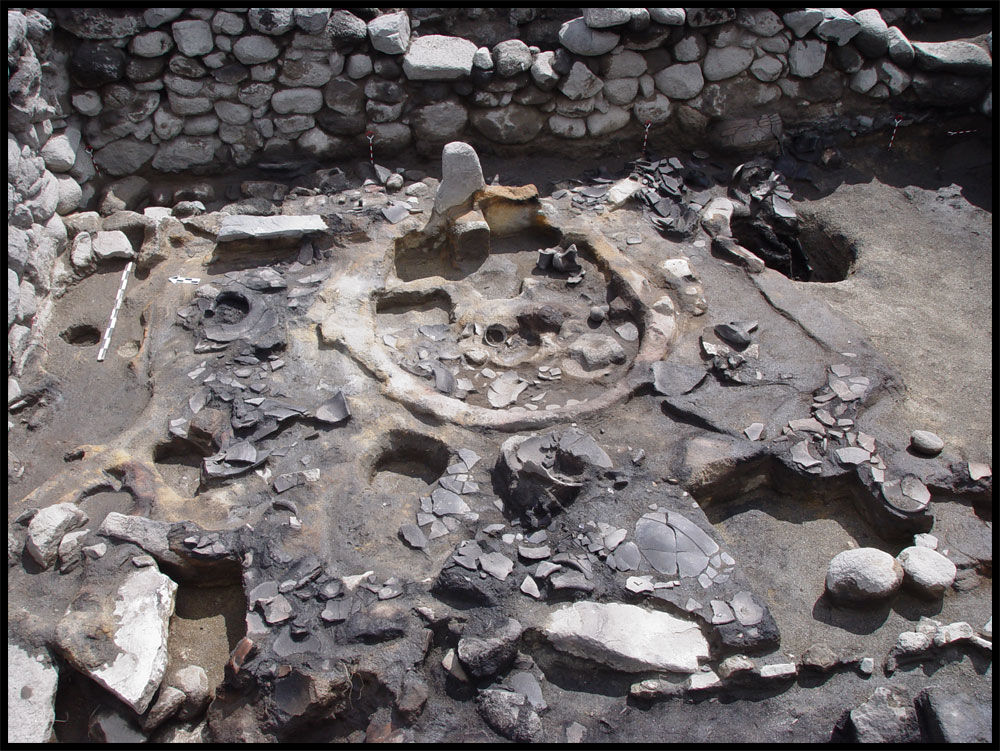
© Professor Adam SmithA shrine excavated at the entrance of a fortress' west terrace in Gegharot in Armenia. The stone stele like would've been a focal point for rituals practiced there some 3,300 years ago.
Three shrines, dating back about 3,300 years, have been discovered within a hilltop fortress at Gegharot, in Armenia.

Local rulers at the time likely used the shrines for divination, a practice aimed at predicting the future, the archaeologists involved in the discovery say.

Each of the three shrines consists of a single room holding a clay basin filled with ash and ceramic vessels. A wide variety of artifacts were discovered including clay idols with horns, stamp seals, censers used to burn substances and a vast amount of animal bones with markings on them. During divination practices, the rulers and diviners may have burnt some form of substances and drank wine, allowing them to experience "altered" states of mind, the archaeologists say.

Info

Neanderthal teeth suggest sexual division of labor

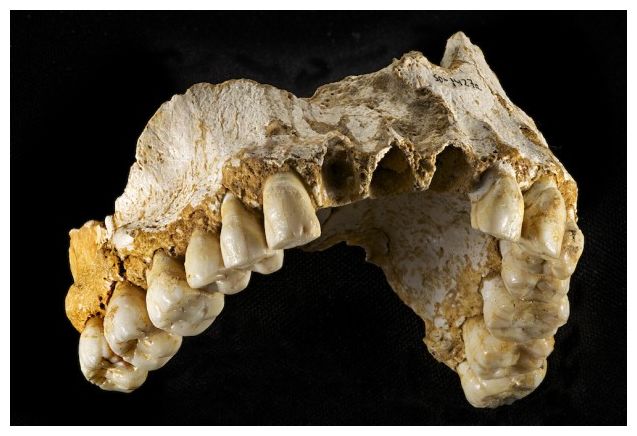
Neanderthal jaw bone
© Joan Costa/Spanish National Research Council (CSIC)Neanderthal jaw bone.
A new study examining Neanderthal teeth from Western Europe suggests that there was a division of labor between males and females. The study was conducted by members of the Department of Paleobiology at the Spanish Museo Nacional de Ciencias Naturales and published online this month in the Journal of Human Evolution.

Although Neanderthals were once thought to be less intelligent, adaptable, and creative than modern humans, recent studies have significantly changed the understanding of our Ice Age cousins. We now know that Neanderthals had the capability for complex speech, controlled fire, created a variety of sophisticated bone and stone tools, wore clothing, decorated their bodies with shells and pigment, and may have created art. In addition, they were culturally and physically similar enough to the first modern humans in Europe that the two groups exchanged genetic material on multiple occasions beginning around 50,000 - 60,0000 years ago.

Info

Embracing Stone Age couple found in Greek cave

Ancient Tomb
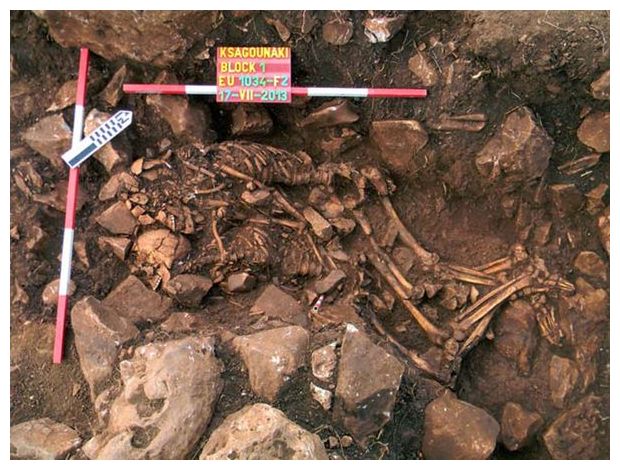
© Photograph courtesy Greek Minstry of Culture, Education and Religious AffairsA man appears to hold a woman in a double burial that took place about 5,800 years ago at Alepotrypa Cave, the site of ancient funerary rites.
Strange and surprising findings have been reported from ongoing excavations at Alepotrypa Cave, a site in the Peloponnesus that one archaeologist called "a Neolithic Pompeii," the Greek Ministry of Culture, Education, and Religious Affairs announced.

The most striking discovery was a burial from roughly 5,800 years ago containing two well-preserved adult human skeletons, one male and one female, with arms and legs interlocked in an embrace.

Archaeologists also found bones from two other Neolithic double burials, as well as a roughly 3,300-year-old Mycenaean ossuary holding bone fragments from dozens of individuals and numerous expensive grave goods, including a bronze dagger, agate beads, and ivory likely sourced from Lebanon.

"Like most things in Greece, it's complicated," said Bill Parkinson, associate curator of Eurasian anthropology at Chicago's Field Museum and one of the archaeologists working at the site.

The Alepotrypa—or "foxhole"—Cave represents one of the largest Neolithic burial sites known in all of Europe. Its enormous interior chambers reach more than half a kilometer into a mountain above Diros Bay, and burials in the cave span the entire Neolithic period in Greece, from 6000 to 3200 B.C. There are bones from at least 170 individuals inside the cave.

SOTT Logo

Dr Pauli Murray: black, queer, feminist, erased from history

Image
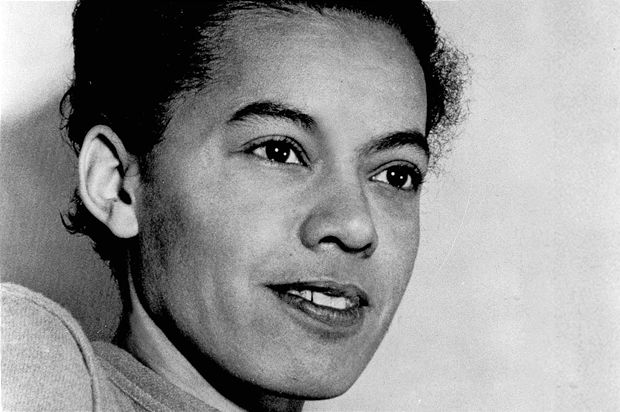
© APDr. Pauli Murray
Ruth Bader Ginsburg has emerged as the liberal hero of a hopelessly right-wing Supreme Court, a ram in the bush for those of us who look on in horror as the court presides over the dismantling of key pieces of legislation like the Voting Rights Act, anti-discrimination law and affirmative action policy, which have been so critical to African-American advancement since the 1960s.

In a recent interview at Georgetown University, Ginsburg reflected on the history behind one of her key legal accomplishments, the 1971 case of Reed v. Reed. After an estranged couple lost their son, his mother, Sally Reed, petitioned to administer his estate. But Idaho law maintained that "males must be preferred to females," in such matters. Ginsburg authored the plaintiff's brief for the case when it reached the Supreme Court, arguing that the 14th amendment protected against discrimination based upon sex. When the court ruled in Sally Reed's favor, it was the first time that the Equal Protection Clause had been applied to a case of sex discrimination.

But much of the legal groundwork for that argument can be attributed to Dr. Pauli Murray, a Howard University-trained lawyer, who began to argue in the 1960s, that the Equal Protection Clause should be applied to cases of sex discrimination in much the same way that it had been applied to cases of racial discrimination. Murray's argument constituted what legal historian Serena Mayeri termed "reasoning from race," in which race analogies were used to make clear the subordinate status of women. Though today we speak of these matters in the language of intersections, a term gleaned from legal scholar Kimberlé Crenshaw, it is Pauli Murray's initial invocation of the race-sex analogy for black women's positionality within the law that is the most direct precursor to Crenshaw's theory of intersectionality.