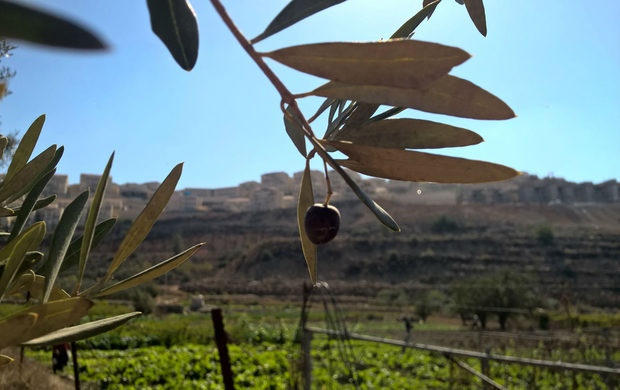
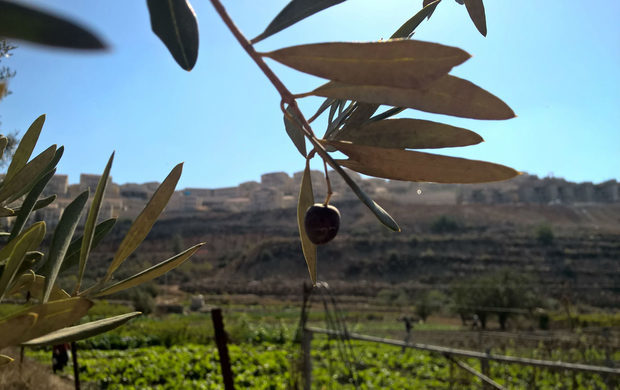
© Middle East Eye/Chloé BenoistThe illegal Israeli settlement of Beitar Illit overlooks the olive groves of Wadi Fuqin
As the Manasra family picked olives from one of its fields in early November, marking the tail end of the harvesting season, the low rumbling of construction equipment in the nearby illegal Israeli settlement of Beitar Illit served as a reminder of the uncertainty ruling the small Palestinian community's existence.
Squeezed between the settlements of Beitar Illit and Tzur Hadassah, and directly adjacent to the Green Line demarcating the border between the occupied West Bank and Israel, Wadi Fuqin has fought since the establishment of the state of Israel to preserve its livelihood and presence on the village's lands, which once were renowned as the "food basket" of the Bethlehem area.
"We are surrounded by all these settlements, and we are stuck in the middle with only one road out," Nadia Manasra, a matriarch of the family, told Middle East Eye.
"It feels like a prison.""None of my human rights are applied, most of the lands down in the valley are confiscated or under threat of confiscation, and we don't know what our fate will be here," Mohammad Moussa Manasra, Nadia's husband, told MEE.
"But in spite of everything, we try to adapt to our situation."

















Comment: See also: