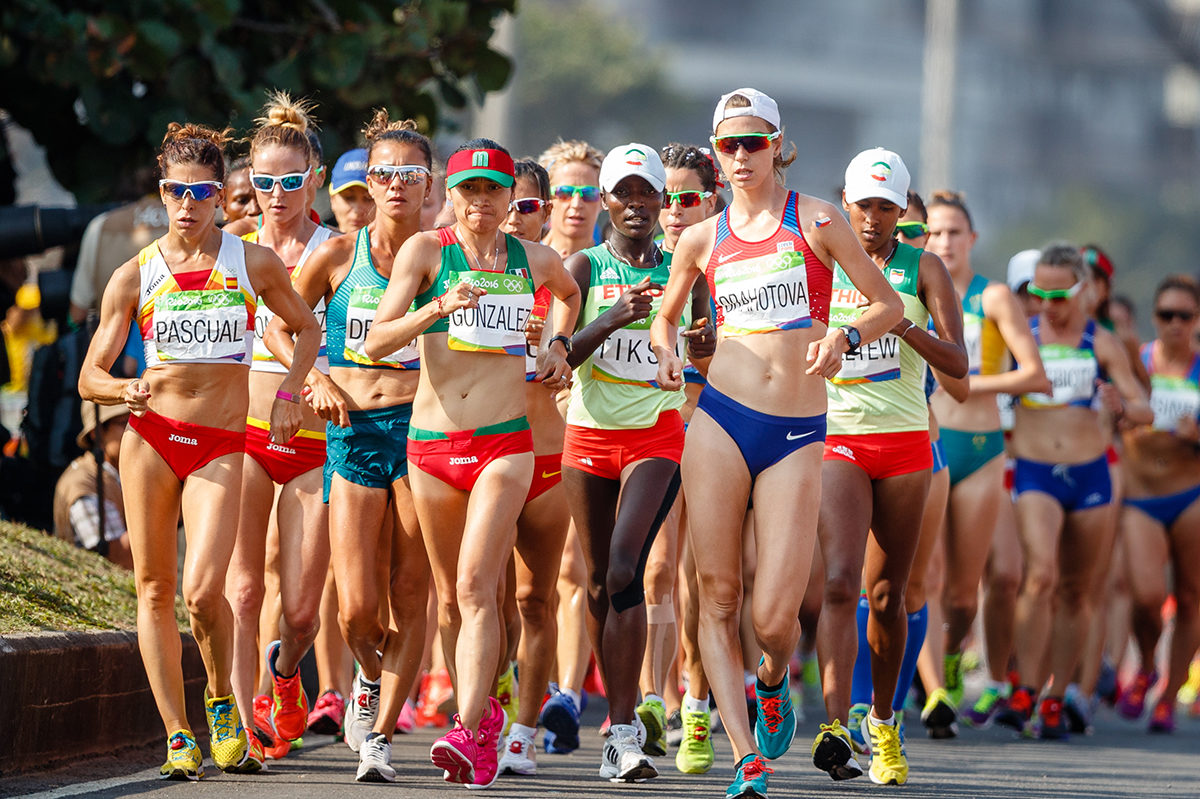
© Petr Toman / Shutterstock.
Sport often presents us with striking visual examples of how certain aspects of society play out. Whether it be nationalism, leadership, teamwork, competitiveness, or the ability of humans to achieve truly great acts, sport is an embodiment of how these factors interact and display themselves on a world stage.
Sport also offers some of the most obvious visual representations of inherent biological sex differences between men and women. Unfortunately, although perhaps not surprisingly, the current desire for equality and inclusion, and the general misunderstandings about biological sex as an evolutionary process has resulted in questions and confusion around the traditional use of sex categories in sport. In some ways this also highlights the difficulties that may be apparent with the erosion of sex categories in other areas of life, such as regarding prisons, changing areas and the issues of equal pay.
As a performance scientist and someone who has worked in elite sport for over a decade, I am interested in the determinants of physical performance and how to manipulate and enhance these variables. Over my years working with athletes, I have become accustomed to observing the differences between the sexes and have extensively studied why these differences exist.
It has therefore been baffling to me to see some of the discussions regarding why sex categories in sport exist and how to include trans-athletes. What we must understand is that there is currently a general lack of understanding regarding the potential consequences on elite sport due to ill-informed policy making and the pressures of activist groups. I will therefore attempt to bring some clarity to the topic and also ask some important questions for future consideration.
Let us first briefly look at what sport is. Sport is a multi-billion dollar industry, with intense competition, professionalism and outstanding feats of natural ability. Athletes, coaches and owners do everything they can to get an advantage over their competition and be successful. For many, the pure competition of sport is enough, regardless of earnings and sponsorship. For others it is their career, their life, their dreams. Yet for some it is a mere past-time, a leisure activity and a way to keep fit. None of these are inherently more important than the other, but recent debate over trans inclusion in sport means that we must appreciate what these things mean to the people involved and what is at stake if we get policies wrong.















Comment: Walmart of course presents this as progress