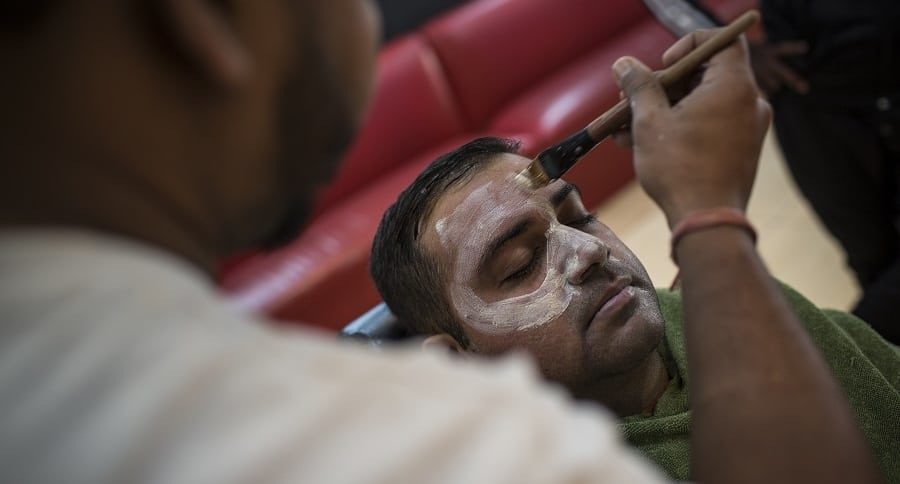
© Gulshan Khan/Getty ImagesSkin whitening - Salons like this one in Johannesburg, South Africa, offer facials that make use of skin lightening products.
A 22-year-old call center agent from the Philippines, J.R.,
* tells me that he takes whitening capsules and uses a soap and facial cream that both claim to have whitening effects. Being lighter, he says, will make him more "noticeable," boosting his chances for promotion or better employment. When I point out that the US$1 a day he spends on the whitening products makes up a large chunk of the US$12 he earns daily, he replies: "It's an investment."
J.R. is part of the growing market for skin whitening products around the world. Shopping malls, cosmetics shops, and online retailers sell a vast number of different soaps, lotions, creams, and more, catering to women and men. Some of them target particular body parts: the face, the hands, the underarm, or
even the vagina.
From Manila to Mumbai and Jakarta to Johannesburg, celebrities endorse skin lightening or bleaching products in larger-than-life billboards, promising "
whiter skin from within" or offering to make users "
fair and handsome." In the Philippines, where I live and work as a medical anthropologist, even the
national basketball league has an official skin whitening product.
This trend isn't harmless. People who are already socially or financially marginalized may end up spending significant amounts of money on products they can ill afford.
The whole notion of desiring paler skin relies upon and emphasizes toxic ideas of white superiority. And many skin whiteners are associated with proven skin damage or other health risks. Inorganic mercury, for example,
described by the World Health Organization as a "common ingredient found in skin lightening soaps and creams" often used in Africa and Asia, can cause kidney damage. Hydroquinone, found in skin exfoliants, including J.R.'s facial lotion, has been
flagged by regulatory agencies around the world due to safety concerns.
Some countries, such as Ghana and Rwanda, have
banned skin whitening products altogether. Yet whitening remains popular-and is big business. According to
industry estimates, the global skin whitening industry is expected to reach US$31.2 billion by 2024.
As both a physician and a medical anthropologist, I recently dove into this issue as part of the
Chemical Youth Project: a multi-country study that looks at the roles of chemicals (from energy drinks to perfumes and vitamins) in the everyday lives of young people seeking to "boost pleasure, moods, sexual performance, appearance, and health." From 2012 to 2015, our team, led by medical anthropologist Anita Hardon of the University of Amsterdam, interviewed over 400 young men and women in different parts of the Philippines-including students, young professionals, tour guides, pedicab drivers, and construction workers. Whitening products were very popular among our informants, with more than half reporting that they had used them at least once in their life. I decided to explore the topic more, carrying out 10 focus group discussions specifically about whitening. Where does the desire to whiten skin come from, I wanted to know, and is it changing?














Comment: Under Macron's reign the authorities have no problem in maiming protesters so whether they decide to pursue the clergy will be more of a tactical than a moral consideration:
- Eye injuries epidemic at Yellow Vest protests: French ophthalmologists demand Macron ban rubber bullets
- "Obstinate, deaf and contemptuous": Macron failed 'personally' in EU election - Official
- Thierry Meyssan: Who owns Macron?
- Salvini backs Yellow Vest protests, lashes out at Macron as a 'president against his people'
Also check out SOTT radio's: NewsReal #26: Globalization vs Nationalism - The Hidden Causes of The Yellow Vest Protests in France