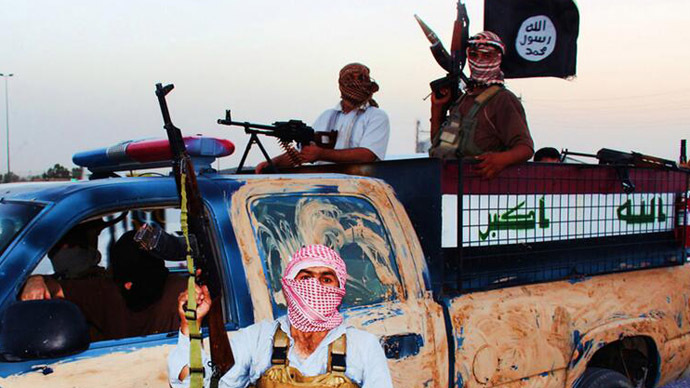
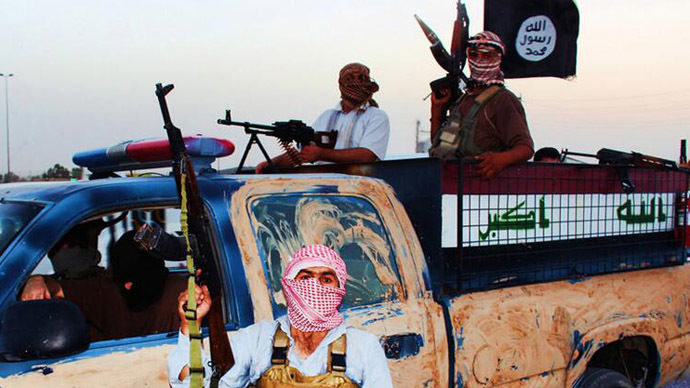
© AFP PhotoMilitants of the Islamic State of Iraq and the Levant (ISIL) riding in a captured vehicle left behind by Iraqi security forces at an unknown location in the Salaheddin province.
Secretary of State John Kerry finished his weekend tour of the Middle East, arriving in Paris to participate in an international conference on Iraq's security. The primary destination of the head of the U.S. Department of State was Saudi Arabia, where he met in Jeddah with representatives of the Arab countries (members of the Gulf Cooperation Council, Egypt and Jordan) and Turkey, to persuade them to join the coalition established by the United States to fight "Islamic State," while,
in reality, to restore the "anti-Syrian alliance" comprised of NATO and conservative Arab regimes.Naturally, the key participant in the talks was Saudi Arabia, as the current spiritual leader of the Sunni world and the richest country in the region, prepared to finance plans for the overthrow of the regime of Bashar al-Assad.
On the agenda was the issue of ending supplies to ISIL from Turkey and Jordan, as well as the prevention of financial support reaching the terrorists from abroad. The United States would also like to see Arab governments use their media for outreach. First and foremost, this would be popular TV networks "Al-Jazeera" and "Al-Arabiya," financed by Qatar and the Kingdom of Saudi Arabia, respectively.
Before flying to Saudi Arabia, Kerry visited Baghdad and Amman. Jordan's King Abdullah II said at the end of the visit by the Secretary of State that he is ready to join the coalition, while stressing that "
but the main problem of the Middle East is Israeli occupation of Palestinian land."
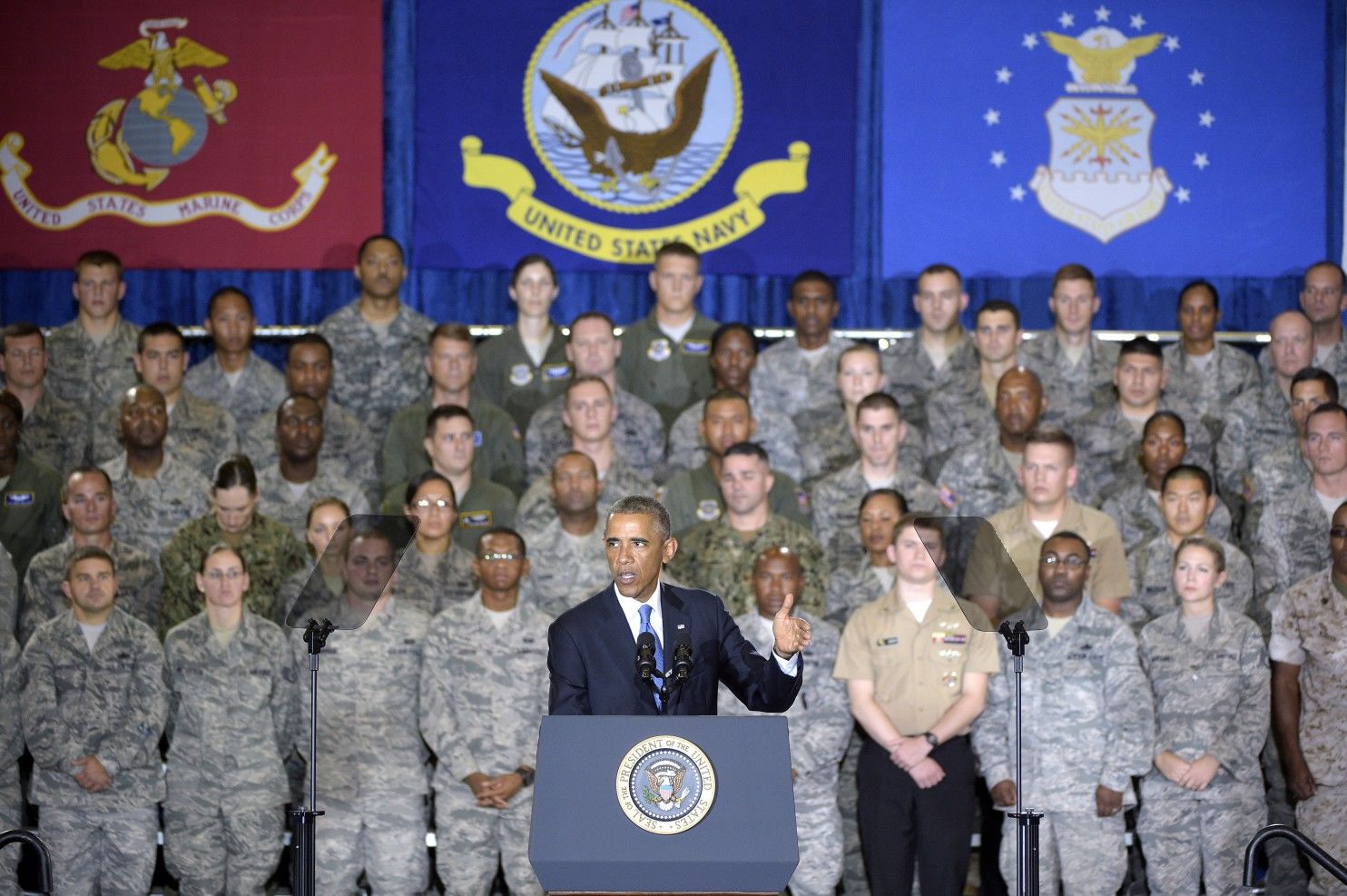
Kerry's talks took place shortly after President Obama's declaration of his intent to "weaken and destroy" IS in both Iraq and Syria. A senior State Department official involved in the negotiations noted that the meetings are being hosted by the Saudis. According to this official, this is significant not only because of the size and economic influence of Saudi Arabia, "but also because of its religious significance for Sunnis." Overcoming the differences between Sunnis and Shiites in the region and in Iraq is an crucial part of improving the effectiveness of the coalition, as the majority of the fighters of "Islamic State" are Sunnis, and the new government in Baghdad Shiite-led, supported by Iran.
As later became clear, John Kerry pushed on participants in the Jeddah meeting the idea that the
coalition might require enhanced presence of military bases in the region and overflight rights for military aircraft carrying out strikes against "Islamic State." The Secretary also called for increased efforts to combat funding of extremist groups by individuals and private Islamic charities, since financial supervision in Kuwait and Qatar is extremely weak. Kerry put special emphasis on ending oil smuggling by "Islamic State" across the Jordanian and Turkish borders. Here, however, certain complexities arise, since IS sells oil and gas products from oil fields and refining facilities in controlled areas to companies owned by the two countries at almost 50% of the world price, allowing Jordanians and Turks to do pretty good business, and IG to earn at least three million. dollars per day. Therefore, as we learned, Washington will carry out "more focused work" with these countries over the next few weeks.











Comment: If it happens, the EU members have only themselves to blame, they've sided with the US bullies who couldn't care less about Europe but are only using it as a playing field to encircle Russia. If we get an extremely harsh winter this year, it could help the EU members realize their mistake.
See also: Russia out of the sanctions game, will pursue its own interests