OF THE
TIMES

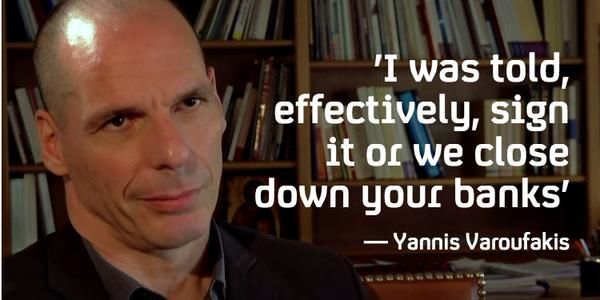
"My father made him an offer he couldn't refuse. Luca Brasi held a gun to his head and my father assured him that either his brains, or his signature, would be on the contract." โ The Godfather (1972)In the modern global banking system, all banks need a credit line with the central bank in order to be part of the payments system. Choking off that credit line was a form of blackmail the Greek government couldn't refuse.
The fact that these things were taken into consideration doesn't mean Syriza was planning a coup . . . . If you want a coup, look instead at the Troika having wrestled control over Greek domestic finances. That's a coup if you ever saw one.So how was that coup pulled off? The answer seems to be through extortion. The European Central Bank threatened to turn off the liquidity that all banks - even solvent ones - need to maintain their day-to-day accounting balances. That threat was made good in the run-up to the Greek referendum, when the ECB did turn off the liquidity tap and Greek banks had to close their doors. Businesses were left without supplies and pensioners without food. How was that apparently criminal act justified? Here is the rather tortured reasoning of ECB President Mario Draghi at a press conference on July 16:
Let's have an independent commission look into how on earth it is possible that a cabal of unelected movers and shakers gets full control over the entire financial structure of a democratically elected eurozone member government. By all means, let's see the legal arguments for this.
There is an article in the [Maastricht] Treaty that says that basically the ECB has the responsibility to promote the smooth functioning of the payment system. But this has to do with . . . the distribution of notes, coins. So not with the provision of liquidity, which actually is regulated by a different provision, in Article 18.1 in the ECB Statute: "In order to achieve the objectives of the ESCB [European System of Central Banks], the ECB and the national central banks may conduct credit operations with credit institutions and other market participants, with lending based on adequate collateral." This is the Treaty provision. But our operations were not monetary policy operations, but ELA [Emergency Liquidity Assistance] operations, and so they are regulated by a separate agreement, which makes explicit reference to the necessity to have sufficient collateral. So, all in all, liquidity provision has never been unconditional and unlimited. [Emphasis added.]In a July 23rd post on Naked Capitalism, Nathan Tankus calls this "a truly shocking statement." Why? Because all banks rely on their central banks to settle payments with other banks. "If the smooth functioning of the payments system is defined as the ability of depository institutions to clear payments," says Tankus, "the central bank must ensure that settlement balances are available at some price."

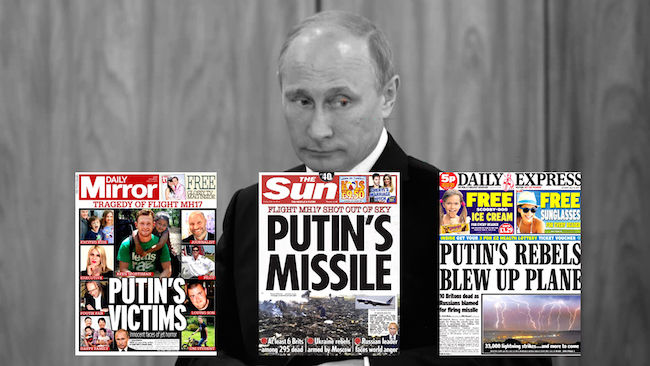
"3. Supports efforts to establish a full, thorough and independent international investigation into the incident in accordance with international civil aviation guidelines" andHowever more than a year after the tragedy the investigation has been far from "thorough" and not in full "accordance with international aviation guidelines".
"11. Demands that those responsible for this incident be held to account and that all States cooperate fully with efforts to establish accountability".
"I am pretty sure that the airliner was destroyed from within and that it was a special operation".In the interview, Sokolov details what he says are the cock pit voice recordings between the pilot of an Su-27 combat aircraft and a flight control officer.
Comment: Russia acts to stop activities of subversive National Endowment for Democracy