Puppet MastersS


Better Earth

West Overplayed Its Hand, Now Things Are Going Moscow's Way

putin
Not along ago the American journalistic, academic and think tank elite were asserting in unison as usual that Russia was at best a regional power isolated globally as a result of its 'invasion' of Ukraine and resulting Western sanctions. I suggested Russia is both a regional and global power and was never isolated with the onset of the Ukraine crisis (see Gordon M. Hahn, "REPORT: Putin's Asia-Eurasia Pivot: 'Isolation' from the West Spurs Eurasian Integration and Russian Globalization," Gordonhahn.com Russian and Eurasian Politics, 31 July 2015). As things have turned out, in reality the West overplayed its weakening hand and allowed Russian President Vladimir Putin to consolidate foreign policy gains outside the West and make inroads inside it as well. Although not all of Russia's wins are of its own making, there can be no doubt that things are going Moscow's way.

In Russia's main security zone and immediate sphere of influence - central Eurasia or the 'former Soviet space' - Russian continues to strengthen the Eurasian Economic Union (EEU) in what can be termed its 'Eurasian-Asian pivot.' Post-Ukraine Moscow won agreement from Armenia and Kyrgyzstan to join the EEU. Armenia even abandoned an EU association agreement it had been working on for years and officially acceded to the EEU in January 2015. Kyrgyzstan did so in August the same year. These additions brought the membership to five states, including also Belarus, Kazakhstan, and Russia. Tajikistan is currently reviewing whether it will seek membership. In May 2015 Vietnam became the first country to sign a free trade zone (FTZ) agreement with the EEU. At the EEU summit in July 2015 Russian presidential aide for foreign policy Yuri Ushakov announced that India and the EEU had agreed to create a working group for exploring an India-EEU FTZ. A recent Kazakhstani report indicates that more than 30 countries - including Zimbabwe, Jordan, Mongolia and Albania - have applied to the Eurasian Economic Commission for a EEU FTZ relationship.

Stock Down

Trump election the beginning of the end for the radical liberal ideology

obama cameron
Western Liberalism is in crisis. Originally conceived as a moderate and tolerant ideology is now caving in on itself. Instead of promoting a set of ideas that are inclusive and open-minded, Liberalism today is unwilling and unable to accept any other worldviews. Essentially it has become a form of political extremism mirroring Islam's jihadist fanatics found in the Middle East and beyond. In fact, both provide the ideological oxygen each needs to survive.

Liberalism is suffering the same fate of other modern Western ideologies, namely Socialism and various forms of Nationalism. Each presented themselves as competing alternatives to the status quo, i.e. the establishment of the time. Each initially aspired to be inclusive. Once each achieved a degree of political traction and legitimacy, elements within each sought to monopolize politics and power. This result was the totalitarian temptation.

In some cases Socialism, the outcome of modern capitalism and the rise of the industrial working class, eventually morphed into Bolshevik terror and dictatorship in Russia, and duplicated around the world. Other strains of Socialism, particularly in the West, lost most of its ideological vigor and largely attempted to imitate Liberalism in every way except in name. The most radical forms of Socialism (Soviet-styled communism) collapsed due to its own internal contradictions and inefficiencies, as well as intolerance to other worldviews.

Eye 1

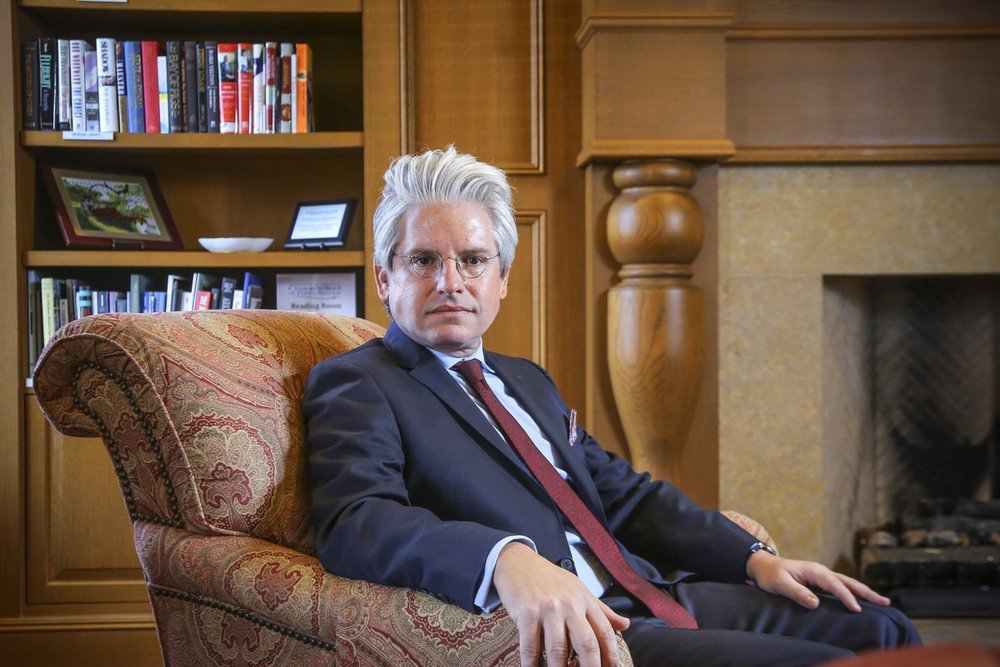
David Brock's Clinton propaganda machine, Media Matters, trying to stay relevant in a post-Hillary world - by going after 'fake news' online

david brock
© STEPHEN B THORNTON/The New York Times/ReduxShill.
On December 6, exactly four weeks after Hillary Clinton lost the presidential election, Media Matters for America, a nonprofit organization dedicated to combating conservative misinformation in media, announced it would be undergoing a makeover. In its twelve-year history, Media Matters's main antagonist had been Fox News—a worthy, if unsurprising target for an organization devoted to conservative bias. But after surveying the media landscape in the aftermath of Clinton's surprising defeat, Media Matters decided that it would focus on exposing falsehoods circulated online. "It used to be simple, Fox News was the gatekeeper ... but now there are so many potential bad actors," Angelo Carusone, who was made president of Media Matters at the time of the announcement, told Politico. "Now there are places like Facebook who aren't bad actors but can be enablers of misinformation."

It would seem to be a logical next step for the media watchdog. In an interview, Carusone told the New Republic that Media Matters was already pivoting in this direction. But in a subtle way, the shift was actually a significant reinvention. The organization had long ceased to be a mere watchdog, having positioned itself at the center of a group of public relations and advocacy outfits whose mission was to help put Clinton in the White House. Seen in this light, the shift to focusing on the country's much-discussed fake news problem, which allegedly facilitated Donald Trump's victory, is a way of keeping in business after Media Matters and its founder David Brock had little to show for years of being Clinton's first line of defense. In fact, this wasn't even the first time Media Matters had declared it was going to stop focusing on Fox News.

Comment: Scam? David Brock's super PAC may have made $1 million in fraudulent rent payments to a non-existent company


MIB

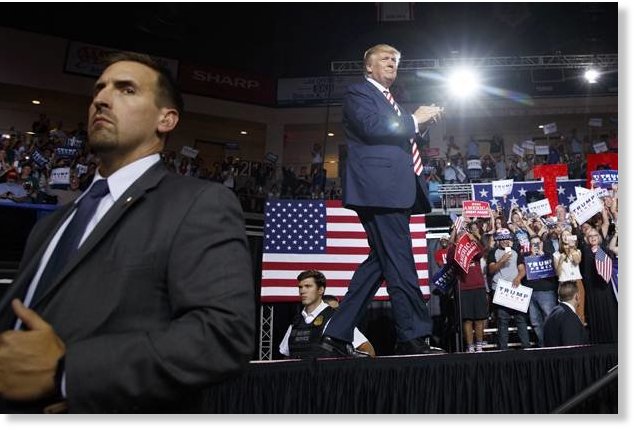
Smart Move: Trump's decision to maintain private security force another break from tradition

trump security team
© AP/ Evan Vucci
President-elect Donald Trump has continued employing a private security and intelligence team at his victory rallies, and he is expected to keep at least some members of the team after he becomes president, according to people familiar with the plans.

The arrangement represents a major break from tradition. All modern presidents and presidents-elect have entrusted their personal security entirely to the Secret Service, and their event security mostly to local law enforcement, according to presidential security experts and Secret Service sources.

But Trump — who puts a premium on loyalty and has demonstrated great interest in having forceful security at his events — has opted to maintain an aggressive and unprecedented private security force, led by Keith Schiller, a retired New York City cop and Navy veteran who started working for Trump in 1999 as a part-time bodyguard, eventually rising to become his head of security.

Security officials warn that employing private security personnel heightens risks for the president-elect and his team, as well as for protesters, dozens of whom have alleged racial profiling, undue force or aggression at the hands of Trump's security, with at least 10 joining a trio of lawsuits now pending against Trump, his campaign or its security.

Comment: Perhaps the reason Trump is breaking from tradition is that, like his Cabinet appointments, he chooses to surround himself with people he has known previously and trusts. The fact that he is going against the Establishment could also be a factor, as Trump is probably aware of the forces he is going against and doesn't want any "fifth column" interlopers to have inside access to his Administration. Also, in case the Elites decide to attempt a coup by assassinating him, having his own private security team of people he trusts will definitely make that more difficult.


Eye 1

President Putin orders Russia's spy chiefs to track down ambassador's murderers: "This crime is undeniably a provocation"

Putin
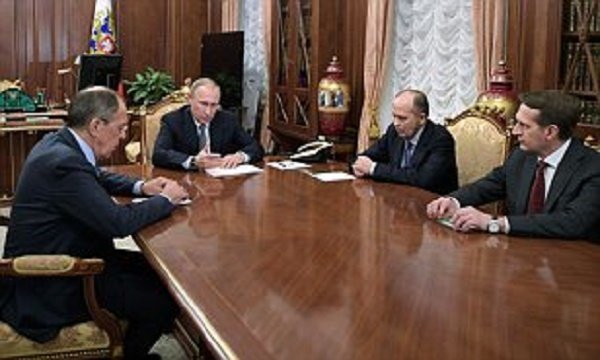
Vladimir Putin confers with his intelligence and security chiefs in order to track down anyone responsible for ordering the murder of the Russian ambassador to Turkey.

In the hours following news of the murder of the Russian ambassador to Turkey, Russian President Vladimir Putin convened an urgent meeting of his top foreign policy and intelligence advisers.

The meeting took place yesterday Monday 19th December 2016 in the Kremlin, and brought together President Putin, Russian Foreign Minister Lavrov, Sergey Naryshkin, who is the head of Russia's principal intelligence agency, the SVR ("Foreign Intelligence Service") and Alexander Bortnikov, who is the head of Russia's principal counter-intelligence and security agency, the FSB ("Federal Security Service").

Comment: See also: Russian ambassador in Ankara shot dead in gun attack (Updates)


Snakes in Suits

Tired old rhetoric: US extends sanctions against Russia over Ukraine

White House
© Uwe Kazmaier / Global Look Press
Seven Russian individuals, eight entities and two vessels have been added to the US sanctions over the conflict in Ukraine, the US Treasury Department said in a statement.

The Treasury also named 26 subsidiaries of Russian Agricultural Bank and gas producer Novatek, both of which had already been sanctioned in 2014.

The American sanctions on those firms are relatively narrow, prohibiting the US citizens from dealing in certain kinds of debt with the companies, Reuters reported.

Comment: More on why the Kremlin caterer Prigozhin is listed: U.S. Adds More Russians To Sanctions List, Including 'Putin's Chef'
Yevgeny Prigozhin
Yevgeny Prigozhin
The United States has levied new sanctions against more Russians for Moscow's actions in Ukraine, hitting well-connected insiders, including the man known as Russian President Vladimir Putin's chef.

The names added to the Specially Designated Nationals List include Yevgeny Prigozhin, a St. Petersburg businessman whose company has provided catering to the Kremlin.

Prigozhin has also been linked to a notorious "troll factory" that paid Russians to post anonymous comments to news sites, social media networks, and blogs in an effort to bolster Kremlin policies and undermine anti-Russian sentiment.


Document

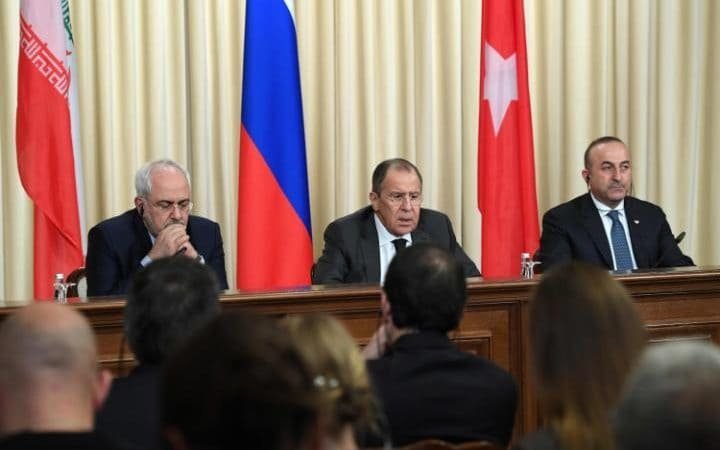
Russia, Turkey, Iran Triumvirate ready to resolve Syrian crisis, act as guarantors for negotiations

lavrov cavusoglu
A text of the Moscow declaration on immediate steps in resolving the Syrian crisis is being prepared. Moscow, Ankara and Tehran are ready to be guarantors of its implementation, Russian Defense Minister Sergey Shoigu said.

"Today experts are working on the text of the Moscow declaration on immediate steps toward resolving the Syrian crisis. This is a thorough, extremely necessary document," Shoigu said at the meeting with his Iranian counterpart Hossein Dehghan.

According to Shoigu, all previous "attempts to agree on joint efforts undertaken by the US or their partners were doomed."

"None of them exerted real influence on the situation on the ground," he said.

The approval of the declaration at the level of defense and foreign ministers shows a willingness to "act as guarantors and jointly resolve the urgent issues of the Syrian crisis," Shoigu said.

"That's why we support the adoption of this declaration," he added.

Comment: Here's the text of their joint statement:
The Ministers of Foreign Affairs of the Islamic Republic of Iran, the Russian Federation and the Republic of Turkey, meeting in Moscow on 20 December 2016, agreed on the following.

1. Iran, Russia and Turkey reiterate their full respect for sovereignty, independence, unity and territorial integrity of the Syrian Arab Republic as multi-ethnic, multi-religious, non-sectarian, democratic and secular state.

2. Iran, Russia and Turkey are convinced that there is no military solution to the Syrian conflict. They recognize the essential role of the United Nations in the efforts to resolve this crisis in accordance with UNSC resolution 2254. The Ministers also take note of the decisions of the International Syria Support Croup (ISSG). They urge all members of the international community to cooperate in good faith in order to remove the obstacles on the way to implement the agreements contained in these documents.

3. Iran, Russia and Turkey welcome joint efforts in Eastern Aleppo allowing for voluntary evacuation of civilians and organized departure of armed opposition. The Ministers also welcome partial evacuation of civilians from Fuaa, Kafraia, Zabadani and Madaya. They commit to ensure the completion of the process without interruption and in a safe and secure manner. The Ministers express their gratitude to the representatives of ICRC and WHO for their assistance in conducting the evacuation.

4. The Ministers agree on the importance of expanding ceasefire, unhindered humanitarian assistance and free movement of civilians throughout the country.

5. Iran, Russia and Turkey express their readiness to facilitate and become the guarantors of the prospective agreement, being negotiated, between the Syrian Government and the opposition. They invited all other countries with the influence on the situation on the ground to do the same.

6. They strongly believe that this Agreement will be instrumental to create the necessary momentum for the resumption of the political process in Syria in accordance with the UNSC resolution 2254.

7. The Ministers take note of the kind offer of the President of Kazakhstan to host relevant meetings in Astana.

8. Iran, Russia and Turkey reiterate their determination to fight jointly against ISIL/DAESH and Al-Nusra and to separate from them armed opposition groups.
And Lavrov's statements from the press briefing:
"The most effective format is the one that you are witnessing today. This is not an attempt to cast a shadow on the attempts of our partners; this is just statement of a fact," Lavrov said at a briefing after the meeting.
...
"Unfortunately, the [ISSG] group failed to play its role to force all parties to fulfill all obligations. Our colleagues tried to show the activity in May [2016]..., but then the activity disappeared," Lavrov pointed out, while noting that "the Russia-Iran-Turkey 'troika' has proven with actual deeds that it is in demand."

"Russia, Iran, and Turkey have been recently taking coordinated steps that have allowed for the safe evacuation of the majority of the civilian population from eastern Aleppo with support of the International Committee of the Red Cross and the World Health Organization," Lavrov said.

He added that the evacuation will soon be complete - "a matter of one-two days maximum."
...
The ceasefire should be implemented in all parts of Syria, Lavrov's Turkish counterpart, Mevlüt Çavuşoğlu, said at the conference.

"Today we are talking about the ceasefire, and the ceasefire should be in all Syria," he said, adding this shouldn't apply to attacks on terrorist groups such as Islamic State or Al-Nusra Front (now rebranded as Jabhat Fateh al-Sham).


Dollars

Putin raises minimum wage beginning July 2017

rubles
Vladimir Putin signed the law on raising the minimum wage, to July 1, 2017 this figure will be equal to 7.8 thousand rubles. The corresponding document was published on the official website of legal information.

Currently the minimum wage in Russia is 7.5 thousand rubles a month. Previous indexation took place July 1, 2016, where the minimum wage has increased by almost 1300 rubles.

Earlier it was reported that the increase in the minimum wage in 2017 will affect 930 thousand workers, of which 70.4% are workers in state and municipal institutions.

The MPOT establishes minimum wage, which employers must pay their employees. This value is also used to determine the amount of taxes, fees, fines and other types of payments.

Comment: In the US there is endless debate, squabbling, and fighting over raising the minimum wage of workers to a level where the people can provide food, shelter, and clothing for themselves and their family. This seeming constant back-and-forth ensures nothing is ever done, to the detriment of the people. As you can see, in Russia it's much simpler when you have a unified government and population that overwhelmingly supports its leader. The people benefit from this arrangement, and Putin somehow looks even more competent than the stumble-bums in office in the US.


Snakes in Suits

Al Jazeera board member says Russian ambassador's murder was 'human reaction' to Moscow's 'barbarism'

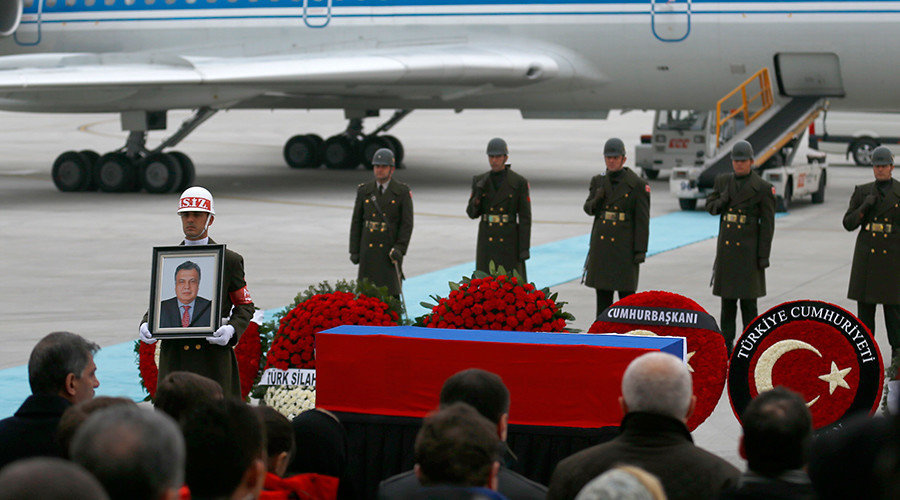
Flag-wrapped coffin of late Russian Ambassador to Turkey Andrei Karlov
© Umit Bektas / ReutersFlag-wrapped coffin of late Russian Ambassador to Turkey Andrei Karlov is carried to a plane during a ceremony at Esenboga airport in Ankara, Turkey, December 20, 2016.
A member of Al Jazeera's board says the shooting death of the Russian ambassador to Turkey was a "human reaction" to what the prominent Qatari journalist alleges to be Moscow's "barbarism" in war-torn Syria. She added that Russia "deserves the worst."

Andrey Karlov, 62, was fatally shot by an assailant who shouted "Don't forget Syria! Don't forget Aleppo! ...Until our towns are safe, you won't enjoy security either. Everyone who is involved in this will pay a price. Only death can take me from here."

The attacker, identified as 22-year-old Mevlut Altintas, who was a member of the police's special forces, was killed at the scene.

Comment: More on Bader:
Dr. Elham Bader Al Sada, a respected academic, currently a presenter at Qatar TV & Radio Corporation. A popular as well as somewhat controversial Qatari personality, she hosts a lively morning show on Qatari national radio that sometimes takes a critical stance on domestic issues, including nationality and sponsorship laws. A Qatari citizen, she is married to a Jordanian and her mother is of Palestinian origin.


Chess

The cold-blooded assassination of the Russian ambassador- Retaliation, but by whom

Mevlüt Mert Altıntaş
Mevlüt Mert Altıntaş- The assassin of the Russian ambassador Andrey Karlov
Just days after the liberation of Syria's northern city of Aleppo, Russia's ambassador to Turkey, Andrei Karlov, was gunned down while giving a talk at an art gallery in Turkey's capital of Ankara.

The gunman, identified as a former Turkish police officer, flashed the familiar one finger gesture used by terrorist organizations operating in neighboring Syria including by Jabhat Al Nusra and the self-proclaimed "Islamic State" - while shouting, according to the Guardian:
Don't forget Aleppo. Don't forget Syria. Unless our towns are secure, you won't enjoy security. Only death can take me from here. Everyone who is involved in this suffering will pay a price.
The attack coincided with an alleged security incident near America's embassy in Ankara, characterized by the US Embassy as a "shooting," though it may be in reference to the actual assassination.

Western newspapers, however, including the Daily Mail, the UK Express, and The Sun attempted to portray the announcement as a separate incident. This may be a deliberate attempt to portray the US as a victim in tandem with Russia, to divert suspicion away from US involvement.

Assassination Takes Place Days After US Vowed "Retaliation" Against Russia

US President Barack Obama, US policymakers and pundits, as well as US Senators for the past week have vowed "retaliation" against Russia for alleged "hacking" during the 2016 US presidential election. These threats take place against a wider backdrop of increasingly unhinged outbursts made by Western politicians, pundits, and policymakers amid frustration in advancing their global agenda versus a re-emerging Russia and a rising China.

The Guardian in an article published just this week titled, "Barack Obama promises retaliation against Russia over hacking during US election," would state:

Comment: See also: Russian ambassador in Ankara shot dead in gun attack (Updates)