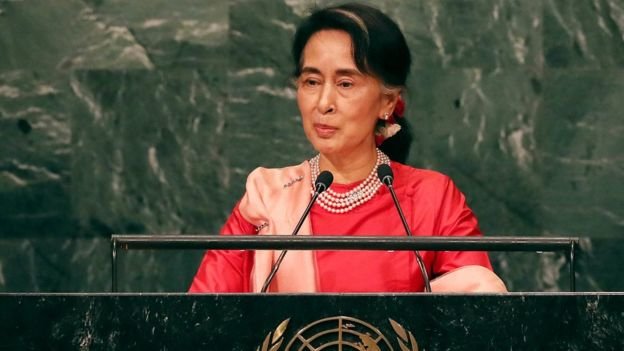
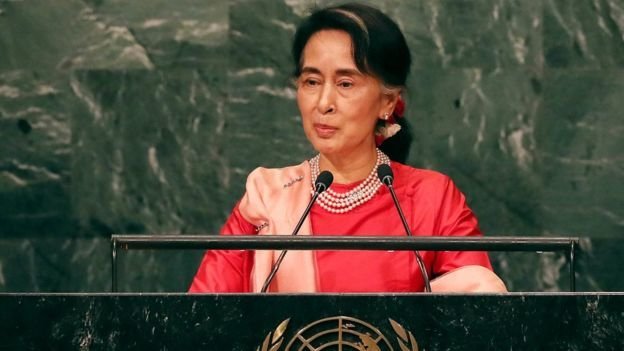
Nobel Peace Laureate Aung San Suu Kyi has been criticised for failing to protect the Rohingya population.
Dear President and Members of the UNSC,
As you are aware, a human tragedy amounting to ethnic cleansing and crimes against humanity is unfolding in Myanmar.
Over the past two months, a military offensive by the Myanmar Army in Rakhine State has led to the killing of hundreds of Rohingya people. Over 30,000 people have been displaced. Houses have been burned, women raped, many civilians arbitrarily arrested, and children killed. Crucially, access for humanitarian aid organisations has been almost completely denied, creating an appalling humanitarian crisis in an area already extremely poor. Thousands have fled to neighbouring Bangladesh, only to be sent back. Some international experts have warned of the potential for genocide. It has all the hallmarks of recent past tragedies - Rwanda, Darfur, Bosnia, Kosovo.
The head of the office of the United Nations High Commissioner for Refugees (UNHCR) on the Bangladesh side of the border, John McKissick, has accused Myanmar's government of ethnic cleansing. The UN's Special Rapporteur on human rights in Myanmar Yanghee Lee has condemned the restricted access to Rakhine State as "unacceptable." The Rohingyas are among the world's most persecuted minorities, who for decades have been subjected to a campaign of marginalisation and dehumanisation. In 1982, their rights to citizenship were removed, and they were rendered stateless, despite living in the country for generations. They have endured severe restrictions on movement, marriage, education and religious freedom. Yet despite the claims by government and military, and many in society, that they are in fact illegal Bengali immigrants who have crossed the border, Bangladesh does not recognise them either.
Their plight intensified dramatically in 2012 when
two severe outbreaks of violence resulted in the displacement of hundreds of thousands and a new apartheid between Rohingya Muslims and their Rakhine Buddhist neighbours. Since then they have existed in ever more dire conditions. This latest crisis was sparked by an attack on Myanmar border police posts on 9 October, in which nine Myanmar police officers were killed. The truth about who carried out the attack, how and why, is yet to be established, but the Myanmar military accuse a group of Rohingyas. Even if that is true, the military's response has been grossly disproportionate. It would be one thing to round up suspects, interrogate them and put them on trial.
It is quite another to unleash helicopter gunships on thousands of ordinary civilians and to rape women and throw babies into a fire. According to one Rohingya interviewed by Amnesty International, "they shot at people who were fleeing. They surrounded the village and started going from house to house. They were verbally abusing the people. They were threatening to rape the women."















Comment: ISIS may be feeling the pinch and its Obama "care" is packing up and leaving office. With Trump adamant that ISIS will be swiftly and thoroughly dealt with, it does indeed seem like the US proxy will have run its gamut, at least in this locale. The level of desperation will dictate the level of terror at the expense of Mosul and its occupants in the race to January 20th.