While most of us are aware of the massive U.S. intelligence network, we rarely see exactly how much this network costs taxpayers. In this posting, I want to look at the budget for the Department of Defense's Military Intelligence Program or MIP as well as the National Intelligence Program or NIP. Fortunately, in a
June 2018 Congressional Research Service report on intelligence community spending, Micheal DeVine provides us with a detailed look at spending on both the National Intelligence Program and the Military Intelligence program so that we can put the budget requests for fiscal 2020 into context.
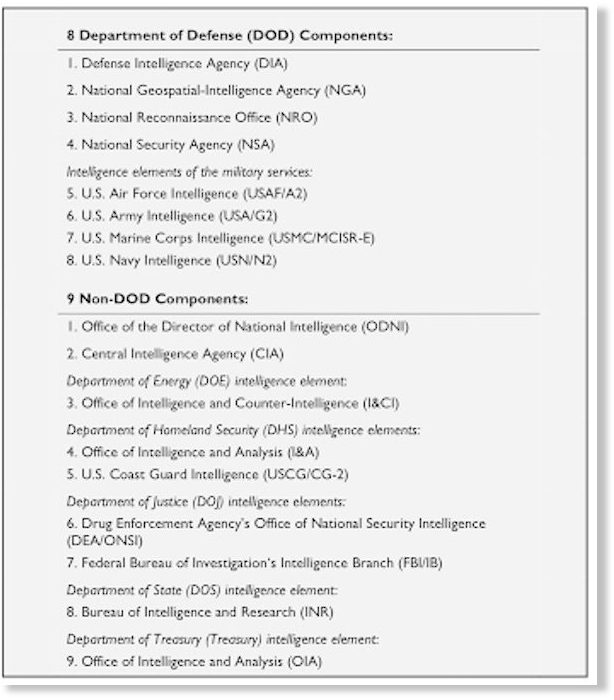
Let's open by looking at the component organizations of the U.S. intelligence community (effective 2018):
Here is a description of intelligence and intelligence-related activities that are part of the United States' intelligence community:
"1.) The collection, analysis, production, dissemination, or use of information that relates to a foreign country, or a government, political group, party, military force, movement, or other association in a foreign country, and that relates to the defense, foreign policy, national security, or related policies of the United States and other activity in support of the collection, analysis, production, dissemination, or use of such information;2.) Activities taken to counter similar activities directed against the United States;
3.) Covert or clandestine activities affecting the relations of the United States with a foreign government, political group, party, military force, movement, or other association;


















Comment: