Puppet MastersS


Star of David

If the United States Wants to Survive It Must Free Itself from Israel

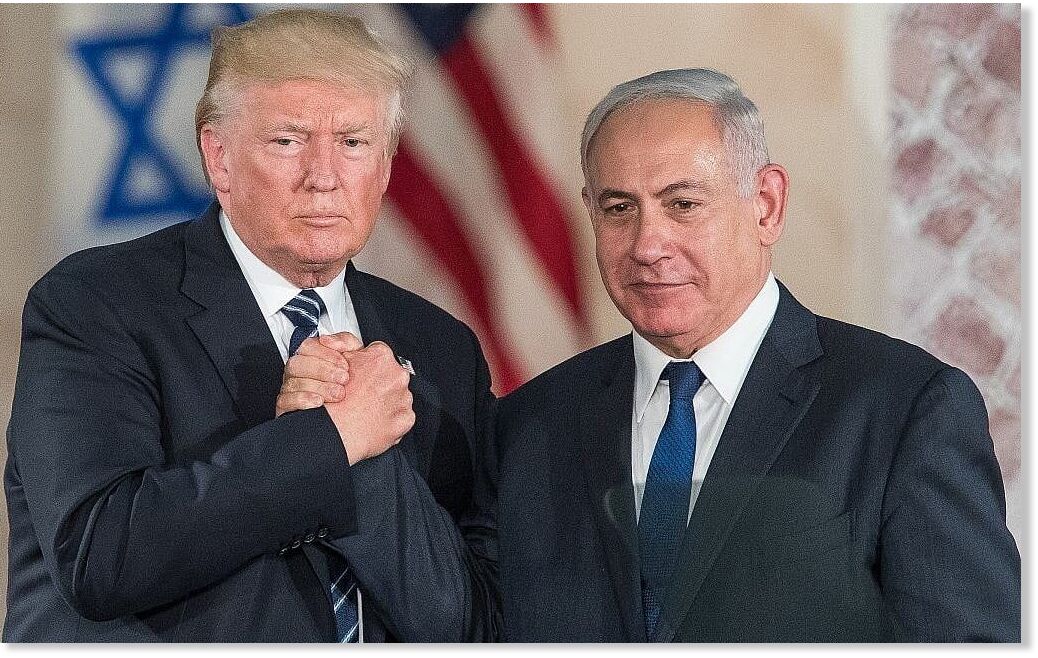
trump netanyahu
© Yonatan Sindel/Flash90
I have university degrees in ancient, medieval and early modern history but search as I may, I cannot find another example of a small, low population state largely devoid of natural resources that has been able to dominate the politics and policies of a much larger great power to the extent that Israel controls many aspects of America's government, its economy, its education system, its media, and, most of all, its foreign and national security policies. Little Israel commands and the superpower United States obeys, a relationship that has coined the expression "the tail wags the dog."

To be sure, Israel has resources that might be regarded as unconventional for most nation states around the globe, consisting of a large and astonishingly wealthy network of "diaspora" co-religionists who are prepared to corrupt the governments in the countries where they actually live to benefit the Jewish state in every way possible.

Politicians can easily be bought by Jewish billionaires, as in the case of President Donald Trump who reportedly received $100 million as a campaign donation from Israeli Las Vegas casino magnate Miriam Adelson, plausibly in exchange for Israel having a free hand in the West Bank, up to and including total annexation and deportation of the inhabitants to eliminate a possible Palestinian state.

Russian Flag

Russian position on the British-German-French interpretation of the "snapback"

IRAN globe
© Unknown
Foreign Ministry statement on the United Kingdom, Germany, and France's unlawful actions to reinstate UN Security Council sanctions on Iran

Despite Russia and China's vigorous efforts to create proper conditions for keeping up the substantive dialogue on settling the Iranian nuclear programme-related issues, including the two countries submitting a corresponding draft resolution to the UN Security Council, on August 28, the foreign ministers of the United Kingdom, Germany, and France sent a letter to the UN Secretary-General and the President of the Security Council alleging significant non-compliance by the Iranian side with its obligations under the JCPOA.
This letter is presented as a notification provided for by paragraph 11 of UNSC Resolution 2231, which triggers a further chain of steps to reinstate long-abrogated UN sanctions on the Islamic Republic of Iran. In reality, it cannot be considered as such. We resolutely condemn these actions by the European countries and call on the international community to reject them. Such manipulations cannot entail any obligations for other states.

In fact, we are dealing with a brazen attempt by the European participants of the JCPOA to manipulate the provisions of UNSC Resolution 2231. Taking advantage of the fact that the mechanism for reinstating previous sanctions contained in this resolution referred to as the "snapback" is a unique and rather complex procedural construct with no precedent in international practice, the British and two other European countries have appropriated the right to interpret the application procedure as they see fit. However, the JCPOA and Resolution 2231 were built on carefully balanced interests, without which the agreements cease to function properly.
The above letter by high-ranking representatives of the British, German, and French authorities to the Panamanian UNSC presidency is part of a long-running campaign they have been conducting to mislead other states in order to legitimise their claims to use the snapback mechanism in order to settle political scores with Tehran. In reality, they have no legal grounds or procedural possibilities to do so.

Light Sabers

Is a new civil war in the U.S. possible?

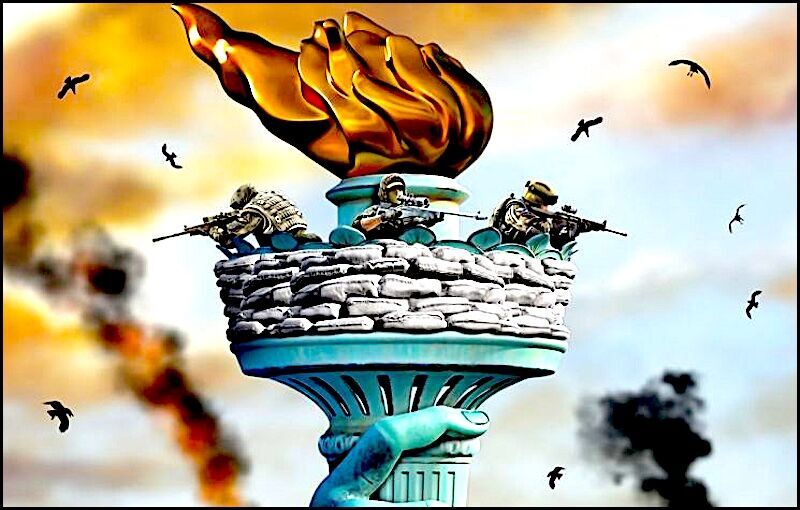
snipers liberty
© SCFCivil War
There may be few other options for Trump than to concentrate more power and implement exceptional measures to guarantee law and order.

The brutal assassination of the American conservative commentator Charlie Kirk has once again brought the possibility of a new civil war in the U.S. into public virtual discussion. The topic of a Civil War 2.0 is not actually new. Over the past few years, according to Google Analytics — especially in the days immediately following the assassination attempt on Donald Trump — terms like "civil war" have seen a growing search volume on search engines. In 2024, the year of Trump's second election, the film Civil War, directed by Alex Garland, was released. In its backdrop, an authoritarian U.S. government faces three simultaneous secessionist movements.

We could say, therefore, that the signs of "civil war" have already started to occupy the American political and cultural imagination, which is truly significant. No idea can update itself in the real world without first having conquered the symbolic, imaginary, and lexical world. The revolutionary ideas of the Enlightenment had already dominated France — including its aristocracy — before there could actually be a French Revolution to overthrow an Old Regime already rotten and emptied of meaning.

Arrow Down

French government collapse: Will Macron learn any lessons?

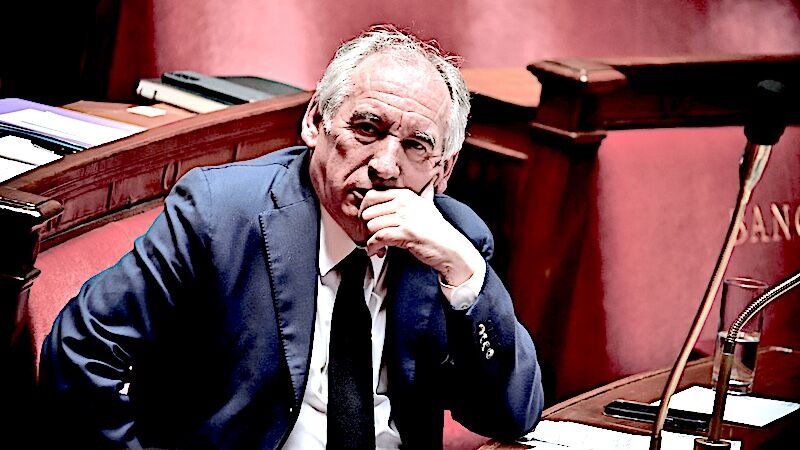
Bayrou
© Thierry NECTOUX/Gamma-Rapho/Getty ImagesFormer French Prime Minister Francois Bayrou
He is burning through prime ministers at a steady pace - not that he's likely to learn his lesson and stop milking the taxpayers

France has gone through so many prime ministers lately that they should just bolt a wind turbine to the revolving door. At least then the political instability could maybe bring down the people's rising power bills, particularly given that the tax on energy just jumped from 5.5% to 20%.

Francois Bayrou is the third handpicked puppet of French President Emmanuel Macron, who's at around 15% popularity himself, to get turfed within a year, and the fourth over the past two years. He called for a no-confidence vote on himself a couple of weeks ago, effectively begging opposition lawmakers to put him out of his political misery after finding himself in the apparently impossible situation of trying to find €44 billion to cut from the French budget.

Gavel

Nepal picks new interim prime minister

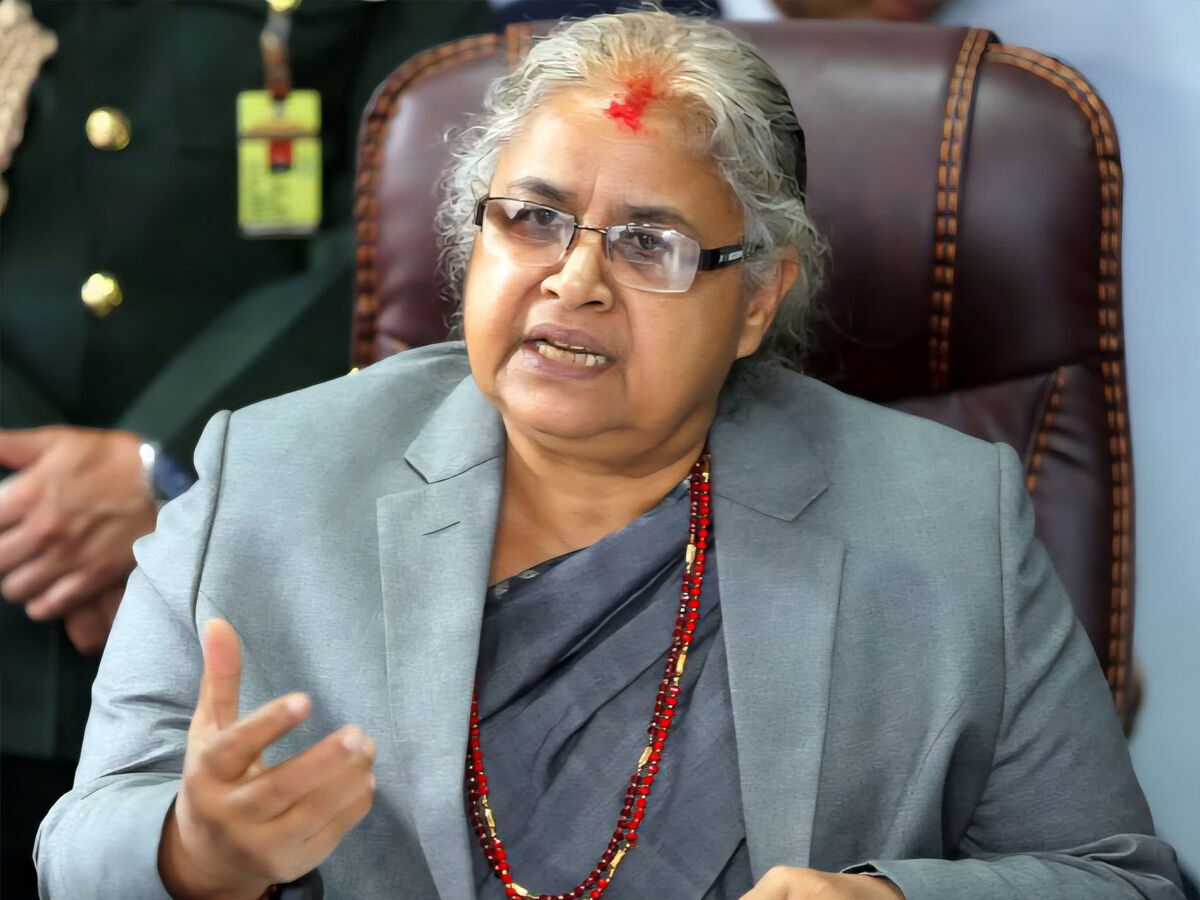
Sushila Karki
Nepali interim Prime minister Sushila Karki
The appointment of former Chief Justice Sushila Karki comes after anti-corruption protests that left at least 51 people dead

Former Chief Justice Sushila Karki has been appointed Nepal's interim prime minister after widespread protests against corruption and the government's ban on social media, which left at least 51 people dead and more than 1,300 injured.

Nepali President Ram Chandra Paudel announced the appointment on Friday after dissolving parliament and setting elections for March 2026. The decision followed negotiations between the president, representatives of the country's 'Generation Z' protest movement, and the chief of the army, General Ashok Raj Sigdel, as the military effectively took control of the capital Kathmandu and enforced a curfew.

Karki, 73, is Nepal's first woman to become interim prime minister and is widely known for her stance against corruption. Between 2016 and 2017, she served as chief justice - the only female to have held this post. In 2017, some lawmakers tried to impeach her on accusations of bias, but the attempt quickly stalled due to a public backlash and a Supreme Court intervention. Karki stepped down when she reached the mandatory age limit of 65.

Cult

Do it! Trump puts crosshairs on radical leftist NGOs: "Looking into Soros. Looks like RICO"

graphic protesters foot soldiers strings pulled
© ZeroHedge
After President Trump told Fox & Friends hosts that Charlie Kirk's assassin is "in custody," he went on to comment about radical leftist organizations, stating, "We are going to look into Soros. It looks like a RICO case."


Recall that on Wednesday night, just hours after Kirk's assassination, President Trump addressed the nation from the Oval Office, calling it a "dark moment for America." He vowed to crack down on radical left movements across the country that have fueled chaos and even death this year.


Comment:


Target

A bridge to influence: Washington's quiet return to Central Asia

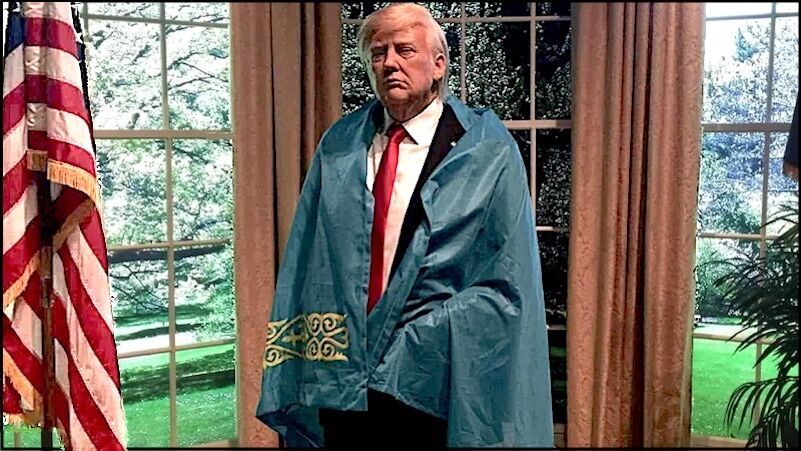
Trump
© UnknownUS President Donald Trump
In a quiet but calculated pivot, the United States is setting its sights on Central Asia once again — not just to loosen Russia's stranglehold on global oil, but also to redraw the strategic map linking East and West.

By deepening ties with regional players, including through a strengthened partnership with Israel, Washington hopes to hem in Moscow and Beijing.

Pivot to Central Asia

Under President Trump's renewed tenure, Washington is steadily reasserting its presence in Central Asia and its surrounding regions — an area long overlooked in recent US foreign policy. At the heart of this re-engagement is a significant infrastructure project in Armenia: a bridge already being dubbed the "Trump Bridge." Backed by US funding and poised to transform regional connectivity, the project reflects more than symbolic investment; it signals a strategic recalibration.

For many within the Trump administration, the previous US disengagement from this part of the world was a costly mistake. The administration's supporters now view this renewed push as correcting course, beginning with the facilitation of a peace agreement between Armenia and Azerbaijan — a conflict that has long destabilized the South Caucasus. While fragile, the agreement has positioned Washington not only as a mediator but increasingly as a power balancer in the region.

Comment: Hard to fault the logic in this article, given US' track record. For some presidents it is a hammer; for others (like Trump) it is a game board. For a rare few, it is taking the present into the future with confidence, dignity and an uplifting purpose to the benefit of all.


X

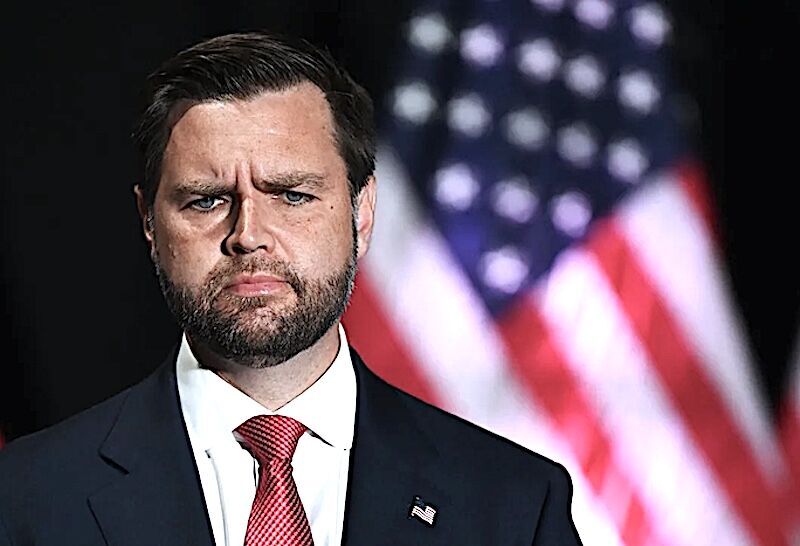
Trump sees no reason to economically isolate Russia outside war in Ukraine, Vance says

Vance flag
© UnknownUS VP JD Vance
U.S. President Donald Trump does not believe Russia should be cut off from the global economy beyond the context of its war against Ukraine, Vice President JD Vance said in an interview with One America News Network published on Sept. 10.

The statement comes as, despite Trump's repeated threats, his administration has imposed only limited penalties on Russia and, in some cases, has rolled back restrictions. Vance said:
"The president's been very open with the Europeans and the Russians that he doesn't see any reason why we should economically isolate Russia except for the continuation of the conflict,"
The vice president added that Russia remains a resource powerhouse:
"Let's be honest, whether you like or dislike Russia, whether you agree or disagree with their underlying arguments for the conflict, the simple fact is they've got a lot of oil. They've got a lot of gas. They've got a lot of mineral wealth."
According to the vice president, once a settlement is reached, Washington could have "a very productive economic relationship" with both Kyiv and Moscow.


Airplane

US lifts sanctions on Belarus' national airline

belavia
© Sputnik/Maxim Blinov
Washington has lifted sanctions on Belarus' flag carrier Belavia as part of the deal, which freed 52 political prisoners from the country, US President Donald Trump's envoy John Coale has said.

The administration of former US President Joe Biden had imposed the measures in 2023 over alleged election fraud and what it described as Minsk's "complicity" in the Ukraine conflict.

Speaking on Thursday in Minsk alongside Belarusian President Alexander Lukashenko, Coale said he was "officially declaring" the lifting of sanctions on Belavia, stressing that the decision had been made directly by Trump, who had told him to "do it immediately."

The decision had already been signed off on by the US State, Commerce, and Treasury Departments, as well as other relevant government agencies, he added.

Design

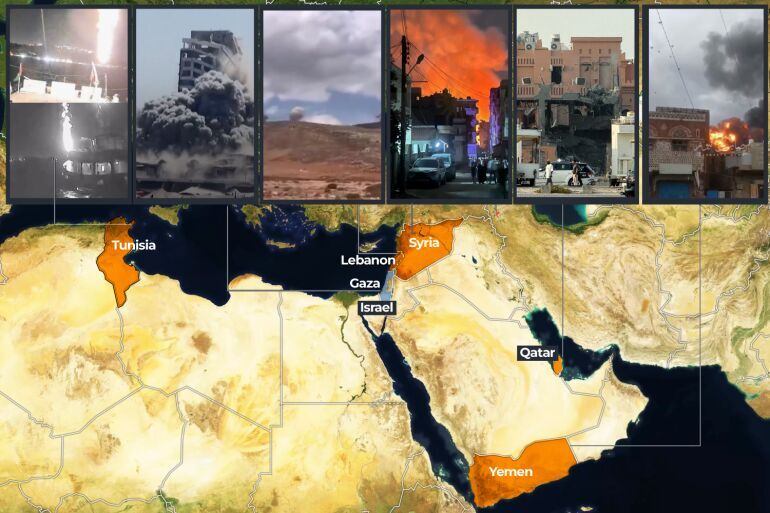
Best of the Web: Israel has attacked six countries in the past 72 hours

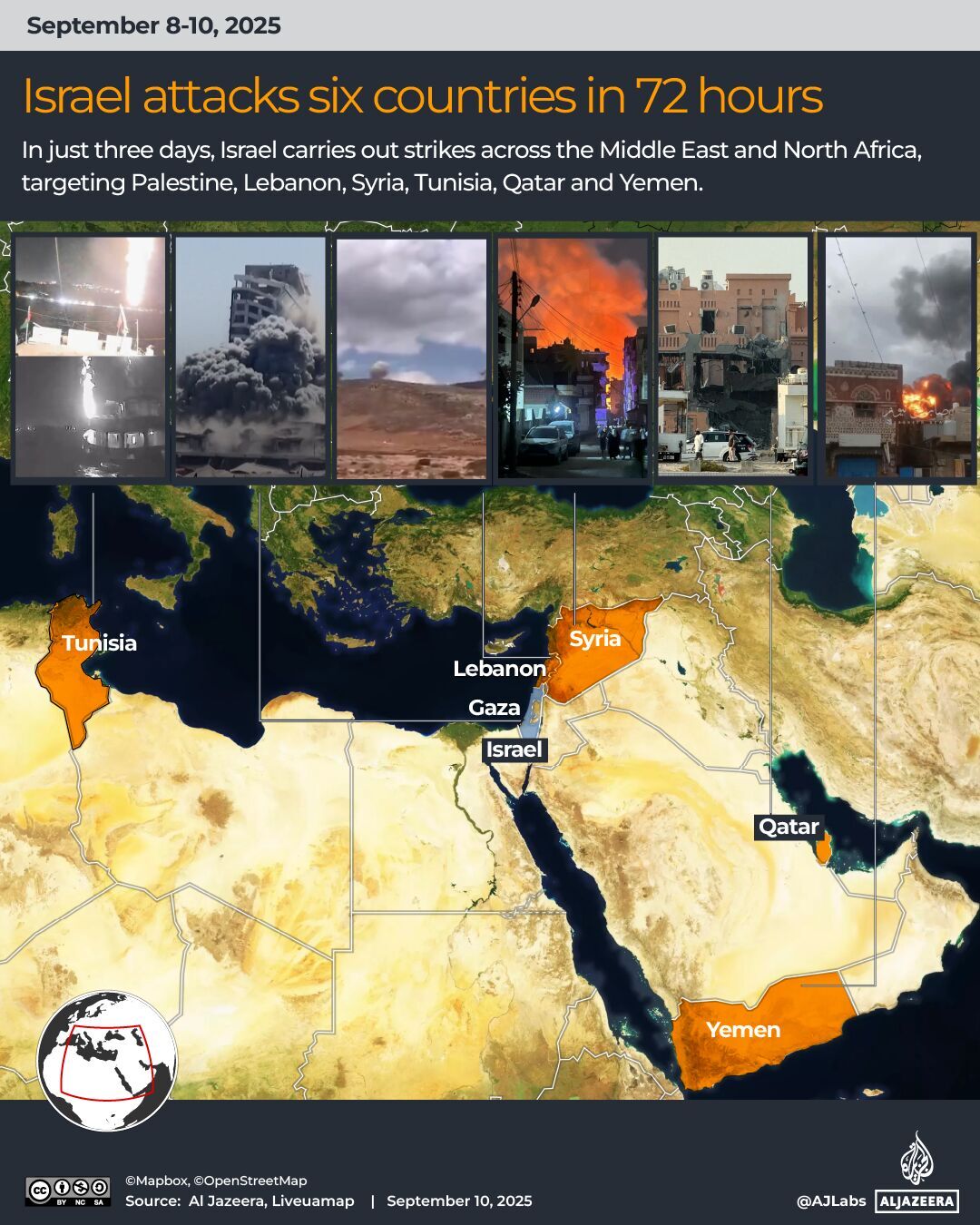
In just three days, Israel has carried out strikes in Palestine, Lebanon, Syria, Tunisia, Qatar and Yemen.
map israel middle east
© Al Jazeera
On Tuesday, Israel launched a targeted air strike on a Hamas leadership compound in Qatar's capital, Doha, during a meeting to discuss a US-proposed ceasefire for Gaza.

The strike killed six people, including the son of senior Hamas leader Khalil al-Hayya, the director of al-Hayya's office, three bodyguards and a Qatari security officer. However, its top leaders are reported to have survived the attack.

The attack was part of a wider wave of Israeli strikes extending beyond its immediate borders, and marked the sixth country attacked in just 72 hours and the seventh since the start of this year.
map israel attacks
© Al Jazeera
Israel continues to bombard Gaza

Israeli attacks across Gaza have killed at least 150 people and injured more than 540 others since Monday.

On Monday, 67 people were killed and hospitals received 320 wounded, including 14 people killed while seeking aid, while six people - among them two children - died from famine-related causes. On Tuesday, another 83 people were killed and 223 were injured.

Israel is continuing its assault on Gaza City, targeting high-rise buildings, destroying infrastructure, and forcing residents from their homes, leaving many with nowhere safe to seek shelter.

Comment: You could also argue that it attacked 8 countries in 72 hours, if you include its own massacre of Israelis in a false-flag terror attack, and the assassination of Trump ally Charlie Kirk in Utah.

Meanwhile, its president is visiting London unmolested, staying in a hotel owned by Qataris. Israel's power has truly become limitless. Only comets can stop it now.