
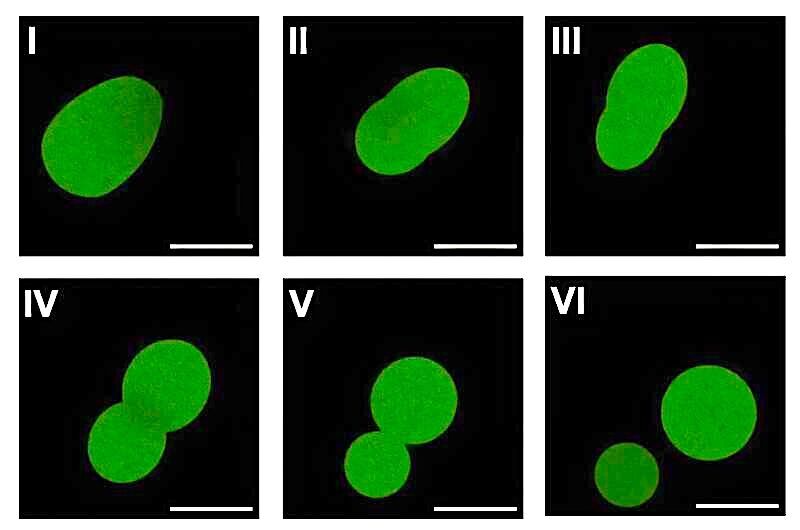
© Kate Adamala, Adamala LabFluorescent microscopy of SpudCell—a synthetic cell assembled entirely from non-living chemical components—undergoing division.
University of Minnesota associate professors Kate Adamala and Aaron Engelhart and their teams have developed the world's first synthetic cell with a complete life cycle, built entirely from nonliving chemical components, and described it in a new paper.
The project, called SpudCell, marks a major breakthrough in biological engineering. In time, it may provide solutions to some of our most challenging problems in medicine and engineering.
Adamala said:
"This is likely the most exciting project I've ever worked on. We've replicated in chemistry what only used to be possible in biology: the complete set of behaviors of a cell. It proves that the most fundamental functions of life, like growth and replication, do not need a mysterious magical spark."

















Comment: