

© Heikka Valja/Aalto UniversityArtistic illustration of an Alice ring, which researchers have just observed for the first time in nature.
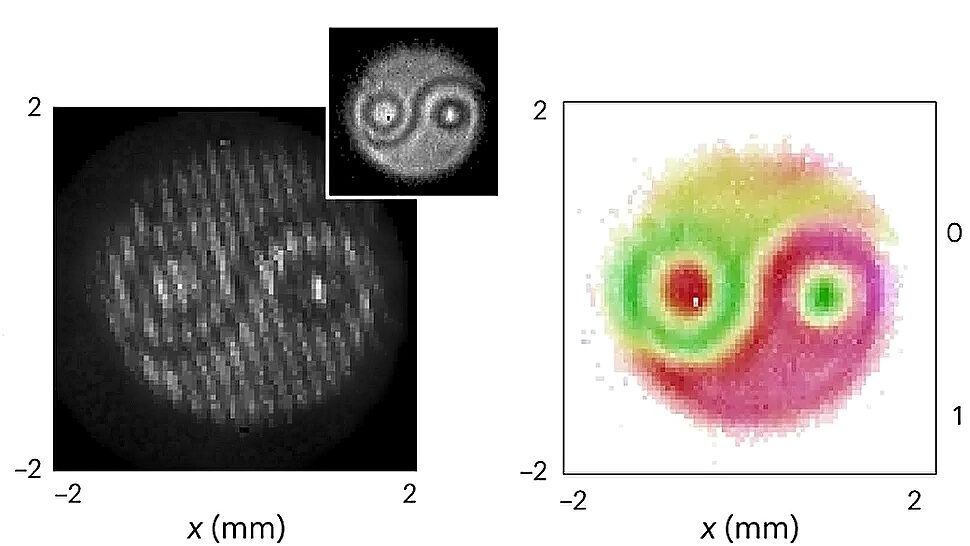
Dubbed the 'Alice ring' after Lewis Carroll's world-renowned stories on Alice's Adventures in Wonderland, the appearance of this object verifies a decades-old theory on how monopoles decay. Specifically, that they decay into a ring-like vortex, where any other monopoles passing through its centre are flipped into their opposite magnetic charges.
Published in Nature Communications on August 29, these findings mark the latest discovery in a string of work that has spanned the collaborative careers of Aalto University Professor Mikko Möttönen and Amherst College Professor David Hall.
'This was the first time our collaboration was able to create Alice rings in nature, which was a monumental achievement,' Möttönen said.
'This fundamental research opens new doors into understanding how these structures and their analogues in particle physics function in the universe,' Hall added.
The long-standing relationship, titled the Monopole Collaboration, initially proved the existence of a quantum analogue of the magnetic monopole in 2014, isolated quantum monopoles in 2015, and eventually observed one decay into the other in 2017.
Monopoles remain an elusive concept in the arena of quantum physics. As the name suggests, monopoles are the solitary counterpart of dipoles, which carry a positive charge at their north pole and a negative charge at the south. In contrast, a monopole carries only either a positive or negative charge.
While the concept sounds simple, realising a true monopole has proven to be a career-defining task. Here's how the Monopole Collaboration has done it: they manipulated a gas of rubidium atoms prepared in a nonmagnetic state near absolute zero temperature. Under these extreme conditions, they were then able to create a monopole by steering a zero point of a three-dimensional magnetic field into the quantum gas.
















Comment: See also: Moon mystery: China, Japan scientists have no answers for space gear disappearances