Scientists have struggled to accurately forecast the strength of the sun's 11-year cycle — even after centuries of solar observations.
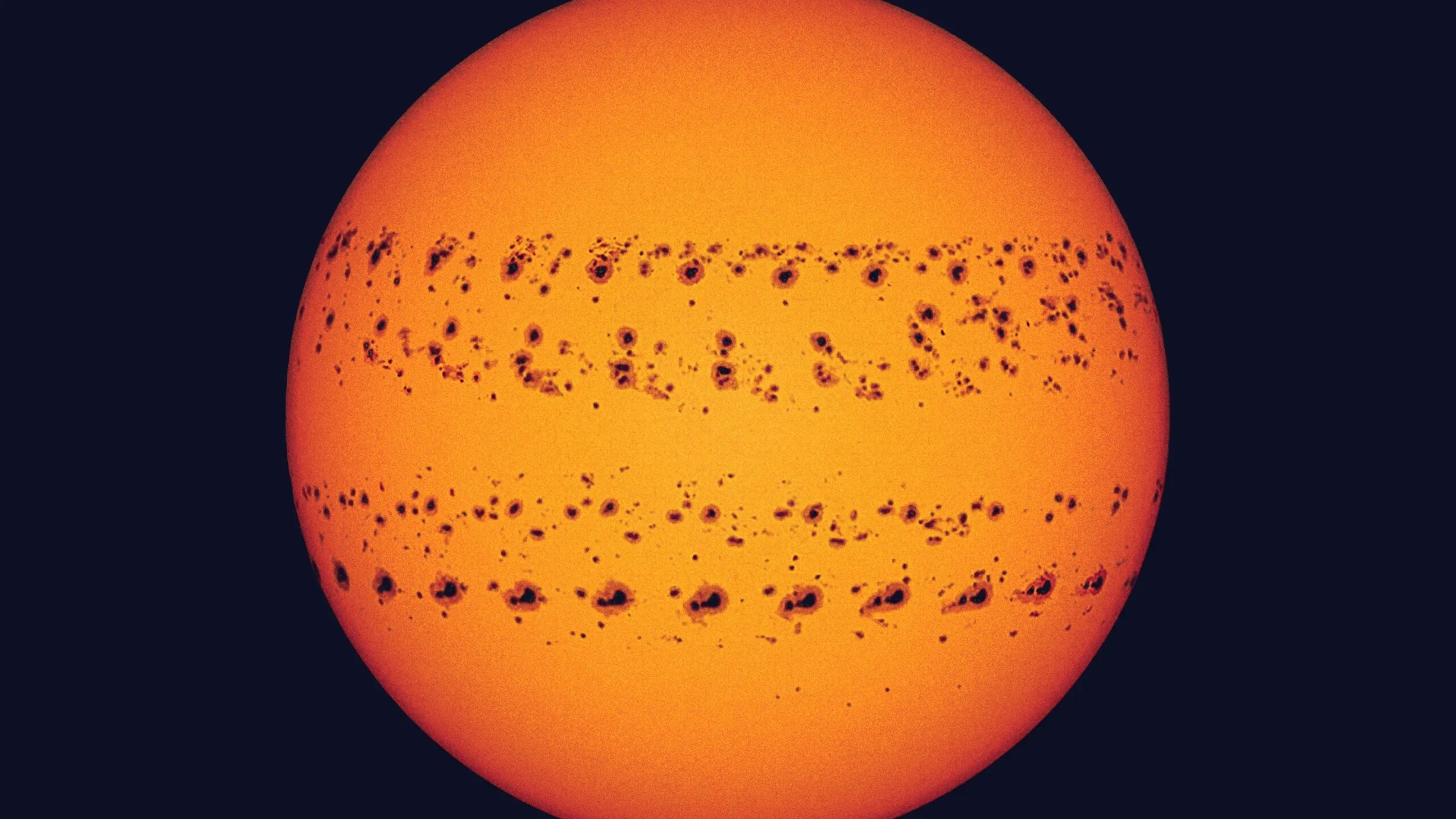
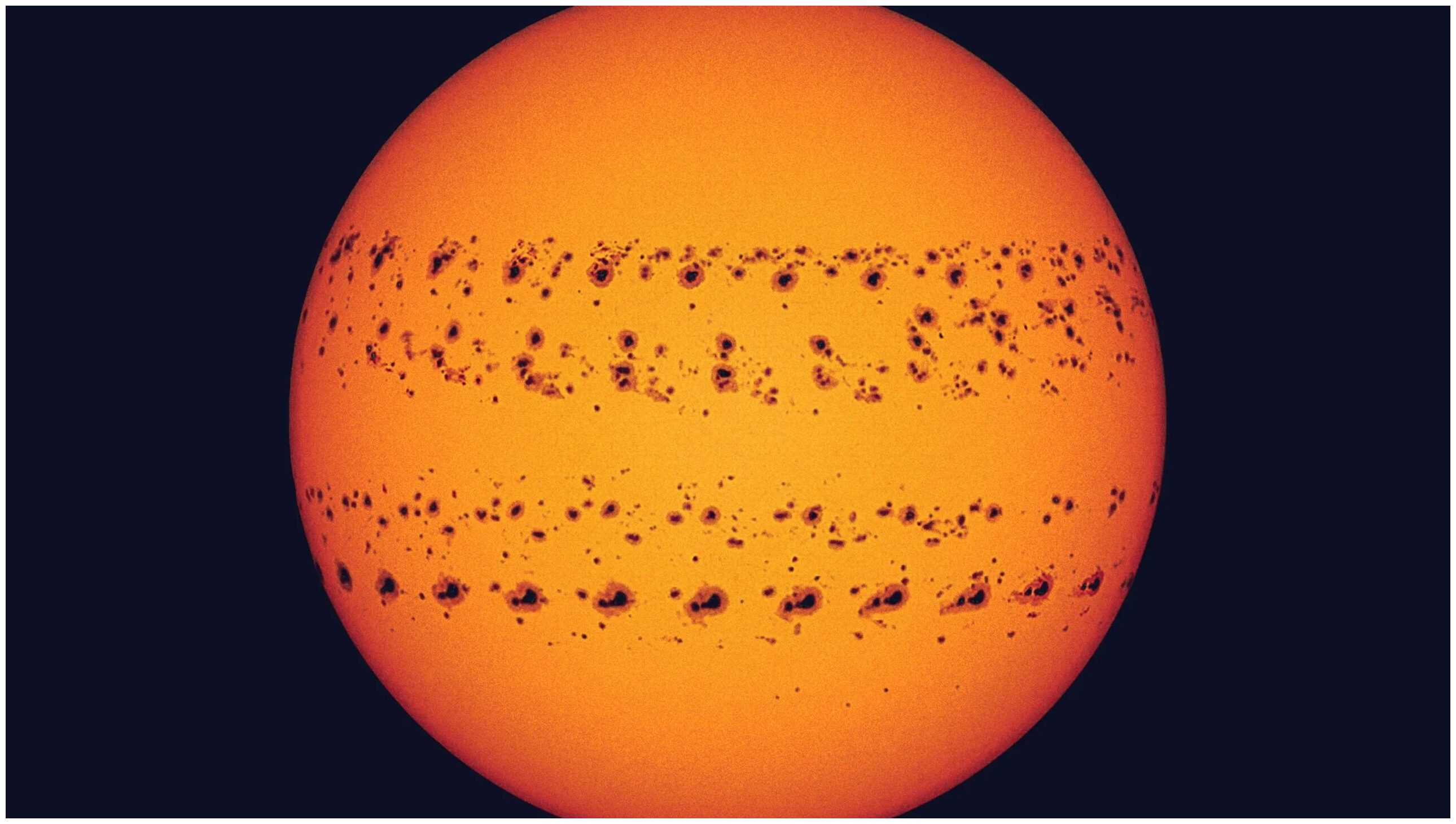
© NASA’s Solar Dynamics ObservatoryAs the solar cycle marches toward maximum, sunspots migrate toward the sun’s equator. This composite image is made from six months’ worth of observations from NASA’s Solar Dynamics Observatory.
The sun looks immutable, a boring celestial lightbulb that's always turned on. But this fusion-powered ball of plasma is in constant flux. Every 11 years or so, it swings between slumber and an active, unruly epoch marked by sunspots and solar eruptions, such as flares and plasma outbursts.
The sun is now approaching its maximum level of activity in the current cycle, and
it's not exactly behaving according to plan. Scientists had predicted that this cycle would be weak, like the previous one, but the sun is exhibiting a level of activity unseen in more than 20 years. In June and July of this year, according to data from the National Oceanic and Atmospheric Administration (NOAA), it averaged
roughly 160 sunspots daily,
more than twice as many as predicted. Solar flares are also increasing.The discrepancy between prediction and observation was apparent as early as July 2022, when
Nicola Fox — then the director of NASA's heliophysics division —
wrote on NASA's website that "the Sun has been much more active this cycle than anticipated."
A reliable solar cycle prediction is now more important than ever because of our increasing dependence on vulnerable technology. Earth's atmosphere puffs up with solar activity and increases the drag on the (very many) satellites that need to maneuver in orbit. Solar outbursts can fry electronic equipment, jam radio signals, confound GPS systems, and disrupt power grids.
As with most forecasts, the challenges of predicting the solar cycle are numerous. It doesn't follow a clear pattern from one cycle to the next — some are shorter than others — and solar physics is still a relatively young discipline. "We like to say we're about 60 years behind the weather forecasters," said
Robert Leamon, a solar physicist at the University of Maryland.
Historically, researchers looked for statistical correlations between solar activity and the number of sunspots, their total surface area, and the timing of their appearance. But the scientific consensus is that those techniques — even while modernized — don't reveal much about the sun's future behavior. Now, fueled by more sophisticated solar observations, scientists are evaluating and finessing methods that instead use the inner workings of the sun as a guide.
While progress is slow — 11 years is a long time — let's take a closer look at the current state of solar system prediction.










![Sunspot count, SC5 to SC25 [SWPC/NOAA].](/image/s34/687512/full/image_23.png "Click to enlarge")


Comment: So, all is not as quiet on the Moon as it seems.