Science & TechnologyS


Question

Are space-time and locality not so fundamental after all?

One of the weirdest aspects of quantum mechanics is entanglement, because two entangled particles affecting each other across vast distances seems to violate a fundamental principle of physics called locality: things that happen at a particular point in space can only influence the points closest to it. But what if locality — and space itself — is not so fundamental after all? Author George Musser explores the implications in his new book, Spooky Action At a Distance.
kaleidoscope
When the philosopher Jenann Ismael was ten years old, her father, an Iraqi-born professor at the University of Calgary, bought a big wooden cabinet at an auction. Rummaging through it, she came across an old kaleidoscope, and she was entranced. For hours she experimented with it and figured out how it worked. "I didn't tell my sister when I found it, because I was scared she'd want it," she recalls.

Info

Humans aren't the only species to use names; dolphins and parrots do too

Dolphins
© Borat Furlan/Getty ImagesRalph?
Four-year old Simon is lost. His mother was in front of him just a moment ago, standing right there next to the grocery-store pyramid of apples, but now she's gone. He looks past the lemons, the pears, the bananas, but still can't see her. "Mom?" he cries, hoping she'll come to his rescue. "Mom? Mom!"

His mother, a few paces ahead, hears his call. Her ears perk up. "Simon?"

He shouts back. "Mom!" Following his voice, she circles back around to find him.

This grocery-store scene could take place at a park, a zoo, a mall, or almost anywhere else. But it also occurs outside our human realm. In the ocean, bottlenose dolphins and calves whistle to call each other when they're out of visual contact: Mom calls Junior using his signature whistle, and he echoes it back in acknowledgement. In the Venezuelan jungle, when green-rumped parrotlets and their offspring get separated, they do the same thing as the dolphins.

Chalkboard

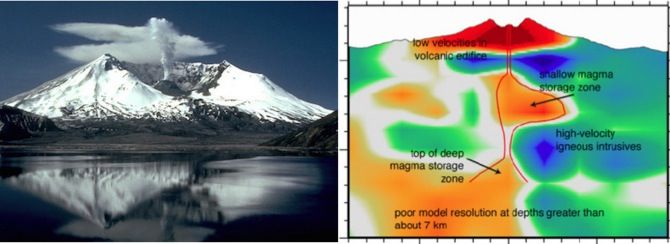
Researchers: Mount St. Helens may share magma with entire field of volcanoes

Image
© Lyn Topinka/USGS; IMUSH
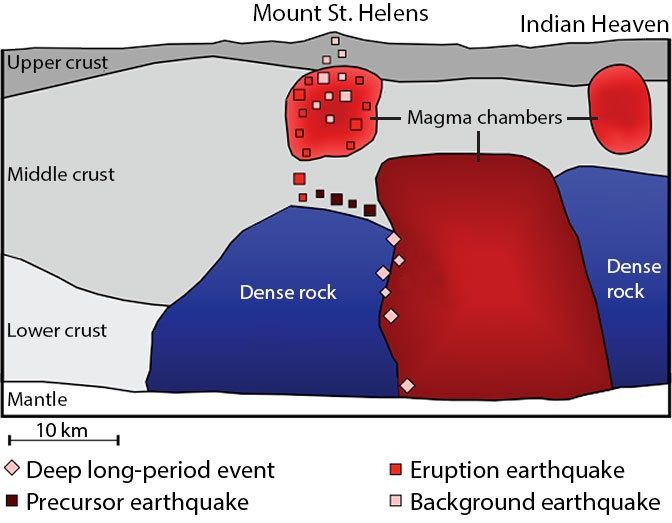
It took 2,500 seismometers, 23 explosive blasts, and countless earthquakes, but researchers now have a much better idea of what the magma chambers look like deep below Mount Saint Helens. The weird bit? It looks like it shares a magma chamber with a whole field of local volcanoes.

The iconic volcano of the Pacific Northwest is directly fed by a shallow magma chamber, but that wasn't enough to satisfy the researchers behind the interdisciplinary Imaging Magma Under Saint Helens (IMUSH) project. They're using a variety of geophysical techniques to peer deep into the Earth in an attempt to understand the deeper and more complicated plumbing under the volcano. Their first batch of results suggest that like the second chamber lurking deep below Yellowstone, Mount Saint Helens also has a deeper, larger second chamber.
Image
Geophysics works by detecting the differences between different physical characteristics of rocks. How quickly seismic waves travel give indications of rock density, while electrical methods can get a glimpse at the rock's conductivity. By comparing the spacial locations of different properties, geophysicists can interpret solid rock from warm chambers filled with pre-melt magma. These aren't deep lakes of liquid lava; the magma chambers have shockingly little melt and are more ductile than fluid.

The newly-discovered deeper chamber is big, but we don't yet know its full dimensions. Although the researchers have so far only put together a 2D slice of the structure, it's plausible the chamber extends out just as wide. If it does, it could be a single feeder-chamber for the entire realm of inactive and dormant volcanoes in the region like Mount Adams and the rest of the Indian Heaven volcanic field.

Comment: See also:


Evil Rays

Expanding the frequency fence: Alphabet and Facebook develop rival drone plans to bring WiFi to undeveloped parts of the world

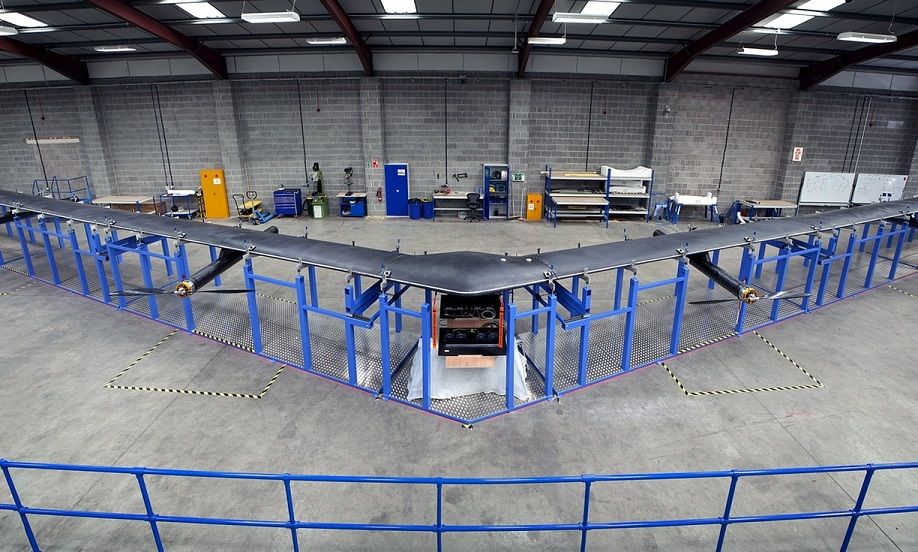
Facebook's Aquila drone
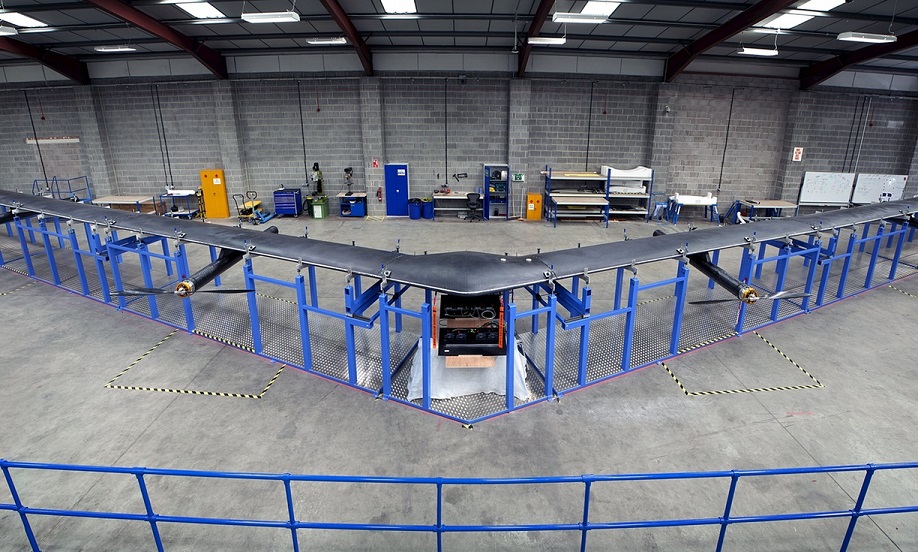
© Handout/ReutersAquila, a drone with a 42-metre wingspan built by social media company Facebook, was unveiled in July.
The tech giants are racing to provide internet access from unmanned aircraft flying higher than passenger jets, having quietly registered new drone designs.

Google and Facebook have significantly expanded their rival plans to develop unmanned aircraft that can provide broadband internet access from high above the Earth, the Guardian has learned.

Both Facebook and Alphabet, Google's parent company, have quietly registered new drone designs with the US Federal Aviation Administration.

Meanwhile, Alphabet is also planning secret high-altitude airborne operations at Spaceport America in New Mexico, which has been largely unused since Virgin Galactic's SpaceShipTwo craft crashed in December 2014, and an American subsidiary of Facebook has taken delivery of a prototype solar-powered drone.

Much of the world's attention is focused on small drones, such as Alphabet's Project Wing or Amazon's Prime Air delivery drones, but Google and Facebook are also working on much larger drones that can operate far above passenger jets, and even as high as 90,000 feet.

Flying for weeks or months at a time, such drones could theoretically provide city-sized areas with high-speed internet access, particularly in remote or undeveloped parts of the world.

"We're working on ways to use drones and satellites to connect the billion people who don't live in range of existing wireless networks," said Facebook's CEO, Mark Zuckerberg, in July. Last year, Facebook set up an initiative with Nokia, Samsung and others called Internet.org to provide some online access to the two-thirds of the world lacking a reliable connection.

Comment: Yes, just what the remote and undeveloped parts of the world need. Forget humane living conditions, a sustainable food supply, and a workable infrastructure. Just give them WiFi so they can suffer the same health problems as the rest of the developed world!


Meteor

Mercury gets a meteoroid shower from Comet Encke

Image
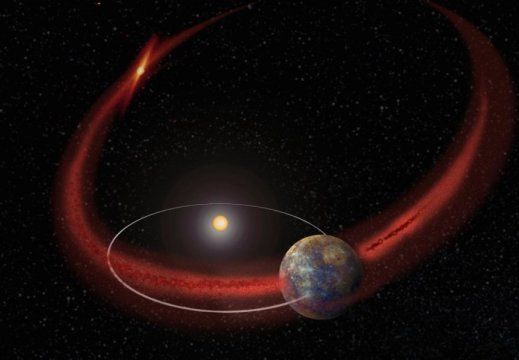
© NASA/GoddardMercury appears to undergo a recurring meteoroid shower when its orbit crosses the debris trail left by comet Encke. (Artist's concept.)
The planet Mercury is being pelted regularly by bits of dust from an ancient comet, a new study has concluded. This has a discernible effect in the planet's tenuous atmosphere and may lead to a new paradigm on how these airless bodies maintain their ethereal envelopes.

The findings are to be presented at the annual Meeting of the Division of Planetary Sciences of the American Astronomical Society at National Harbor, Maryland, this week, by Apostolos Christou at the Armagh Observatory in Northern Ireland, Rosemary Killen at NASA's Goddard Space Flight Center in Greenbelt, Maryland, and Matthew Burger of Morgan State University in Baltimore, working at Goddard.

Earthlings are no strangers to the effects of cometary dust on a planet and its environment. On a clear, moonless night we witness the demise of countless such dust grains as they burn up in the Earth's atmosphere in the form of meteors or "shooting stars." At certain times of the year, their numbers increase manyfold, creating a natural fireworks display: a meteor shower. This is caused by the Earth passing through a stream of dust particles left behind by certain comets.

One of the most well-known showers, the August Perseids, originates from comet Swift-Tuttle, which was last seen back in 1992 and won't be back in the inner solar system for another century. But Earth is not the only planet in the solar system to sweep up cometary dust in this fashion. Last year, comet Siding Spring came within 100,000 miles of Mars, loading its upper atmosphere with several tons of cometary material. The aftermath was recorded by instruments onboard several Mars-orbiting spacecraft such as NASA's Mars Atmosphere and Volatile Evolution mission and ESA's Mars Express.

Mars

Mars' moon Phobos is slowly falling apart

Image
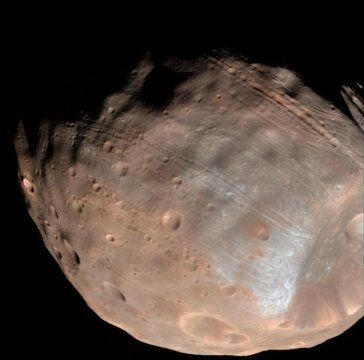
© NASA/JPL-Caltech/University of ArizonaNew modeling indicates that the grooves on Mars' moon Phobos could be produced by tidal forces -- the mutual gravitational pull of the planet and the moon. Initially, scientists had thought the grooves were created by the massive impact that made Stickney crater (lower right).
The long, shallow grooves lining the surface of Phobos are likely early signs of the structural failure that will ultimately destroy this moon of Mars.

Orbiting a mere 3,700 miles (6,000 kilometers) above the surface of Mars, Phobos is closer to its planet than any other moon in the solar system. Mars' gravity is drawing in Phobos, the larger of its two moons, by about 6.6 feet (2 meters) every hundred years. Scientists expect the moon to be pulled apart in 30 to 50 million years.

"We think that Phobos has already started to fail, and the first sign of this failure is the production of these grooves," said Terry Hurford of NASA's Goddard Space Flight Center in Greenbelt, Maryland.

The findings by Hurford and his colleagues are being presented Nov. 10, 2015, at the annual Meeting of the Division of Planetary Sciences of the American Astronomical Society at National Harbor, Maryland.

Beaker

Big Brother: DNA from newborn blood samples being sold for research

dna
© bigstock
Big Brother alive and well in California


Every year millions of newborns throughout the U.S. get a small heel prick in order to take a blood sample which is then screened for congenital abnormalities. But what happens to that blood sample after those tests? If you were born in California in 1983 or later the California Department of Public Health - CDPH (or Big Brother) can tell you exactly what happened.

From the CBS article:
Turns out a non-descript office building in Richmond contains the DNA of every person born in California since 1983. It's a treasure trove of information about you, from the color of your eyes and hair to your pre-disposition to diseases like Alzheimer's and cancer.

Using these newborn blood spots for research, the state is able to screen babies for hereditary diseases. But the California Department of Public Health (CDPH) is not the only agency using the blood spots.
On page 12 of the Newborn Screening Program brochure (found in the papers the hospital sends home with the new mom) is information describing how the state collects blood sample information and stores it in a CDPH database.

2 + 2 = 4

Your job is literally 'killing' you

Image
© John Taggart/Bloomberg NewsThe Empire State Building stands past the silhouette of a construction worker at 10 Hudson Yards in New York this month.
People often like to groan about how their job is "killing" them. Tragically, for some groups of people in the U.S., that statement appears to be true.

A new study by researchers at Harvard and Stanford has quantified just how much a stressful workplace may be shaving off of Americans' life spans. It suggests that the amount of life lost to stress varies significantly for people of different races, educational levels and genders, and ranges up to nearly three years of life lost for some groups.

Comment: Your stressful job may kill you -- especially if you're a woman


Magnify

Ancient brains turn paleontology on its head

Strongest evidence yet that it's possible for brains to fossilize and, in fact, a set of 520-million-year-old arthropod brains have done just that

Image
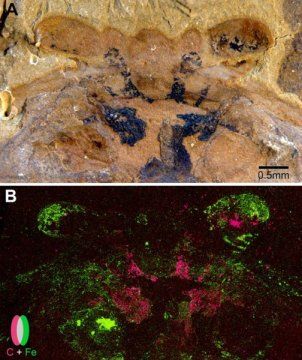
© Strausfeld et al. and Current BiologyA: Under a light microscope, the above fossil shows traces of preserved neural tissues in black. B: An elemental scan of this fossil uncovered that carbon (in pink) and iron (in green) do not overlap in the preserved neural tissue.
Science has long dictated that brains don't fossilize, so when Nicholas Strausfeld co-authored the first ever report of a fossilized brain in a 2012 edition of Nature, it was met with "a lot of flack."

"It was questioned by many paleontologists, who thought -- and in fact some claimed in print -- that maybe it was just an artifact or a one-off, implausible fossilization event," said Strausfeld, a Regents' professor in UA's Department of Neuroscience.

His latest paper in Current Biology addresses these doubts head-on, with definitive evidence that, indeed, brains do fossilize.

In the paper, Strausfeld and his collaborators, including Xiaoya Ma of Yunnan Key Laboratory for Palaeobiology at China's Yunnan University and Gregory Edgecombe of the Natural History Museum in London, analyze seven newly discovered fossils of the same species to find, in each, traces of what was undoubtedly a brain.

Magnify

Complex grammar of the genomic language

Image
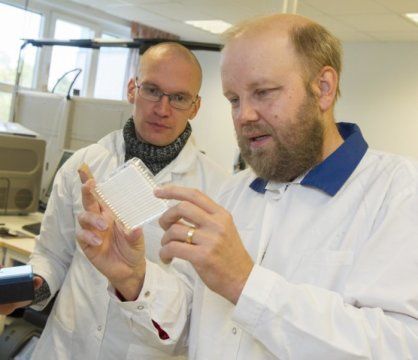
© Ulf SirbornResearchers Arttu Jolma and Jussi Taipale in the lab at the Department of Biosciences and Nutrition, Karolinska Institutet in Sweden.
A new study from Sweden's Karolinska Institutet shows that the 'grammar' of the human genetic code is more complex than that of even the most intricately constructed spoken languages in the world. The findings, published in the journal Nature, explain why the human genome is so difficult to decipher -- and contribute to the further understanding of how genetic differences affect the risk of developing diseases on an individual level.

"The genome contains all the information needed to build and maintain an organism, but it also holds the details of an individual's risk of developing common diseases such as diabetes, heart disease and cancer," says study lead-author Arttu Jolma, doctoral student at the Department of Biosciences and Nutrition. "If we can improve our ability to read and understand the human genome, we will also be able to make better use of the rapidly accumulating genomic information on a large number of diseases for medical benefits."

The sequencing of the human genome in the year 2000 revealed how the 3 billion letters of A, C, G and T, that the human genome consists of, are ordered. However, knowing just the order of the letters is not sufficient for translating the genomic discoveries into medical benefits; one also needs to understand what the sequences of letters mean. In other words, it is necessary to identify the 'words' and the 'grammar' of the language of the genome.