Science & TechnologyS


Satellite

NASA's Cassini finds monstrous ice cloud in south polar region of Saturn's moon Titan

Image
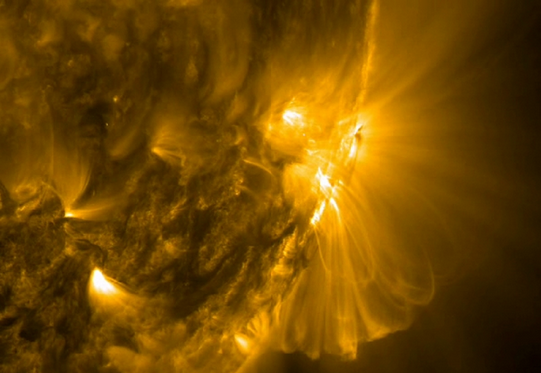
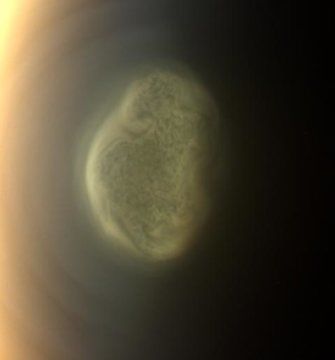
© NASA/JPL-Caltech/Space Science InstituteThis 2012 close-up offers an early snapshot of the changes taking place at Titan's south pole. Cassini's camera spotted this impressive cloud hovering at an altitude of about 186 miles (300 kilometers). Cassini s thermal infrared instrument has now detected a massive ice cloud below it.
New observations made near the south pole of Titan by NASA's Cassini spacecraft add to the evidence that winter comes in like a lion on this moon of Saturn.

Scientists have detected a monstrous new cloud of frozen compounds in the moon's low- to mid-stratosphere -- a stable atmospheric region above the troposphere, or active weather layer.

Cassini's camera had already imaged an impressive cloud hovering over Titan's south pole at an altitude of about 186 miles (300 kilometers). However, that cloud, first seen in 2012, turned out to be just the tip of the iceberg. A much more massive ice cloud system has now been found lower in the stratosphere, peaking at an altitude of about 124 miles (200 kilometers).

The new cloud was detected by Cassini's infrared instrument -- the Composite Infrared Spectrometer, or CIRS -- which obtains profiles of the atmosphere at invisible thermal wavelengths. The cloud has a low density, similar to Earth's fog but likely flat on top.

Eye 1

Your smart TV is tracking your viewing data and sharing it with advertisers

spying eye
Since 9/11, American citizens have become relatively anesthetized to the growth of the surveillance state. However, the NSA's civil liberty transgressions sometimes obscure a reality that is becoming increasingly noxious: private industry is watching us just as voraciously as the government. Sometimes they use cameras, but it seems that more often, they are creating data-driven behavioral profiles of us based on everyday consumption in our own homes.

A troubling new report by ProPublica reveals that Vizio Smart TVs track what we view and report that information in a form that allows advertisers to then directly reach us on other devices. This is a bold new step past previous data collection by Samsung and LG Electronics.

The system is called "Smart Interactivity," and here's how it works: when you watch a Vizio Smart TV, the company assesses samples of what you're viewing to note the date, time, content, and channel of programming, as well as your IP address; Vizio partners with data brokers to link your IP address with your age, gender, income and interests; the new "enhanced data" is given to advertisers, who track all devices associated with that IP address.

Comment: See also: Smart TVs can spy on their owners


Galaxy

New theory might tell us how galactic magnetic fields form

Image
© NASA | FlickrPhysicists at Princeton may have the answer to how magnetic fields form around stars and galaxies ... and it's totally counter-intuitive. Pictured here, charged particles spin along the sun's magnetic field lines, giving us this rare view of its magnetic loops.
Physicists have figured out why we're all so attracted to stars.

For the first time ever, physicists from Princeton Plasma Physics Laboratory (which they call PPPL, even though that's essentially just making a spitting noise) believe they have begun to understand how stars and galaxies form their magnetic fields.

We already know how planets get their magnetic fields. It starts with swirling plasma-like liquids at the planet's core. Those churning liquids conduct electricity and create an electric charge. However, until now, the origin of magnetic fields around stars and galaxies (which are by definition areas that share a large magnetic field) has been a mystery.

Comment:


Satellite

'New Horizons' photo shows psychedelic colors of Pluto

Image
© NASA
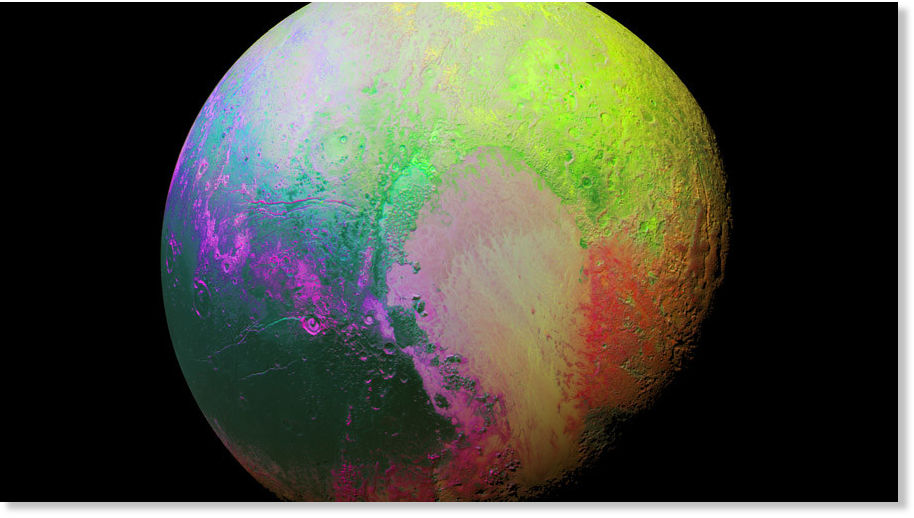
A newly-released photo of Pluto shows the dwarf planet like you've never seen it before - shining in a rainbow of vivid colors. Released by NASA, the 'Psychedelic Pluto' image is the latest in a series of photographs taken by the New Horizons spacecraft.

According to NASA, scientists created the image using a technique called principal component analysis, which highlights the "many subtle color differences between Pluto's distinct regions." The exaggerated colors make it easy for scientists to determine the varied texture and composition of Pluto's surface.

The original photo was taken by the Ralph/MVIC color camera on the New Horizons spacecraft during its historic flyby of the dwarf planet in mid-July. It was snapped from a range of 22,000 miles.

This is just the latest in a string of photos released from the flyby. Last month, an image was released showing the dwarf planet's crescent. Other photos released in October showed Pluto's tiniest moon, which measures just five miles across, and its largest moon, Charon.

Cassiopaea

NASA announces discovery of new pulsar in faraway galaxy

Image
© NASA Goddard / YouTube
Space-watchers have a lot of news to digest after the discoveries of a new pulsar in a faraway galaxy. A Venus-like exoplanet was also spotted, a mere 39 light-years away, and a rocky dwarf planet in our own solar system.

NASA announced on Thursday that its Fermi space telescope has found a gamma-ray pulsar in another galaxy. Dubbed PSR J0540-6919, the rapidly spinning neutron star lies outside the Tarantula Nebula in the Large Magellanic Cloud, a galaxy about 163,000 light-years away.

"It's now clear that a single pulsar... is responsible for roughly half of the gamma-ray brightness we originally thought came from the nebula," said Pierrick Martin, an astrophysicist at the National Center for Scientific Research (CNRS) in Toulouse, France, and lead researcher on the project. "That is a genuine surprise."

Pulsars are neutron stars, left over from supernova explosions. The rapidly spinning magnetic field of the extremely dense star core sends out beams of radio waves, visible light, X-rays and gamma rays. J0540 spins just under 20 times per second, according to data obtained by the Fermi probe.


Telescope

10x sharper than Hubble: Giant Magellan telescope being built in Chile's Atacama Desert


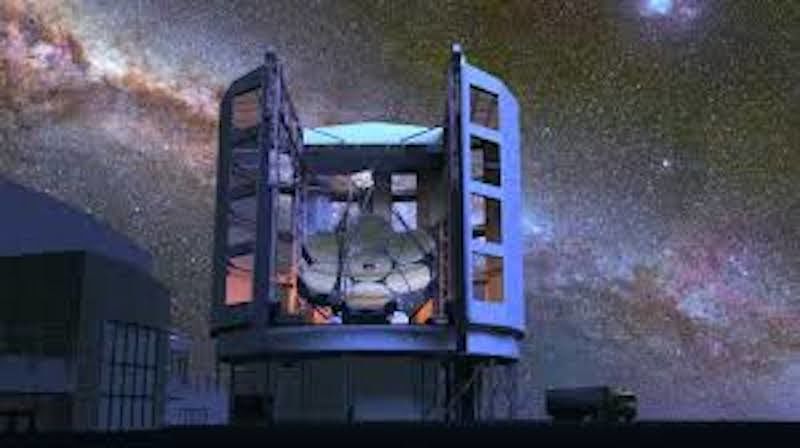
The most powerful ground-based telescope in the world is being built in Chile, enabling astronomers to take pictures of the deep space ten times sharper than those delivered by the Hubble Space Telescope.

The groundbreaking ceremony for the Giant Magellan Telescope (GMT) was held on a remote mountaintop in northern Chile on Wednesday with prominent scientists, top officials, and supporters from an international consortium of universities and research institutions in attendance. Chilean President Verónica Michelle Bachelet Jeria also took part in the ceremony, hosted by the 11-member consortium of the GMT.

The new astronomical facility, expected to begin its early stargazing in 2021, will be constructed on-site at the Las Campanas Observatory in Chile's Atacama Desert, known for its clear, dark skies and outstanding astronomical image clarity.

The unique design of the $500-million optical marvel employs seven huge mirrors, each 8.4 meters (27.5 feet) wide, to make a single telescope with a resolving power of a telescope with a 24.5-meter primary mirror system and a collecting area equivalent to a 22-meter (72.2 ft) telescope -- about 368 square meters (3,961 square ft). "The Giant Magellan Telescope will revolutionize our view and understanding of the universe, and allow us to see and study objects whose light has been traveling for over 13 billion years to reach us.


Comment: Going "beyond" seeing.


Books

Why science needs metaphysics: It doesn't make sense without it

francis bacon
Francis Bacon had no purpose.
Over the past couple of days I have been commenting on the modern debate about philosophy of the mind (see here and here). What follows are some thoughts on scientific versus philosophical discussions of the mind and other matters.

I was at a conference recently and was asked by friends who are quite sympathetic to the immaterial understanding of the mind if I could discuss some of the scientific evidence for it and not rely as heavily as I otherwise do on philosophical reasoning. It's an understandable request, and one that I hear often from allies and adversaries alike.

Indeed there is much scientific evidence that the mind cannot be explained adequately in material terms, especially if one understands matter according to modern mechanical philosophy. I have an aversion to the use of scientific arguments to bolster claims that are inherently logical and metaphysical. Such recourse to scientific, rather than logical and metaphysical, arguments are the mainstay of materialist arguments about the mind, about biology, and about many aspects of physics.

The difficulty with using raw scientific evidence, untethered from a valid metaphysical framework, is that it gives free reign to ideological bias. In that sense our metaphysical framework -- whether explicit or implicit -- is analogous to train tracks, where the trains are our scientific investigations, and the destination is the truth. Our scientific investigations are restricted to the tracks that the trains run on, and if we are to understand the truth of our science we must understand the tracks that constrain our work. If our metaphysical framework is materialistic, the destination of our inquiries will always be materialistic -- we can do no other.

Comment: Science cannot work without certain metaphysical principles, such as the existence and validity of reason and logic, and the existence of truth. These are what make one theory better or worse than another, e.g. more consistent with the facts and non-contradictory. Scientific theories need to measure up to some kind of non-physical standard. But if a scientific philosophy cannot allow for the existence of such a standard, it has no legs to stand on. Without good metaphysics, good science can't exist.


Telescope

Main-belt asteroid shows evidence of March collision

Image
© D. Tholen, SFour-panel image: The top three panels are three different exposures with Subaru with asteroid (493) Griseldis moving from left to right as you move from the first panel to the third one. The bottom panel shows all three exposures added together, after suppressing the galaxy that interferes with the "tail" in the first exposure; the asteroid is on the right.
The main-belt asteroid (493) Griseldis was probably hit by another object last March. The results were reported on November 12 at the annual meeting of the Division for Planetary Sciences of the American Astronomical Society near Washington, DC.

Observations taken with the 8-meter Subaru Telescope on Maunakea on 17 March 2015 UT showed that the main-belt asteroid (493) Griseldis had "an extended feature," which is astronomer-speak for a tail.

However, unlike the tails of comets, which flow in the direction opposite from the sun due to the solar wind, the extension on Griseldis was not in the antisolar direction, and the extension proved to be a short-lived phenomenon.

Additional observations taken with the 6.5-m Magellan telescope four nights later still detected the extension, though it was weaker, but exposures taken with the 2.2-meter University of Hawaii telescope on 24 March UT or Magellan on 18 April UT and 21 May UT showed no such feature, nor did images from telescope archives taken in 2010 and 2012.

Magnify

"Spooky action at a distance" is really real

Image
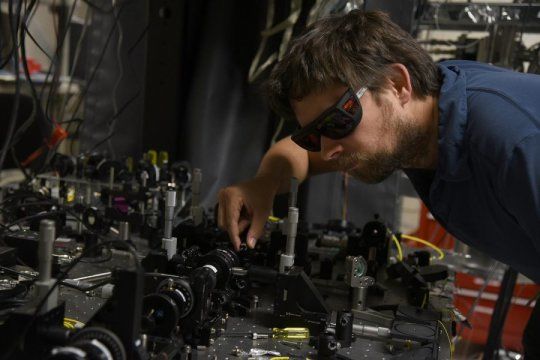
© Burrus/NISTNIST physicist Krister Shalm with the photon source used in the 'Bell test' that strongly supported a key prediction of quantum mechanics: There are in fact 'spooky actions at a distance.'
Einstein was wrong about at least one thing: There are, in fact, "spooky actions at a distance," as now proven by researchers at the National Institute of Standards and Technology (NIST).

Einstein used that term to refer to quantum mechanics, which describes the curious behavior of the smallest particles of matter and light. He was referring, specifically, to entanglement, the idea that two physically separated particles can have correlated properties, with values that are uncertain until they are measured. Einstein was dubious, and until now, researchers have been unable to support it with near-total confidence.

As described in a paper posted online and submitted to Physical Review Letters (PRL), researchers from NIST and several other institutions created pairs of identical light particles, or photons, and sent them to two different locations to be measured. Researchers showed the measured results not only were correlated, but also--by eliminating all other known options--that these correlations cannot be caused by the locally controlled, "realistic" universe Einstein thought we lived in. This implies a different explanation such as entanglement.

Telescope

5400mph winds discovered hurtling around planet outside solar system

Image
© Mark A. Garlick/University of WarwickThe planet HD 189733b is shown here in front of its parent star. A belt of wind around the equator of the planet travels at 5400mph from the heated day side to the night side. The day side of the planet appears blue due to scattering of light from silicate haze in the atmosphere. The night side of the planet glows a deep red due to its high temperature.
Winds of over 2km per second have been discovered flowing around planet outside of the Earth's solar system, new research has found.

The University of Warwick discovery is the first time that a weather system on a planet outside of Earth's solar system has been directly measured and mapped. The wind speed recorded is 20x greater than the fastest ever known on earth, where it would be seven times the speed of sound.

Commenting on the discovery lead researcher Tom Louden, of the University of Warwick's Astrophysics group, said: "This is the first ever weather map from outside of our solar system. Whilst we have previously known of wind on exoplanets, we have never before been able to directly measure and map a weather system."