Science & TechnologyS


Beaker

No surprise: Study shows Corexit dispersant not helpful in degrading Deepwater Horizon oil slick

deepwater horizon
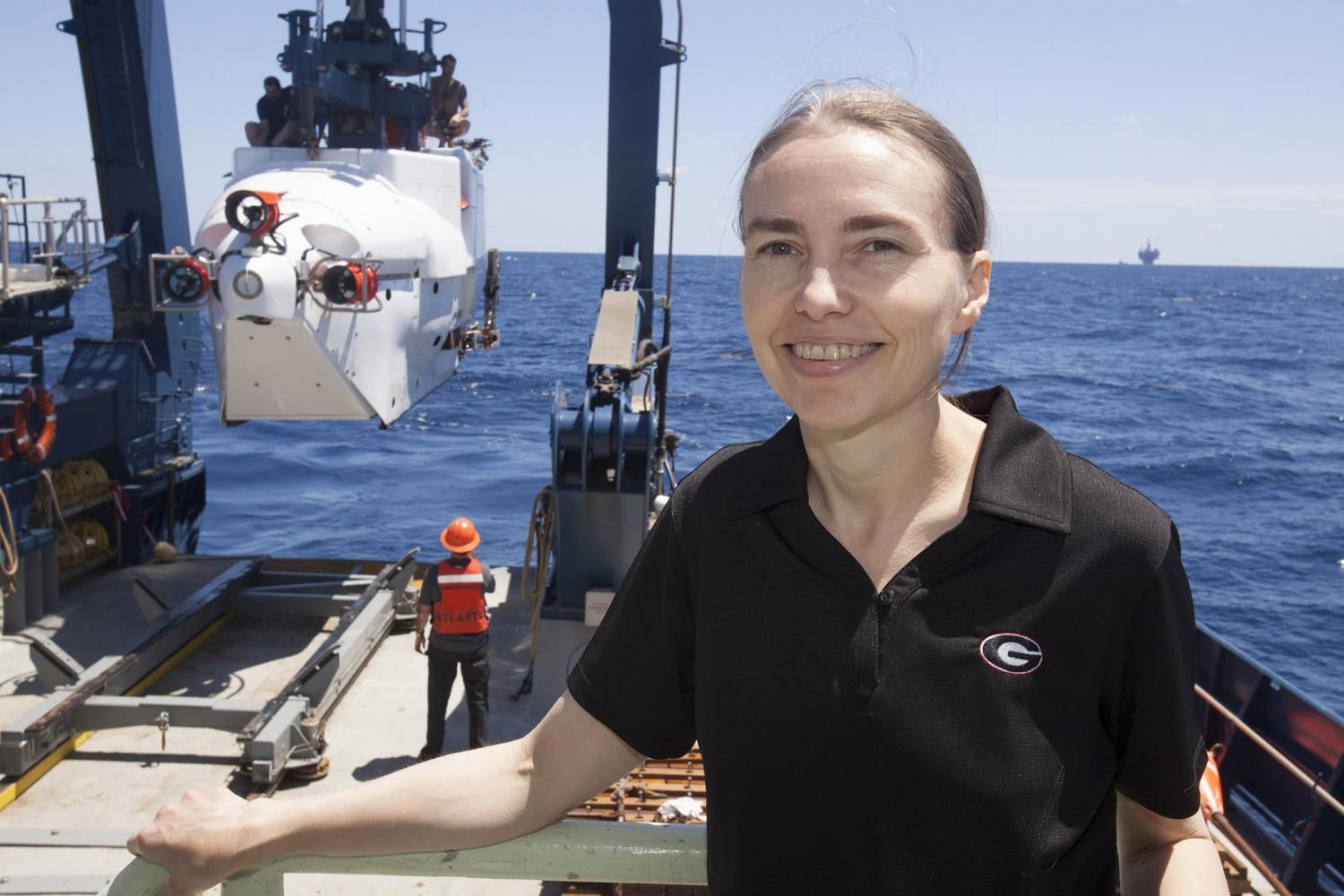
© Todd Dickey/University of Georgia Samantha Joye, a professor of marine sciences in the University of Georgia Franklin College of Arts and Sciences, studies the oil plumes generated by the 2010 Deepwater Horizon blowout.
The chemical sprayed on the 2010 BP oil spill may not have helped crucial petroleum-munching microbes get rid of the slick, a new study suggests.

And that leads to more questions about where much of the Deepwater Horizon oil spill went. If the new results are true, up to half the oil can't be accounted for, said the author of a new study on the spill in the Gulf of Mexico.

After the 172 million gallon (650 million liter) spill, the chemical dispersant Corexit 9500 was applied by airplane on the slick to help it go away and help natural microbes in the water eat the oil faster. The oil appeared to dissipate, but scientists and government officials didn't really monitor the microbes and chemicals, said University of Georgia marine scientist Samantha Joye.

So Joye and colleagues recreated the application in a lab, with the dispersant, BP oil and water from the gulf, and found that it didn't help the microbes at all and even hurt one key oil-munching bug, according to a study published Monday in the journal Proceedings of the National Academy of Sciences.

Comment: The government's consent to BP's use of Corexit has caused long-term human and ecological tragedies that may be worse than the original spill. Millions of gallons of the dispersant were used to 'disappear' the gushing oil in the Macondo Prospect. Disappearing the oil actually meant sinking it, after micronizing it, so that both BP and the US Federal Government could be 'applauded' for a successful response. However, the known health risks/dangers and environmental damage caused by Corexit became so well publicized that it has now been banned in those countries which have learned from the BP fiasco.


Nebula

Most powerful explosion since Big Bang detected

largest explosion big bang
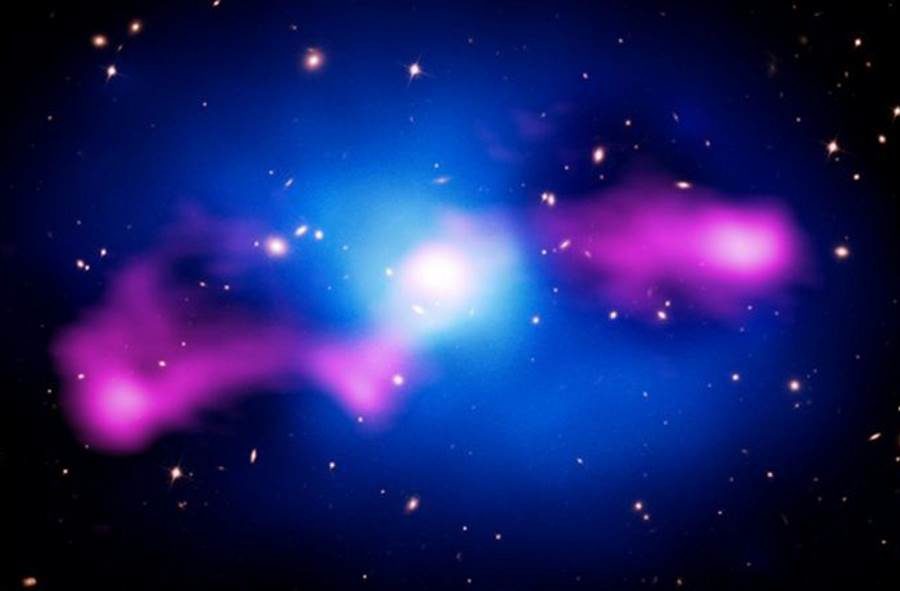
© NASA/CXC/Univ. of Waterloo/A.Vantyghem/STScI/NRAO/VLAThis combined X-ray, radio and visible light image of galaxy cluster MS 0735.6+7421 shows the continuing eruption of the most powerful explosion since the big bang.
Bathed in bright blue and fluorescent pink light, the galaxy cluster in this image is home to the most powerful explosion since the big bang. What's more, the explosion is ongoing and has been continuing for the last 100 million years, releasing as much energy as hundreds of millions of gamma ray bursts.

The blast is generated by the largest black hole in the known universe, a gravitational monster over 10 billion times the mass of our sun. Astronomers calculate this behemoth has consumed almost 600 million times the mass of the sun in order to generate such a powerful explosion.

To create the image, X-ray and radio wave data was combined with optical images from the Hubble Space Telescope. The X-rays are shown in blue and were detected by NASA's Chandra X-Ray Observatory. They indicate the hot gas that makes up most of the mass of this enormous galaxy cluster.

Shown in pink are vast cavities each over 600,000 light-years in diameter, blasted out by powerful supersonic jets from the gargantuan galaxy at the very heart of this image. These cavities have displaced a trillion suns' worth of mass and have been filled with magnetized, extremely high-energy electrons emitting radio waves, which were detected by the Very Large Array radio telescope.

Most, if not all, galaxies are thought to contain supermassive black holes at their centers. Astronomers are still trying to determine which forms first — the black hole, or the galaxy around it.

Galaxy cluster MS 0735.6+7421 is located 2.6 billion light-years away in the constellation Camelopardalis, the Giraffe.

Telescope

Pluto's surprises continue

green pluto
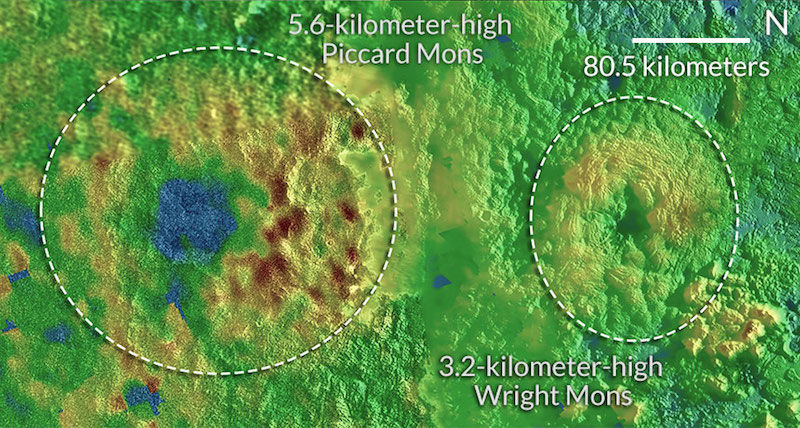
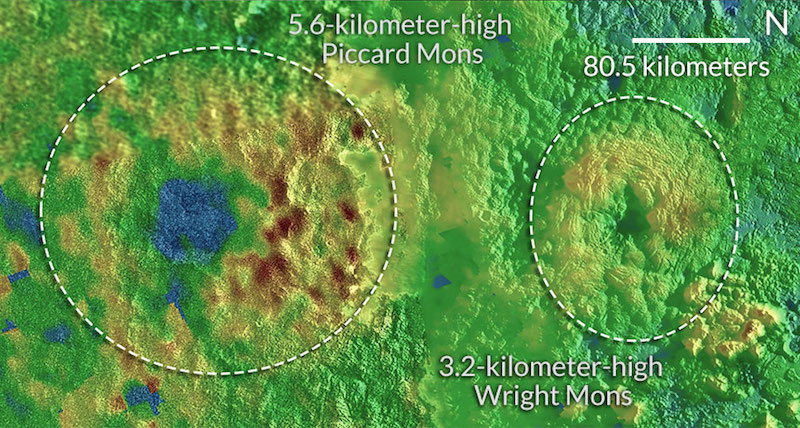
© SWRI, JHUAPL, NASAOUT-OF-THIS-WORLD LANDSCAPE The latest data from the New Horizons mission has helped create topographical maps of Pluto (blue shows lower elevations, brown, higher elevations) that have revealed surprises such as these two possible ice volcanoes, the first of their kind in the outer solar system.
Spinning moons, possible ice volcanoes detected on dwarf planet

At this point, the only thing unsurprising about Pluto is that it continues to offer up surprises. A wide variety of landscapes, ongoing surface transformations and a family of wildly spinning moons are among the riddles reported by the New Horizons mission team November 9 at a meeting of the American Astronomical Society's Division for Planetary Sciences.

Terrains both new and old sit side-by-side on Pluto's surface. Some heavily cratered regions are roughly 4 billion years old, about as old as Pluto itself. Others, like the now famous heart, appear to have been laid down within the last 10 million years, judging by the total lack of craters.

Two mountains look strangely similar to shield volcanoes back on Earth. On Pluto, though, the volcanoes would spew ice, not rock. "There's nothing like this seen in the outer solar system," says Oliver White, a planetary scientist at the NASA Ames Research Center in Moffett Field, Calif. The mountains aren't definitely volcanoes, but researchers aren't sure what else to call them. "Whatever they are, they're definitely weird," says White.

Whirling far above Pluto, four tiny satellites — Nix, Hydra, Kerberos and Styx — are also behaving unexpectedly (SN Online: 11/2/15). Pluto's gravity should have slammed on the brakes and slowed down their spins. But the rapidly twirling moons seem to be unfazed. Hydra, the outermost moon, whips around its axis about 89 times during each loop around Pluto and Charon. Nix, meanwhile, appears to be flipped nearly upside down while the other three tiny moons might be spinning on their sides. "This is unprecedented," says planetary scientist Mark Showalter of the SETI Institute in Mountain View, Calif., who discovered Kerberos and Styx several years after New Horizons launched. "We've never seen anything like this before, and we still don't know what to make of it."

Published on Nov 9, 2015 Most inner moons in the solar system keep one face pointed toward their central planet; this animation shows that certainly isn't the case with the small moons of Pluto, which behave like spinning tops. Pluto is shown at center with, in order, from smaller to wider orbit: Charon, Styx, Nix, Kerberos, Hydra.

Comment: See also:
'New Horizon' sends back stunning images of Pluto's atmosphere, giant ice mountains
NASA probe New Horizons sends puzzling, unexpected photos from Pluto


Info

Generate electric to power your house with a daily workout

Image
Just imagine that you can workout for one hour at home, and that workout will generate enough power to supply your house of electricity for 24 hours. Now that is what I call great.

Comment: We have been unconscious users and wasters of electricity and water for the total period of late-modern man, with perhaps the exception of the late 1800's. A big reality check is coming.


Apple Green

Environment: A greener way to die

green burial
© landarchs.com
Are We Doing Our Worst Environmental Damage From the Grave?

Back in the early '60's Jessica Mitford wrote a shocking book — The American Way of Death — that exposed how the funeral industry took advantage of the aggrieved with expensive and unnecessary burial practices. Now we are learning that this $15 billion-a-year business is also unsustainable — and highly destructive to the environment.
Consider this: the millions of gallons of toxic embalming fluid used to pretty up and "preserve" corpses eventually find their way into the ground, contaminating soil and water resources. And the iron, lead, copper, zinc, and cobalt used in caskets and vaults also contaminate the soil. Even cremation isn't nearly as clean as you might think. Crematories release by-products from embalming fluid, dental fillings, surgical devices, etc.
Eco-cemetery
© inhabitat.comEco cemetery offers natural burials.
Enter the "Green Burial" movement that advocates burying a body, without embalming, in a biodegradable container that allows direct immersion into the earth — and the body returns to the land and to the cycle of life.

Suzanne Kelly, PhD — author of Greening Death: Reclaiming Burial Practices and Restoring Our Tie to the Earth, (Rowman & Littlefield Publishers, September 2015) — has been a chief advocate for this practice. Kelly's work, which she discusses in this podcast with Jeff Schechtman, is beginning to have an impact. She says that today families are starting to push back on non-sustainable practices.

"Death is understood to be a path to environmental protection," says Kelly. "The Green burial offers us the possibility of restoring our lost relationship to the land."


Comment: When ya gotta go...go green! "Dust to dust"...what kind matters!


Jupiter

Data from surveyor Rover Spirit indicates acid 'fog" eroding Martian rocks

Mars
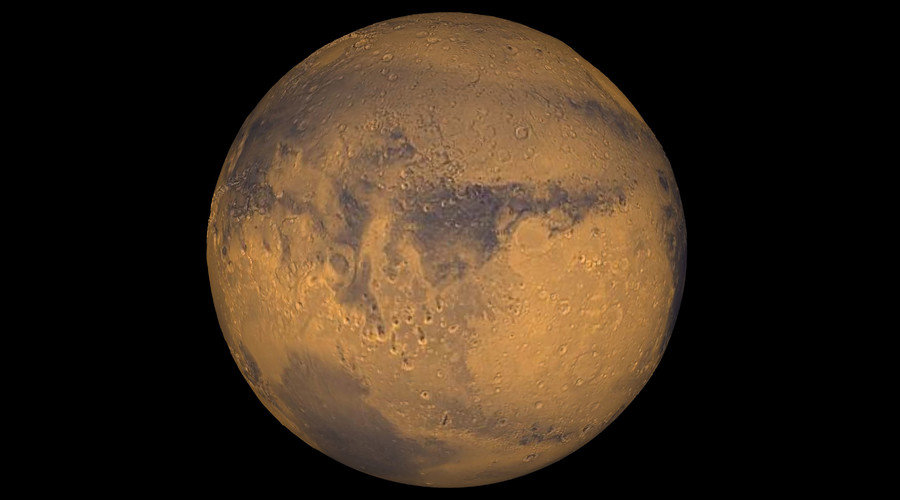
© Greg Shirah / ReutersThe planet Mars showing showing Terra Meridiani is seen in an undated NASA image.
Scientists believe they have figured out why rocks on Mars are eroding. They say an acidic fog created by volcanic eruptions on the red planet is the probable culprit.

Planetary scientist Shoshanna Cole came up with the theory after studying a 100-acre area on Husband Hill in the Columbia Hills of the Gusev Crater on Mars using data gathered by a number of instruments on the 2003 Mars Exploration Rover Spirit.

She found that acidic vapors released by eruptions may have been responsible for eating away rocks on the Watchtower Class outcrops on the Cumberland Ridge and Husband Hill summit.

"The special thing about Watchtower Class is that it's very widespread and we see it in different locations. As far as we can tell, it is part of the ground there," which means that these rocks record environments that existed on Mars billions of years ago, Cole said in a press release submitted by the Geological Society of America.

Sun

Climatologists create atlas showing a millennium of droughts and downpours

Image
© Wikimedia commonsQueen Mary's Psalter shows men harvesting in 14th century Europe.
The new Old World Drought Atlas of droughts and wet weather in the Old World gives climate scientists greater perspective on current weather phenomenon.

Climate scientists have produced an atlas reconstructing weather conditions over the last millennium, in an effort to understand more about current changes to the weather.

They hope their Old World Drought Atlas (OWDA) will allow for a greater understanding of climate forecasts.

"Climate model projections suggest widespread drying in the Mediterranean Basin and wetting in Fennoscandia in the coming decades largely as a consequence of greenhouse gas forcing of climate," write the scientists in their paper, published in Science Advances on Friday.

Beaker

New medical diagnostic test: Scientists use sound waves to levitate cells

acoustic levitation machine
Utah Valley University physicists are literally applying rocket science to the field of medical diagnostics. With a few key changes, the researchers used a noninvasive ultrasonic technique originally developed to detect microscopic flaws in solid fuel rockets, such as space shuttle boosters, to successfully detect cell stiffness changes associated with certain cancers and other diseases.

The method combines a low-frequency ultrasonic wave to levitate the cells and confine them to a single layer within a fluid and a high-frequency ultrasonic wave to measure the cell's stiffness.
"An acoustic wave is a pressure wave so it travels as a wave of high and low pressure. By trapping a sound wave between a transducer — such as a speaker — and a reflective surface, we can create a 'standing wave' in the space between," explained research assistant Brian Patchett. "This standing wave has stationary layers of high and low pressure, a.k.a. 'anti-nodes,' and areas, 'the nodes' where the pressure remains the same."

Bulb

Speaking in tongues: the many benefits of bilingualism

Image
© Cambridge University Photo Library, Author providedBilingualism unlocks the way words work.
We live in a world of great linguistic diversity. More than half of the world's population grows up with more than one language. There are, on the other hand, language communities that are monolingual, typically some parts of the English-speaking world.

In this case, bilingualism or multilingualism can be seen as an extraordinary situation - a source of admiration and worry at the same time. But there are communities where bilingualism or multilingualism are the norm - for example in regions of Africa. A Cameroonian, for example, could speak Limbum and Sari, both indigenous languages, plus Ewondo, a lingua franca, plus English or French, the official languages, plus Camfranglais, a further lingua franca used between anglophone and francophone Cameroonians.

Comment:


Bulb

'Charge density wave': A new dimension to high-temperature superconductivity discovered

high-temperature superconducto
© SLAC National Accelerator LaboratoryIn this artistic rendering, a magnetic pulse (right) and X-ray laser light (left) converge on a high-temperature superconductor to study the behavior of its electrons.
A team led by scientists at the Department of Energy's SLAC National Accelerator Laboratory combined powerful magnetic pulses with some of the brightest X-rays on the planet to discover a surprising 3-D arrangement of a material's electrons that appears closely linked to a mysterious phenomenon known as high-temperature superconductivity.

This unexpected twist marks an important milestone in the 30-year journey to better understand how materials known as high-temperature superconductors conduct electricity with no resistance at temperatures hundreds of degrees Fahrenheit above those of conventional metal superconductors but still hundreds of degrees below freezing. The study was published today in Science.

The study also resolves an apparent mismatch in data from previous experiments and charts a new course for fully mapping the behaviors of electrons in these exotic materials under different conditions. Researchers have an ultimate goal to aid the design and development of new superconductors that work at warmer temperatures.