Science & TechnologyS


Magnify

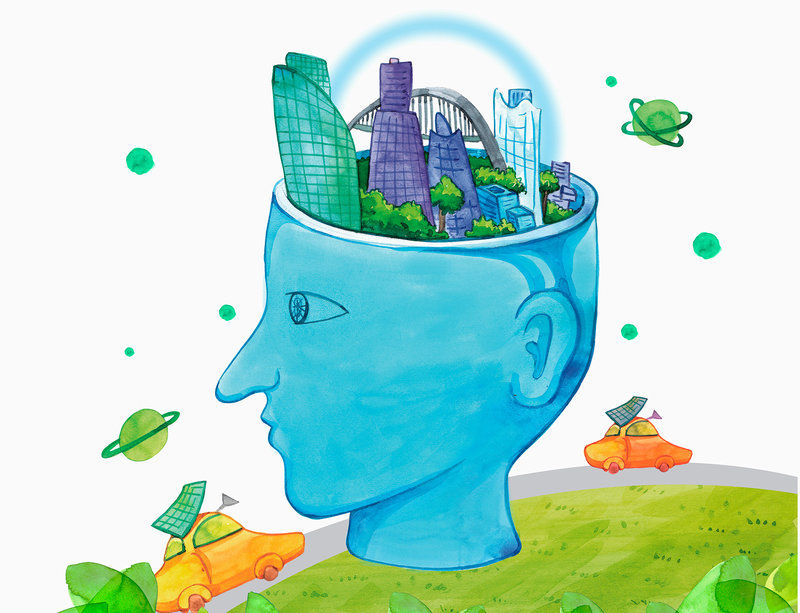
The brain's GPS may also help us map our memories

Image
© TongRo Images/Corbis
A brain system that helps us find our way to the supermarket may also help us navigate a lifetime of memories.

At least, that's the implication of a study of rats published in the journal Neuron.

It found that special brain cells that track an animal's location also can track time and distance. This could explain how rat and human brains are able to organize memories according to where and when an event occurred.

The cells, called grid cells, appear to be "laying down the sequence of space and time that provide a framework for events that are unfolding," says Howard Eichenbaum, an author of the study and director of the Center for Memory and Brain at Boston University.

Info

Study finds supervolcanoes likely triggered by an 'external mechanism'

supervolcano
Supervolcanoes, massive eruptions with potential global consequences, appear not to follow the conventional volcano mechanics of internal pressure building until the volcano blows. Instead, a new study finds, such massive magma chambers might erupt when the roof above them cracks or collapses.

Knowledge of triggering mechanisms is crucial for monitoring supervolcano systems, including ones that lie beneath Yellowstone National Park and Long Valley, California, according to the study led by Patricia Gregg, University of Illinois professor of geology, in collaboration with professor Eric Grosfils of Pomona College and professor Shan de Silva of Oregon State University. The study was published in the Journal of Volcanology and Geothermal Research. Gregg also presented the findings this week at the annual meeting of the Geological Society of America.

"If we want to monitor supervolcanoes to determine if one is progressing toward eruption, we need better understanding of what triggers a supereruption," Gregg said. "It's very likely that supereruptions must be triggered by an external mechanism and not an internal mechanism, which makes them very different from the typical, smaller volcanoes that we monitor."

A supervolcano is classed as more than 500 cubic kilometers of erupted magma volume. For comparison, Gregg said, Mount St. Helen's ejected about one cubic kilometer of material, so a supervolcano is more than five hundred times larger.

Comment: The 'external mechanism' for triggering supervolcanoes (and other natural phenomena) could be Nemesis - Sol's dark companion. As Earth 'opens up' we are seeing an increase and intensification of lightning strikes, Jet stream meanderings, Gulf stream slow-downs, hurricanes, earthquakes, volcanic eruptions, meteor fireballs, tornadoes, deluges, sinkholes and noctilucent clouds.

SOTT Earth Changes Summary - September 2015: Extreme Weather, Planetary Upheaval, Meteor Fireballs

See Earth Changes and the Human Cosmic Connection by Pierre Lescaudron and Laura Knight-Jadczyk, for more in depth explanations of these related Earth changes, the application of the Electric Universe paradigm and plasma physics, and how they may be connected to a common cause - the close approach of our Sun's 'twin' and an accompanying cometary swarm.

Perhaps 'something wicked this way comes?'


Sherlock

Not just neurons! Genes play a significant role in behavior and brain activity

brain genes
© Unknown
It's not headline news that our brains are the seat of our thoughts and feelings. The brain is a body's decision-maker, the pilot of its actions and the engineer that keeps all systems going. The brain suits the body's actions to its surroundings, taking in sensory details and sending out appropriate and timely responses. We've long attributed the marvelous workings of the brain to the intricate structures formed by its highly specialized cells, neurons. These structures constitute the hardware of the brain.

But new genomic research reveals that, at an even deeper level, emotions and behavior are also shaped by a second layer of organization in the brain, one that we only recently created the tools to see. This one relies on genes.

We are beginning to appreciate how genes and neurons work together, like software and hardware, to make brain function possible. Learning to understand this two-layer system can help us understand how the environment affects behavior, and how to hack the system to improve mental health.

It is time to fully recognize gene activity not as the background utility of the brain, but as an integral part of its operation.

Beaker

Scientists finally have an answer to what makes us scratch an itch

itch science nervous system
Having an itch can be incredibly annoying but it actually serves an important function, protecting us from damage to our skin. However, scientists have long struggled to explain what actually causes the sensation - in particular why some types of touch cause an itch whereas others do not.

Now a new study in mice has shed light on what actually happens in the body when we want to scratch an itch. The research, published in Science, could lead to treatments for many thousands of people suffering from chronic itch, a disorder causing an intense desire to scratch.

A hairy problem

The itching sensation usually occurs following a light touch on the hairy skin of our bodies. This triggers us to move our hand to the source of the insult and scratch away at it. While seemingly mindless, this simple behaviour is our body's neat way of attempting to protect us from damage to our skin from objects in the environment or nasty insects and parasites.

The protective element comes from the fact that by scratching you may disturb whatever is on your skin causing the itch - just as when a mosquito lands on your arm and the tickle causes you to scratch the site and dislodge that freeloading blood sucker. What clever bodies we have.

Beaker

Japanese researchers make glass that's almost as strong as steel

magnifying glass
© unknown
Scientists in Japan say they've fashioned glass that's almost as strong as steel.

The ability to make super strong glass could lead to a whole new generation of windows in buildings and vehicles, but could also prove useful in screens for electronics, like tablets, computers, and smartphones. The team, from the University of Tokyo's Institute of Industrial Science, had their findings published earlier this month in Scientific Reports by Nature.

"We are looking to commercialize the technique within five years," University of Tokyo assistant professor Atsunobu Masuno told Asahi Shimbun.

Here's the secret ingredient in such tough glass: alumina. It's an oxide of aluminum, and mixing it with silicon dioxide makes glass way tougher. Problem is, when scientists have tried to use large amounts of alumina in the past, it caused the mixture to crystallize as soon as it touched any kind of container, preventing glass from being formed.

So the Tokyo team brewed up a method of making glass that required no container at all: they used gas to push the chemical components into the air, where they synthesized together. The result? A transparent ultra glass that's 50% alumina and rivals the Young's modulus of steel and iron, which measures rigidity and elasticity in solids.

The practical uses are broad, since the study notes that alumina glass made via aerodynamic levitation can yield a product that's thin, light, and has excellent optical properties. We say, bring on commercialization.

Rocket

US Air Force rocket disintegrates one minute after launch from Hawaii

'Super Strypi' rocket
© Usaf / Wikipedia
The US Air Force has confirmed that its 'Super Strypi' sounding, or research, rocket has broken up on launch as its booster gained excessive rotation, destroying the vehicle a minute after lift-off.

"The ORS-4 mission on an experimental Super Strypi launch vehicle failed in mid-flight shortly after liftoff at 5:45 p.m.," the US Air Force said in a statement.


The launch was carried out from the Pacific Missile Range Facility on the Hawaiian island of Kauai late Tuesday, November 3.

The launch of a modified, three-stage Strypi rocket has been postponed several times over the last two years, since October 2013, due to technical problems.

Comment: Other rocket launch failures this year include:

SpaceX rocket to ISS explodes two minutes after launch

What's going on? Russian Proton rocket feared lost after another botched launch


Frog

The surprising trick jellyfish use to swim

Image
© francescopaoli / FotoliaJellyfish swimming in the ocean. Millions of years ago, even before the continents had settled into place, jellyfish were already swimming the oceans with the same pulsing motions we observe today.
Millions of years ago, even before the continents had settled into place, jellyfish were already swimming the oceans with the same pulsing motions we observe today.

Now through clever experiments and insightful math, an interdisciplinary research team has revealed a startling truth about how jellyfish and lampreys, another ancient species that undulate like eels, move through the water with unmatched efficiency.

"It confounds all our assumptions," said John Dabiri, a professor of civil and environmental engineering and of mechanical engineering at Stanford. "But our experiments show that jellyfish and lampreys actually suck water toward themselves to move forward instead of pushing against the water behind them, as had been previously supposed."

This new understanding of motion in fluids is published in a Nature Communications article that Dabiri co-authored with Brad Gemmell of the University of South Florida, Sean Colin of Roger Williams University and John Costello of Providence College.

Saturn

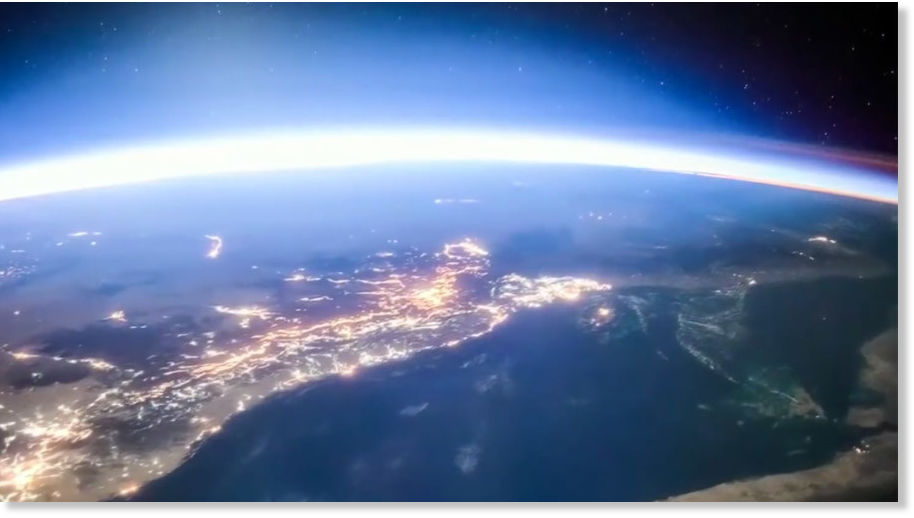
5 of the most stunning views from the ISS over its first 15 years

Image
© Ruptly
When Expedition 1 reached the International Space Station on November 2, 2000, neither GoPro, nor YouTube had been invented, and most people only saw momentary glimpses from space on the news. The ISS and Earth-made technology have changed all that.

Here are five of the most captivating sequences shot from the space station.


Made in 2011, this is the most popular ISS video on the internet - and deservedly so. Hundreds of photos were combined and put into a time lapse sequence, creating a fantastical odyssey, which is, nonetheless, absolutely real. As the music booms, our eyes sweep over networks of roads and settlements, flashing storms, and mysterious auroras above - a sight that make us see our home planet with fresh eyes.

Magnify

Diamonds may not be so rare as once thought

Image
© lienkie / FotoliaDiamond mine.
Diamonds may not be as rare as once believed, but this finding in a new Johns Hopkins University research report won't mean deep discounts at local jewelry stores.

"Diamond formation in the deep Earth, the very deep Earth, may be a more common process than we thought," said Johns Hopkins geochemist Dimitri A. Sverjensky, whose article co-written with doctoral student Fang Huang appears today in the online journal Nature Communications. The report says the results 'constitute a new quantitative theory of diamond formation,' but that does not mean it will be easier to find gem-quality diamonds and bring them to market.

For one thing, the prevalence of diamonds near the Earth's surface -- where they can be mined -- still depends on relatively rare volcanic magma eruptions that raise them from the depths where they form. For another, the diamonds being considered in these studies are not necessarily the stuff of engagement rings, unless the recipient is equipped with a microscope. Most are only a few microns across and are not visible to the unaided eye.

Magnify

Hippocampus essential for recognition memory, study shows

Image
© Medical News TodayThe researchers found elevated high-frequency neuron firing activity in the hippocampus when the participants correctly identified a word they had seen before.
The hippocampus - a small region of the brain known to be important for memory and spatial navigation - supports both recollection and familiarity, the two processes of recognition memory.

This was the conclusion of new research published in the Proceedings of the National Academy of Sciences.

The findings settle a long-standing debate about the role of the hippocampus in recognition memory, note the authors, from the University of Pennsylvania in Philadelphia.

Recognition memory helps us identify something we have come across before. A prominent theory about this aspect of memory is that it comprises recollection - the recovery of vivid details and familiarity - where there is a general sense of the experience but no details.