Science & TechnologyS


Sun

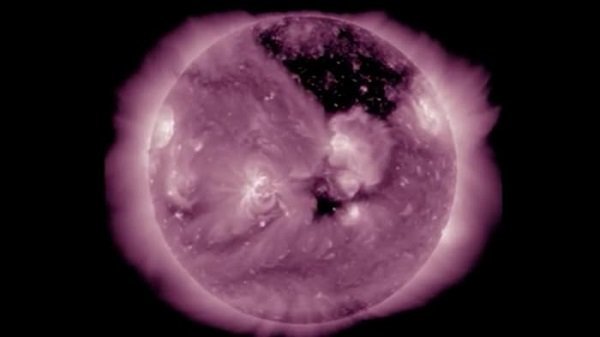
NASA peers into huge coronal hole

coronal hole
© NASAAlthough we're not sure what causes them, coronal holes can have a dramatic impact on our magnetosphere.
While you might think the sun has pretty much just one weather pattern - blistering and violent with a chance of radiation poisoning - it can actually be quite varied. One of the lesser-known weather phenomena on the sun's surface are coronal holes, like the massive one that was recently captured by NASA's Solar Dynamics Observatory (SDO) and featured this week in a short video from the space agency.

"Coronal holes are low-density regions of the sun's atmosphere, known as the corona," says NASA. "Because they contain little solar material, they have lower temperatures and thus appear much darker than their surroundings. Coronal holes are visible in certain types of extreme ultraviolet light, which is typically invisible to our eyes, but is colorized here in purple for easy viewing." The holes are also visible in x-ray wavelengths.

Network

Microsoft, Facebook laying massive cable across the Atlantic ocean

Transatlantic cable
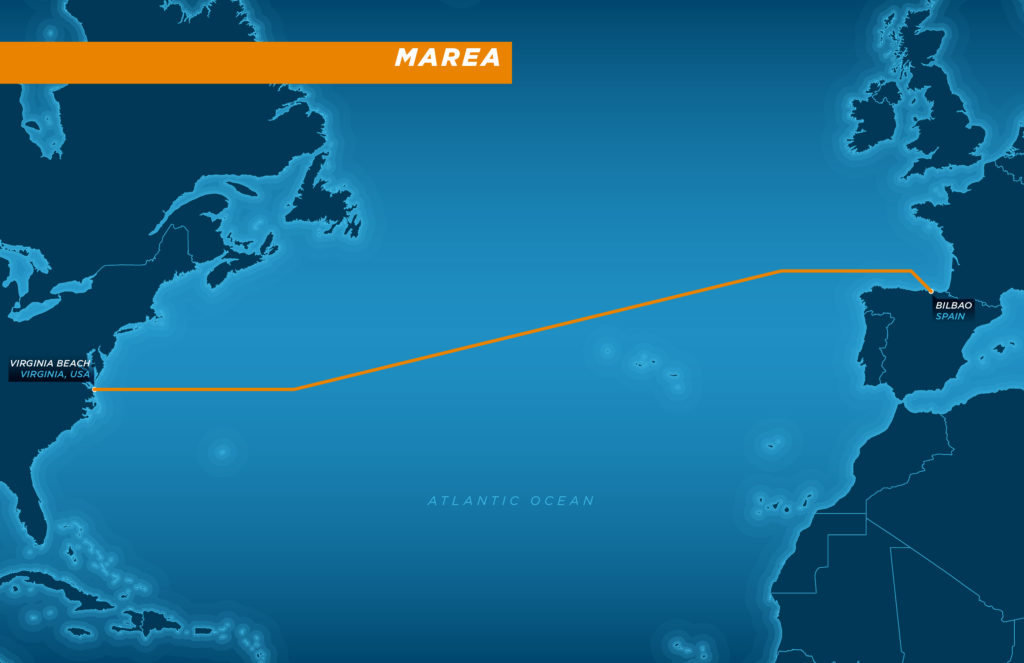
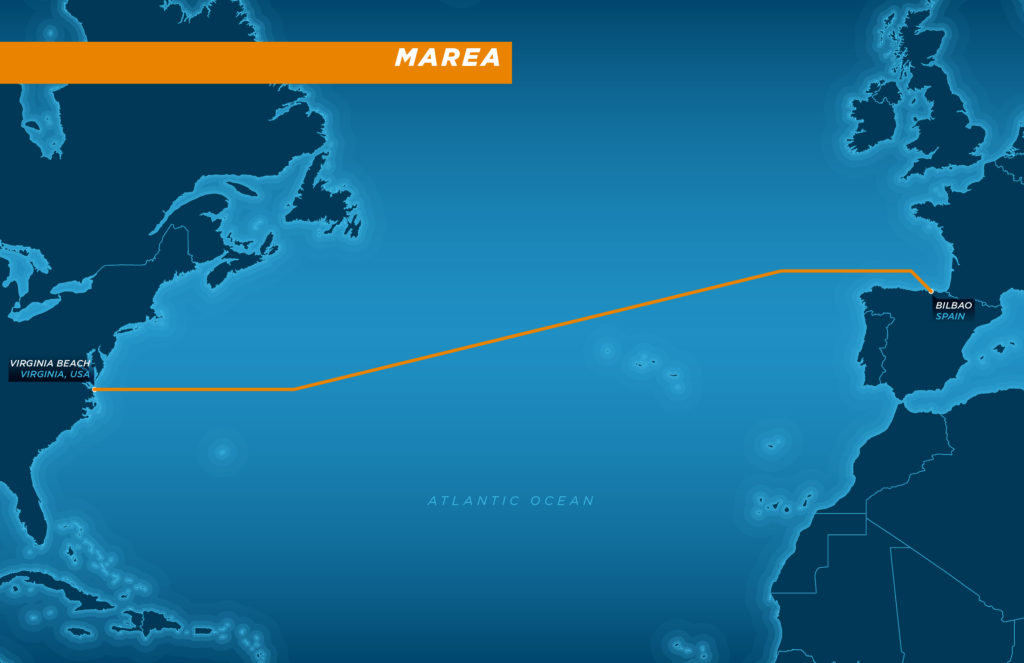
© Microsoft/FacebookMAREA Overview Schematic
Facebook and Microsoft are laying a massive cable across the middle of the Atlantic.

Dubbed MAREA—Spanish for "tide"—this giant underwater cable will stretch from Virginia to Bilbao, Spain, shuttling digital data across 6,600 kilometers of ocean. Providing up to 160 terabits per second of bandwidth—about 16 million times the bandwidth of your home Internet connection—it will allow the two tech titans to more efficiently move enormous amounts of information between the many computer data centers and network hubs that underpin their popular online services.

"If you look at the cable systems across the Atlantic, a majority land in the Northeast somewhere," says Najam Ahmad, Facebook's vice president of network engineering. "This gives us so many more options."

The project expands the increasingly enormous computer networks now being built by the giants of the Internet as they assume a role traditionally played by telecom companies. Google has invested in two undersea cables that stretch from the West Coast of the United States to Japan, another that connects the US and Brazil, and a network of cables that connect various parts of Asia. Rather than just leasing bandwidth on undersea cables and terrestrial connections operated by telecoms, the likes of Google, Facebook, and Microsoft are building their own networking infrastructure both on land and across the seas.

The fact that these Internet giants are laying their own cables—at their own expense—shows just how much data these giants must move. Consider the services they run: Google offers its eponymous search engine, Gmail, Google Docs, Google Maps, and so many more. Microsoft offers Bing, Office365, and its Azure cloud services. Facebook has its social network along with Facebook Messenger, WhatsApp, and Instagram. The data moved by just a few online giants now dwarfs that of most others, so much so that, according to telecommunications research firm Telegeography, more than two thirds of the digital data moving across the Atlantic is traveling on private networks—namely networks operated by the likes of Google, Microsoft, and Facebook. That's up from 10 percent just a few years ago. "It's a tremendous change," says Telegeography analyst Tim Stronge.

Key

Yield! US Army to test driverless vehicles on Michigan interstate

driverless army trucks
© U.S. ArmyA convoy of driverless Army trucks makes its way through the Department of Energy’s Savannah River Site in South Carolina, May 29, 2014.
The U.S. Army is set to send a convoy of vehicles along a stretch of Interstate 69 in Michigan as part of an initial testing of driverless military vehicle equipment on public roadways.

The vehicles will be testing a piece of equipment that is critical to the development of driverless technology.

Representatives from the U.S. Army Tank Automotive Research, Development and Engineering Center and the Michigan Department of Transportation held a public information session on Monday in eastern Michigan to talk about the testing.

Comment: Further reading: Robo bus: Driverless buses are coming to America


Magnify

Confirmed: The soil under your feet is teeming with life

worm
© LadyDragonFlyCC, Global Soil Biodiversity Atlas
A myriapod, part of the group that includes centipedes and millipedes. Myriapods are distinguished by their many legs and long, segmented bodies.
What lies beneath? Researchers hardly know.

That's the message of a new atlas describing the biodiversity of soil, to be released tomorrow (May 25) at the United Nations Environmental Assembly in Nairobi, Kenya.

Dirt, the authors say, is remarkably diverse. There are some 30,000 worm species squirming in the soil around the world, and 5 million species of fungi sending out thread-like branches. Soil even has its own microbiome containing at least a million bacterial species.

But scientists have hardly scratched the surface of this subterranean world. Only about a quarter of worm species, 6 percent of fungi and less than 2 percent of soil bacteria have been studied and categorized.

Comment: For more information, see:


Rocket

Russia unveils plans for reusable space 'shuttle' between ISS and Moon

far side of moon
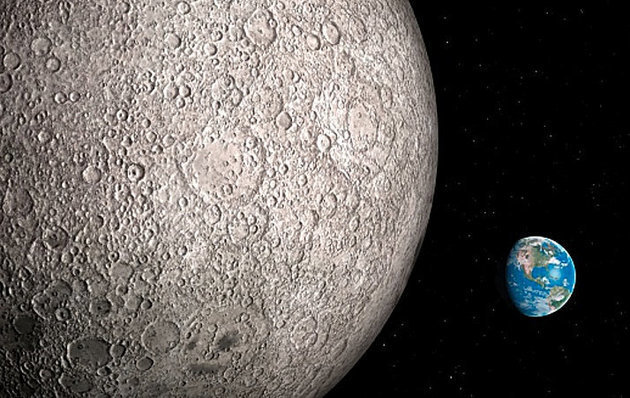
© MARK GARLICK. VIA GETTY IMAGESEarth and the far side of the moon, where the Apollo astronauts encountered the strange music-like radio transmissions.
Russian space rocket corporation Energia has unveiled draft plans for a new reusable space vehicle to shuttle cargo and crews between the Space Station and the moon. The new spacecraft called 'Ryvok' or 'Charge' would greatly cut the costs of the lunar trip. The "Ryvok" (Charge of Breakthrough) project has been unveiled at the Human Space Exploration international conference in the city of Korolev located near Moscow - a first-of-its-kind event hosted by Roscosmos with the cooperation of the International Academy of Astronautics (IAA).

According to Energia's plans, the new spacecraft will be permanently based on the ISS - or its descendant - and will serve as the mid-way shuttle for delivering cargo and crews to the moon, previously brought up to the Earth's orbit by the time-tested and trustworthy Soyuz series ships and the cutting edge Angara series rockets.

Comment: "Russia should not limit itself to the role of an international space ferryman. We need to increase our presence on the global space market.." Putin said.See also:


Info

Hungarian physicists possibly found evidence of a mysterious fifth force of nature

Fifth Force
© SJagiello/Shutterstock
Physics can be pretty intense at times, but one of the most straightforward aspects is that everything in the Universe is controlled by just four fundamental forces: gravity, electromagnetic, and strong and weak nuclear forces.

But now physicists in Hungary think they might have found evidence of a mysterious fifth force of nature. And, if verified, it would mean we'd need to rethink our understanding of how the Universe actually works.

Before we get into that, let's go back to those four forces for a second, because they're pretty important. They're a fundamental part of the standard model of physics, which explain all the behaviour and particles we see in the Universe.

Starting from the larger end of the scale, gravity is responsible for holding together the planets and gravity, and electromagnetic force is in charge of keeping our molecules together.

"At the smallest level are the two other forces: the strong nuclear force is the glue for atomic nuclei, and the weak nuclear force helps some atoms go through radioactive decay," writes Ryan F. Mandelbaum for Popular Science. "These forces seemed to explain the physics we can observe, more or less."

Evidence of this fifth force was spotted last year, when a team from the Hungarian Academy of Science reported that they'd fired protons at lithium-7, and in the fall out, had detected a brand new super-light boson that was only 34 times heavier than an electron.

As exciting as that sounds, the paper was mostly overlooked, until a team in the US published their own analysis of the data at the end of last month, on pre-print site arXiv.

Fireball 4

New type of emission discovered coming from fireballs streaking through Earth's upper atmosphere

Long Wavelegnth Array
© University of New MexicoThe first Long Wavelegnth Array was powered up in 2011. Built next to the VLA in Socorro, the low-frequency radio telescope station is made up of 256 dual-polarization dipoles.
When University of New Mexico Physics & Astronomy Professor Greg Taylor turned on the first Long Wavelength Array (LWA1) station in 2011, he wasn't exactly sure what they were going to find. Fast forward five years, and now, Taylor and recent Ph.D. graduate Ken Obenberger have detected and studied a strange, meteoric phenomenon no one else had ever seen.

The pair had discovered a new type of emission coming from fireballs streaking across earth's upper atmosphere.

"When we talk about fireballs, we're talking about large meteors that enter the earth's atmosphere and explode," said Taylor.

Using LWA1, a low-frequency radio telescope station made up of 256 dual-polarization dipoles, the team has tracked about 150 of these fireballs flying more than 90 kilometers (about 56 miles) above us in the sky.

What sets their discovery apart is the strange reaction taking place that allows their radio telescope to detect these meteors. Typically, when a space rock enters earth's atmosphere it explodes and can be seen optically for only a few seconds. According to Taylor's data, these fireballs can radiate radio waves for up to several minutes.

"The meteor burns up and produces this big trail of plasma and then somehow that's producing radio emission," said Obenberger, who graduated with his Ph.D. in May. "But, we still don't really understand what's causing that emission."

Because this project is studying a previously undiscovered type of meteor emission, the research naturally produces a lot of questions for Taylor and Obenberger. And while they still have a lot to learn, they have been able to answer some questions.

Comment: Fun times for meteor observers... they have SO many fireballs to observe!!!


Black Magic

What could go wrong? Nobel-prize winning biologist wants to legalize genetic engineering of human DNA

genetic modification
© Denis Balibouse / Reuters
People destined to inherit serious diseases could be cured by a type of genetic engineering currently illegal in Britain, a Nobel Prize-winner says.

The invention of a new genome editing tool called "germline therapy" means precise changes to genetic material can be made to correct faulty DNA in human sperm, eggs and embryos.

However, the procedure is banned in Britain and many other states because the genetic changes would be passed down to future generations with largely-unknown risks.

Sir Venki Ramakrishnan, speaking to the Guardian, says the risks and benefits of the procedure, which could create the first genetically-modified humans if given the green light, need to be debated.

"It's definitely a major step, there's no getting around that.

"What we need is a diverse and transparent group of people to really come together and get to grips with how we go about using this tool and are there red lines. They may well decide there are red lines we shouldn't cross.

"The concern I have is the same as with any other technology, which is that once a technology is feasible, we may well regulate it but someone somewhere may start using it in ways we consider unethical."

Comment:


Calendar

Fossil find study claims complex life evolved 1 billion years earlier than thought

Something resembling a fish
© Monterey Bay Aquarium Research Institute (MBARI)/YouTube
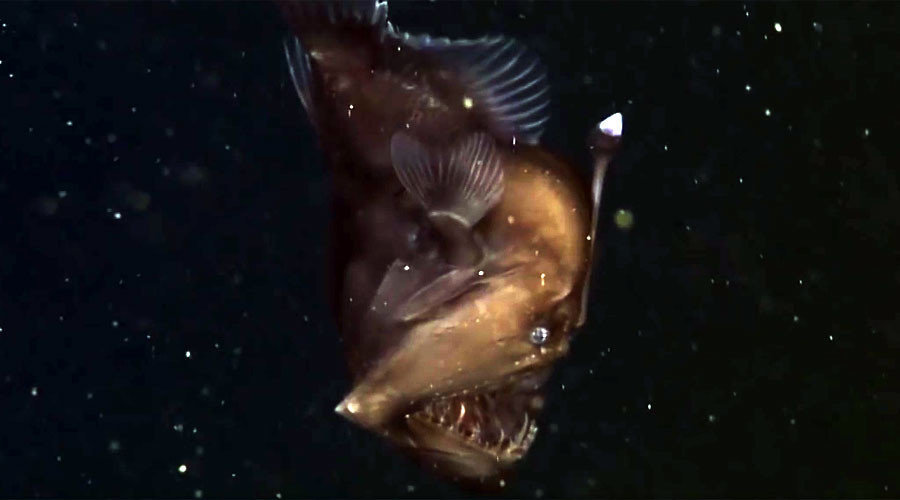
Publishers had better hold off on issuing new biology textbooks this year, as fresh research indicates that complex life on Earth may have evolved as long as a billion years earlier than we currently think. The claim now has scientists divided.

As evolution buffs know, there were several periods in the evolution of life on Earth, from less to more complex. What has always been a matter of disagreement is exactly when the leap from simpler organisms took place. Now, according to an international, Chinese-led study, the jump actually happened 1.5 billion years ago. This means our current ideas are off by about a billion years.

The switch in question has to do with a transition from single to multi-celled organisms. Until that switch happened, scientists used to refer to the quiet period preceding it as 'the boring billion'.

When the period of evolution finally arrived, it would bring with it an evolution of pretty much everything we know on Earth, including plant life - all multi-celled organisms. These organisms, called 'eukaryotes', were different in that each contained a nucleus with genetic material, protected by a membrane.

Now, new fossil evidence puts in question everything we thought about when the upgrade happened.

Bell

Pavlok: Device uses electric shock to zap users out of bad habits

pavlok
© techcrunch.com
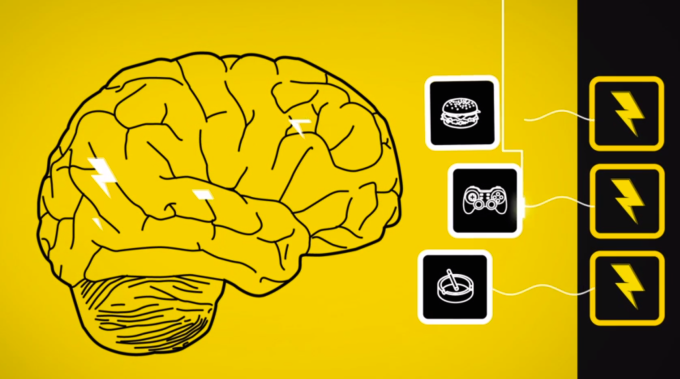
A new device promises to smash your bad habits in a shocking way - by zapping you with electricity.

The device could help users keep their New Year's resolution to lose weight, stop smoking, or wasting time on the internet.

"My bad habit is arguably one of the worst habits in the world - which is smoking cigarettes," said Marty Sanchez of Cupertino.

"My bad habit is I have mindless eating. I graze throughout the day on unhealthy foods," said Brandie Edwards of Vallejo.

"Ever since I was 14, I would pull my hair out - touch it pull it," explained Naomi Cohn of Oakland.

The wearable wristwatch is called a Pavlok.

Comment: Schlock therapy: Self-administered $200 shock bracelet supposed to zap away bad habits