Science & TechnologyS


Jupiter

NASA spacecraft reveals sounds made when crossing into Jupiter's magnetic field

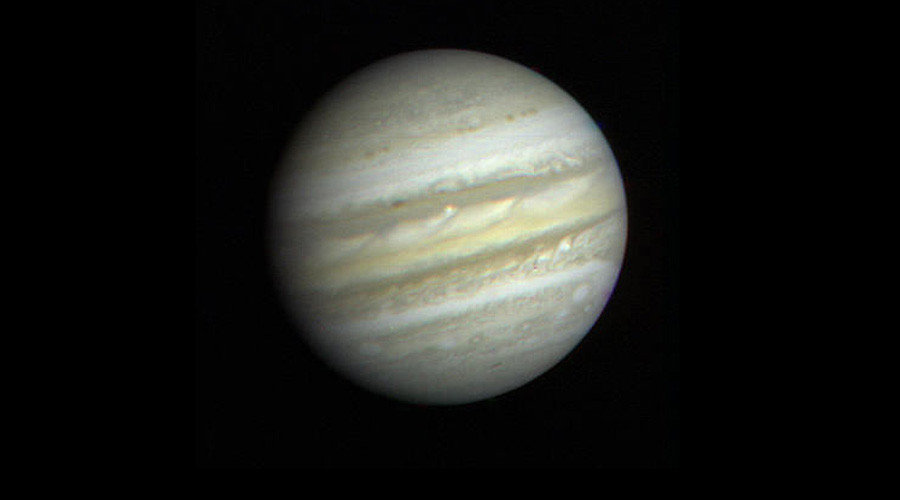
First close-up view of Jupiter from Voyager 1
© NASAFirst close-up view of Jupiter from Voyager 1.
NASA's Juno spacecraft, which is heading towards Jupiter, has entered the planet's magnetic field and has given scientists the chance to hear what it is like to cross from the solar system into "Jupiter's home turf."

Juno has almost completed its 3.2 billion km journey to the gas giant, having left Cape Canaveral in August 2011. Scientists were treated to a strange sound as the spacecraft bore down on Jupiter. After being bombarded with particles in the solar system on its approach, the spacecraft faced dramatically less intensity as it neared the planet because of the magnetosphere protecting Jupiter.

"We can actually listen to what it's like to leave the sun and enter Jupiter," Juno's principal investigator Scott Bolton said at a NASA press conference June 30. "Just the sound of it will tell you that it's non-trivial to go into Jupiter."

The sound, which can be heard on the video after about 10 seconds, is actually known as a bow shock. The data was recorded on June 24 when the probe made the crossing.

"The bow shock is analogous to a sonic boom," William Kurth of the University of Iowa in Iowa City, lead co-investigator for the Waves investigation, said in a statement on NASA's website. "The solar wind blows past all the planets at a speed of about a million miles per hour, and where it hits an obstacle, there's all this turbulence."

Info

New study explains how Aurora Borealis produces strange noises

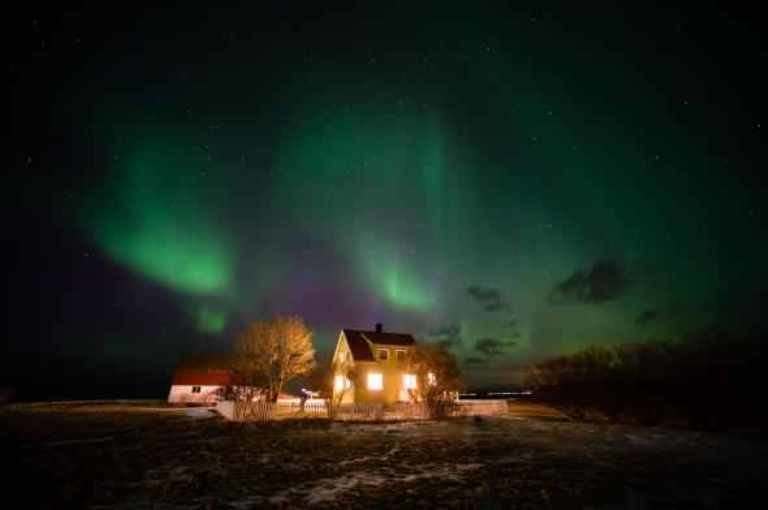
aurora borealis over Norway
© Sergio Pitamitz, National Geographic CreativeThe aurora borealis lights up the sky over a house in Norway.
A new theory offers what may be the best explanation yet for hisses and pops heard during powerful light displays.

Arctic wilderness tales often wax poetic about dazzling displays of northern lights painting the skies. But for at least the past century, some of those stories have also mentioned eerie noises associated with especially powerful auroras.

Witnesses say the sounds are comparable to radio static, like a faint crackling, light rustling, or hissing heard for a few minutes during a strong display. While the weird sounds were long considered folklore, Finnish scientists have not only shown that they really happen, but now the team thinks they know why.

The answer can be traced to charged particles trapped in a layer of the atmosphere that forms during cold nights. These particles rapidly discharge when bursts of material from the sun slam into Earth, producing clapping sounds and other noises, the team reported on June 22 at the Baltic-Nordic Acoustic Meeting in Stockholm, Sweden.

Blue Planet

Ozone hole shrank by 4 million sq km in last 15yrs - hopes for 'healing' by 2050

Ozone hole repair
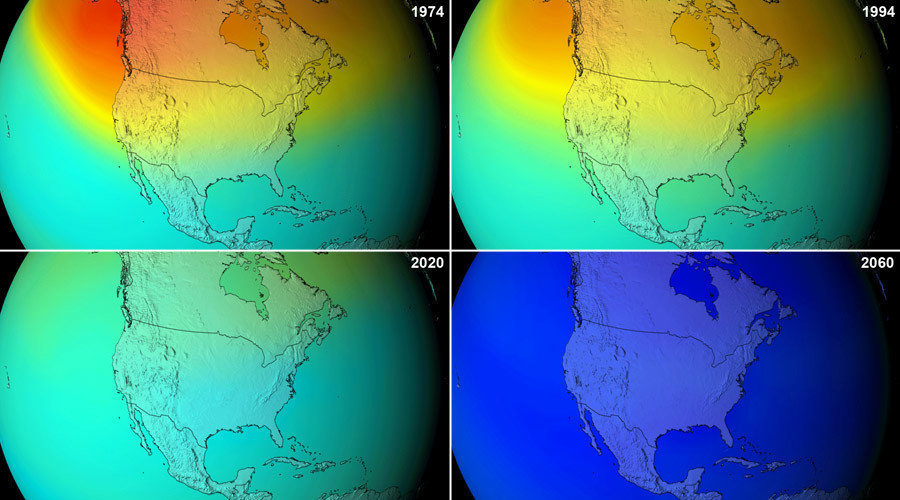
© WikipediaNASA projections of stratospheric ozone concentrations if chlorofluorocarbons had not been banned.
The hole in the ozone layer has diminished by 4 million sq km since 2000 and could heal completely by 2050, scientists at Massachusetts Institute of Technology have shown in their latest study, which appeared in the journal Science.

The changes have happened largely due to the Montreal Protocol adopted in 1987 that oversaw the ban of chemicals.

"We can now be confident that the things we've done have put the planet on a path to heal," lead author Susan Solomon, the professor of Atmospheric Chemistry and Climate Science at MIT, has said, as quoted by the university's news outlet.

"Which is pretty good for us, isn't it? Aren't we amazing humans, that we did something that created a situation that we decided collectively, as a world, 'Let's get rid of these molecules'? We got rid of them, and now we're seeing the planet respond."

The process wasn't uniform, though. At times it slowed,

The ozone hole was first found back in the 1950s, and some 30 years later, researchers from the British Antarctic survey paid attention to the fact the ozone layer was depleting.

Comment: Unfortunately Nature may have more say in the fate of the ozone layer than mankind does.

Planetary upheaval: More volcanoes erupted last week than during entire (average) year in 20th century


Health

Gene editing promises herpes simplex cure

Herpes simplex
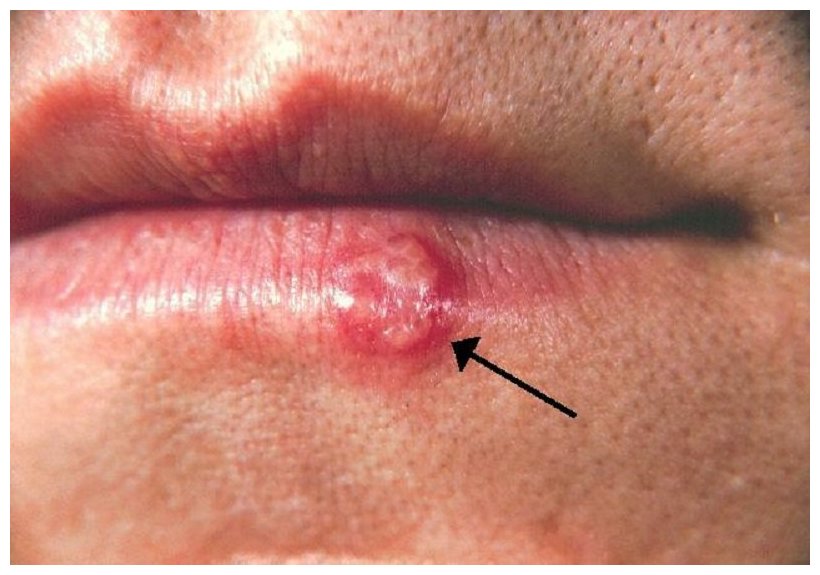
© Wikimedia CommonsHerpes simplex lesion of lower lip, second day after onset.
Most people carry the herpes virus, although only a few suffer with recurrent cold sores. Advances in gene editing pose the promise of getting rid of the virus for good.

Herpes simplex virus causes a range of affects on the human body. These are named according to the location. One of the most common forms is oral herpes, which involves the face or mouth and where cold sores (blisters) are sometimes apparent.

More serious is genital herpes (ulcers.) These can cause fever, muscle pains, swollen lymph nodes and headaches.

There are also life-threatening forms, such as herpes of the brain. For serious cases, a drug can be given which blocks the enzyme required by the virus to copy its DNA. Even here, the virus remains dormant in the body and regular doses of medications are required to keep the virus in check.

With a new breakthrough, Professor Robert Jan Lebbink of the University Medical Center Utrecht, the Netherlands, propose that gene editing can be used to get rid of the virus for good. This involves using CRISPR, the gene-editing technique. CRISPR is an acronym for "Clustered regularly-interspaced short palindromic repeats."

As Digital Journal described earlier, it is a relatively new genome editing tool that functions like molecular scissors. The method allows scientists to modify an organism's DNA.

Jet3

US and Israel unleash AI killing machines

boeing AI fighter
The two most aggressive military forces in the world have added a new frontier in their immense ability to deal death and destruction. In the same week, an Israeli firm launched the first-ever torpedo from an unmanned sea vessel while a U.S. artificially intelligent fighter pilot easily won combat simulations against human pilots.

These achievements are a testament to the sad reality that military interests are often the first to take advantage of wondrous advancements such as AI, just as nuclear physics and other technologies were hijacked for more efficient methods of killing.

Stephen Hawking pointed this out during an interview on the Larry King show.

Jupiter

Dramatic aurora lights up Jupiter's North Pole

Jupiter from Hubble space telescope
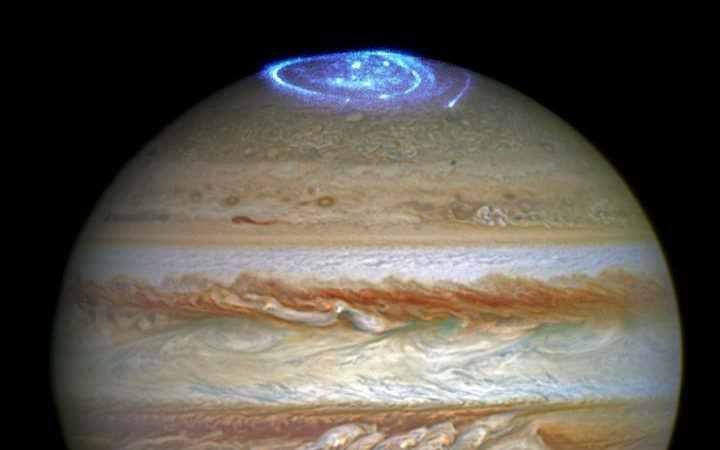
© NasaA composite image of Jupiter taken by the Hubble space telescope
A stunning aurora above Jupiter's North Pole has been captured by the Hubble telescope.

The image of the Northern Lights was taken ahead of the arrival of Nasa's spaceship Juno next week which will spend a year monitoring the largest planet in the Solar System.

Jupiter is known for its colourful storms such as the Great Red Spot which swirls constantly in the planet's atmosphere. But it's powerful magnetic field also means it has spectacular light shows at its poles.

Just like on Earth, auroras are created when high energy particles enter a planet's atmosphere near its magnetic poles and collide with atoms of gas.

"These auroras are very dramatic and among the most active I have ever seen", said Jonathan Nichols from the University of Leicester, UK, and principal investigator of the study.

"It almost seems as if Jupiter is throwing a firework party for the imminent arrival of Juno."

Eye 1

Covert surveillance: Google collects every website you've visited and everything you've searched

google
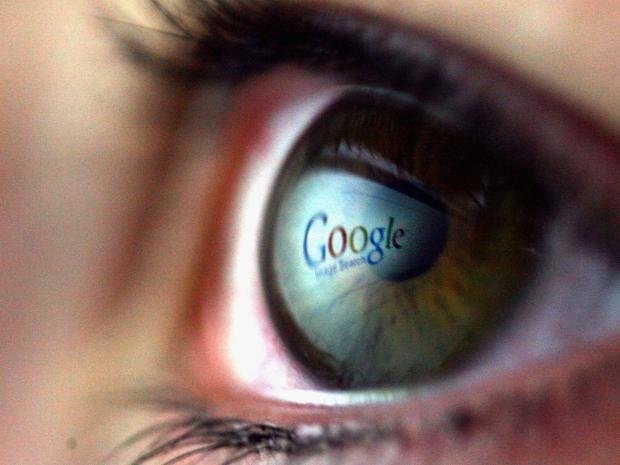
© Chris Jackson/Getty ImagesGoogle collects every website you’ve been on, everything you’ve searched and many of the things you’ve done with your phone.
Google has launched a new site that shows absolutely everything it knows about its users. And there's an awful lot of it.

The new My Activity page collects all of the data that Google has generated by watching its customers as they move around the web. And depending on your settings that could include a comprehensive list of the websites you've visited and the things you've done with your phone.

Google has long allowed its users to see the kinds of information that is being generated as people use the company's products, including letting people listen in on automated recordings that it has made of its users. But the new page collects them together in a more accessible - and potentially more terrifying - way than ever before.

Sun

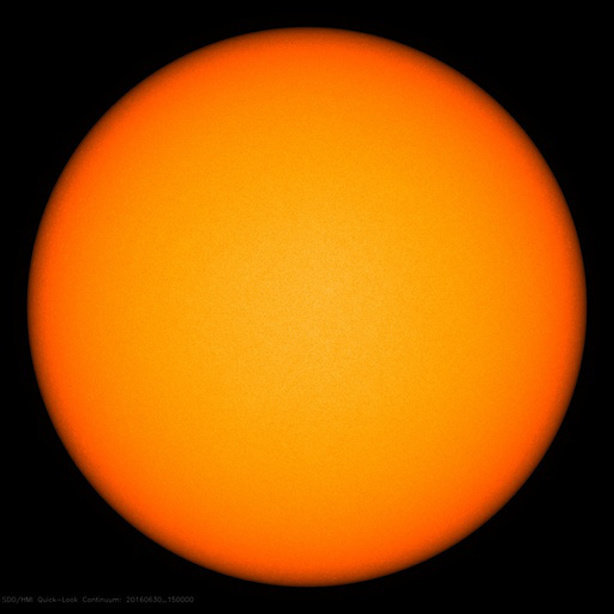
Blank canvas: Solar activity dwindling to lows not seen in 200 years

spotless sun
© NASA
The latest image from the Solar Dynamics Observatory (SDO) shows our sun as a blank canvas. No sunspots. Solar cycle 24 activity continues to be lowest in nearly 200 years

According to NASA's Spaceweather.com:

Sunspot number: 0
Updated 30 Jun 2016

Spotless Days
Current Stretch: 7 days
2016 total: 11 days (6%)
2015 total: 0 days (0%)
2014 total: 1 day (<1%)
2013 total: 0 days (0%)
2012 total: 0 days (0%)
2011 total: 2 days (<1%)
2010 total: 51 days (14%)
2009 total: 260 days (71%)

Comment: The sun goes blank for the second time this month in the weakest solar cycle in more than a century


Arrow Down

Big-brother censorship: Apple granted patent to disable camera recordings

camera phone recordings
© Leonhard Foeger / Reuters
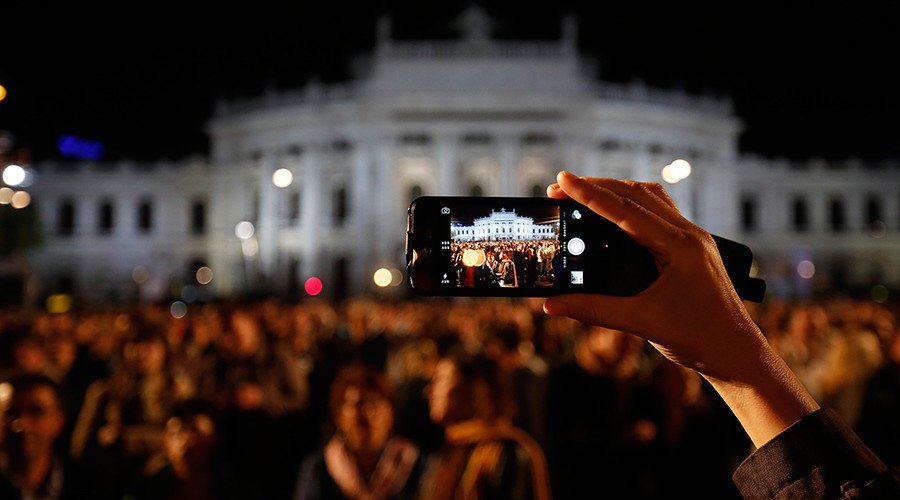
Like recording live shows with your iPhone? A new patent granted to Apple details a new method of shutting down such behavior without the owner's consent, raising concern about the possibility of the technology being used for censorship.

The patent, which Apple acquired Wednesday, describes an iPhone camera design capable of receiving infrared signals in order to prevent the illegal recording of events such as concerts.

"An infrared emitter can be located in areas where picture or video capture is prohibited, and the emitter can generate infrared signals with encoded data that includes commands to disable the recording functions of devices," the patent says. "An electronic device can then receive the infrared signals, decode the data and temporarily disable the device's recording function based on the command."

The ability for personal devices to be disabled by a third party will certainly be controversial among iPhone users who don't want their devices to be accessed or cameras to be turned off.

Comment: Another manifestation of the PTB's incessant march to tightly control the masses by silencing activists, hiding police brutality and hindering the sharing of other vital information.


Bulb

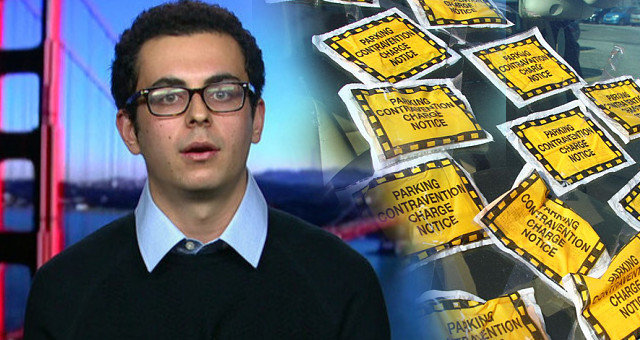
Do Not Pay: UK teen creates robot lawyer to defend unfair parking tickets

Joshua Bowder
Simply and aptly named, Do Not Pay, the ingenious business of a 19-year-old Londoner has already saved citizens of the UK an estimated £2.9 million in civil fines for unjust parking tickets. Less than 2 years old, the already popular 'Robot Lawyer' service has assisted people in absolving some 160,000 tickets by helping users take advantage of the appeals process, which is generally overlooked and underused.
"DoNotPay uses a simple chat-based interface to guide users through a range of basic questions to establish if an appeal on their parking ticket is possible. These include queries on whether there were any visible parking signs at the location where the ticket was given. The AI lawyer then guides the user through the lengthy appeals process." [Source]