Science & TechnologyS


Sun

A gigantic canyon-shaped hole has opened up in the sun's atmosphere

sun's atmosphere
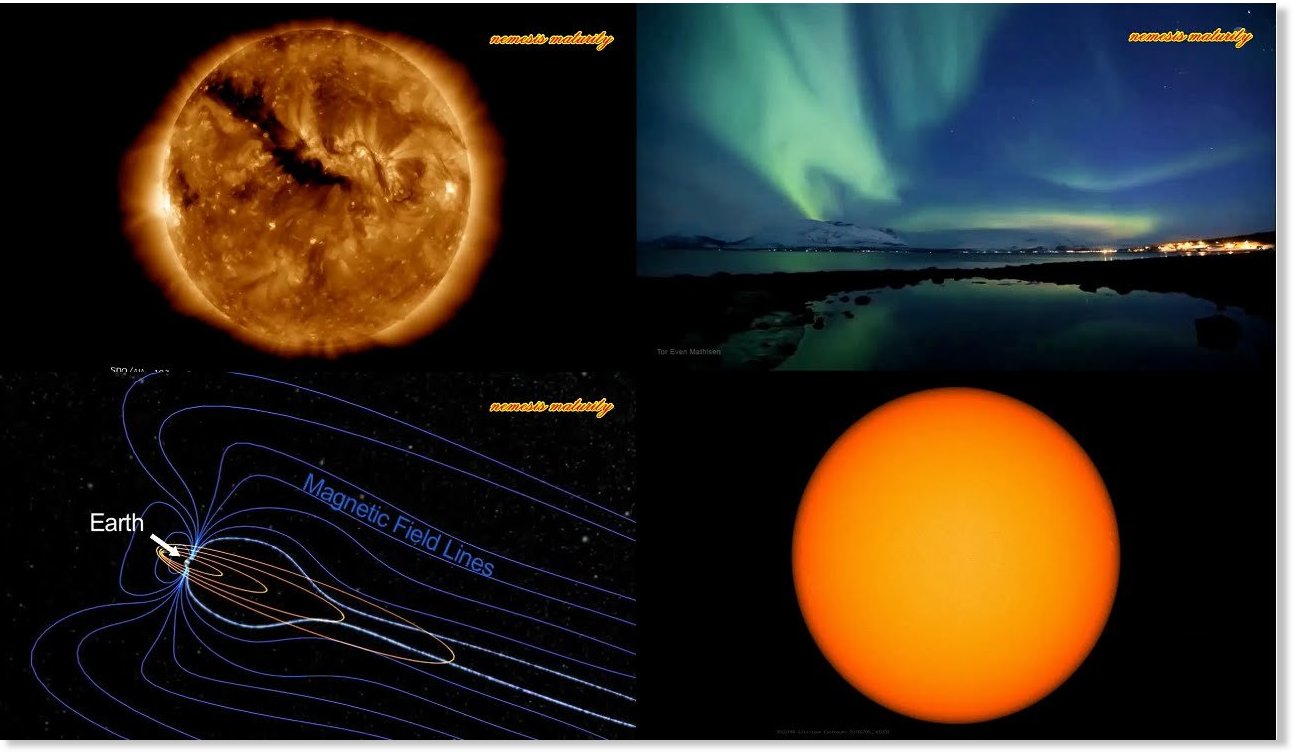
A canyon-shaped hole has opened up in the sun's atmosphere, and it is spewing solar wind into space. NASA's Solar Dynamics Observatory is monitoring the structure, which stretches more than 700,000 km from end to end.

The massive structure is called a "coronal hole."

Coronal holes are places in the sun's atmosphere where magnetic fields peel back and allow hot gas to escape.

A gaseous stream of solar wind flowing from this opening will reach Earth on July 8th or 9th, possibly sparking polar geomagnetic storms when it arrives.

High-latitude sky watchers should be alert for auroras, especially in the southern hemisphere where dark winter skies favor visibility.


Cloud Lightning

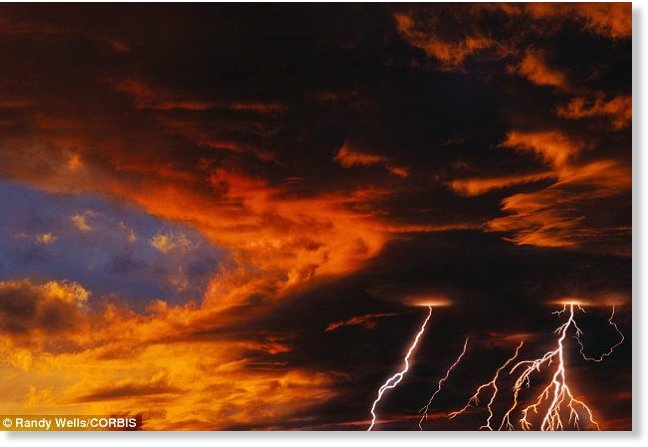
Violent volcanic exoplanet may undergo TRILLIONS of lightning flashes in just one hour

An ultra-hot exoplanet not much larger than Earth may experience trillions of lightning flashes in a span of just one hour. Astronomers say the entire surface of this exoplanet, called Kepler-10b, could be made up of constantly erupting volcanoes, causing
An ultra-hot exoplanet not much larger than Earth may experience trillions of lightning flashes in a span of just one hour. Astronomers say the entire surface of this exoplanet, called Kepler-10b, could be made up of constantly erupting volcanoes, causing its atmosphere to be extremely electric
An ultra-hot exoplanet not much larger than Earth may experience trillions of lightning flashes in just one hour.

Astronomers say the entire surface of this exoplanet, called Kepler-10b, could be made up of constantly erupting volcanoes, causing its atmosphere to be extremely electric.

Along with Kepler-10b, researchers have predicted the lightning patterns of numerous exoplanets based on observations from storms throughout the solar system, including those on Earth, Venus, Jupiter, and Saturn.

In a study published recently to the journal arXiv, researchers led by Gabriella Hodosán of the University of St Andrews, UK, investigated the occurrence of lightning on several exoplanets and brown dwarfs.

Eventually, astronomers may be able to detect radiation from these lightning bursts when the planets travel across their stars, according to New Scientist.

Sherlock

Quantum mind: Can experienced meditators influence the movement of atomic particles?


mind image
© unknown
One of the key mysteries in the realm of quantum physics is the role of the observer, or more precisely, consciousness. As Nobel laureate Eugene Wigner once explained, when this relatively new branch of physics came into being, it was found that "it was not possible to formulate the laws of quantum mechanics in a fully consistent way without reference to the consciousness."

Very few physicists, however, give this mystery much thought (at least publicly). Bruce Rosenbaum and Fred Kuttner, in their book The Quantum Enigma, note that many of their colleagues "are under the impression that it has been resolved by one or another of the 'interpretations' of quantum theory." Even though, they point out, "most developers of those interpretations...still see a mystery."

In a recent talk at the 'Science of Consciousness' conference in Tucson, Arizona, parapsychologist Dean Radin noted that when it comes to the (quantum physics) 'measurement problem', "everyone offers theories about consciousness, but nobody doesanything about it." So Radin and his team decided to see if they could find experimental evidence of consciousness influencing quantum effects.

Comment: Further reading:


Fire

Massive 'lava lamp' blobs deep inside Earth have scientists puzzled

Inside the Earth
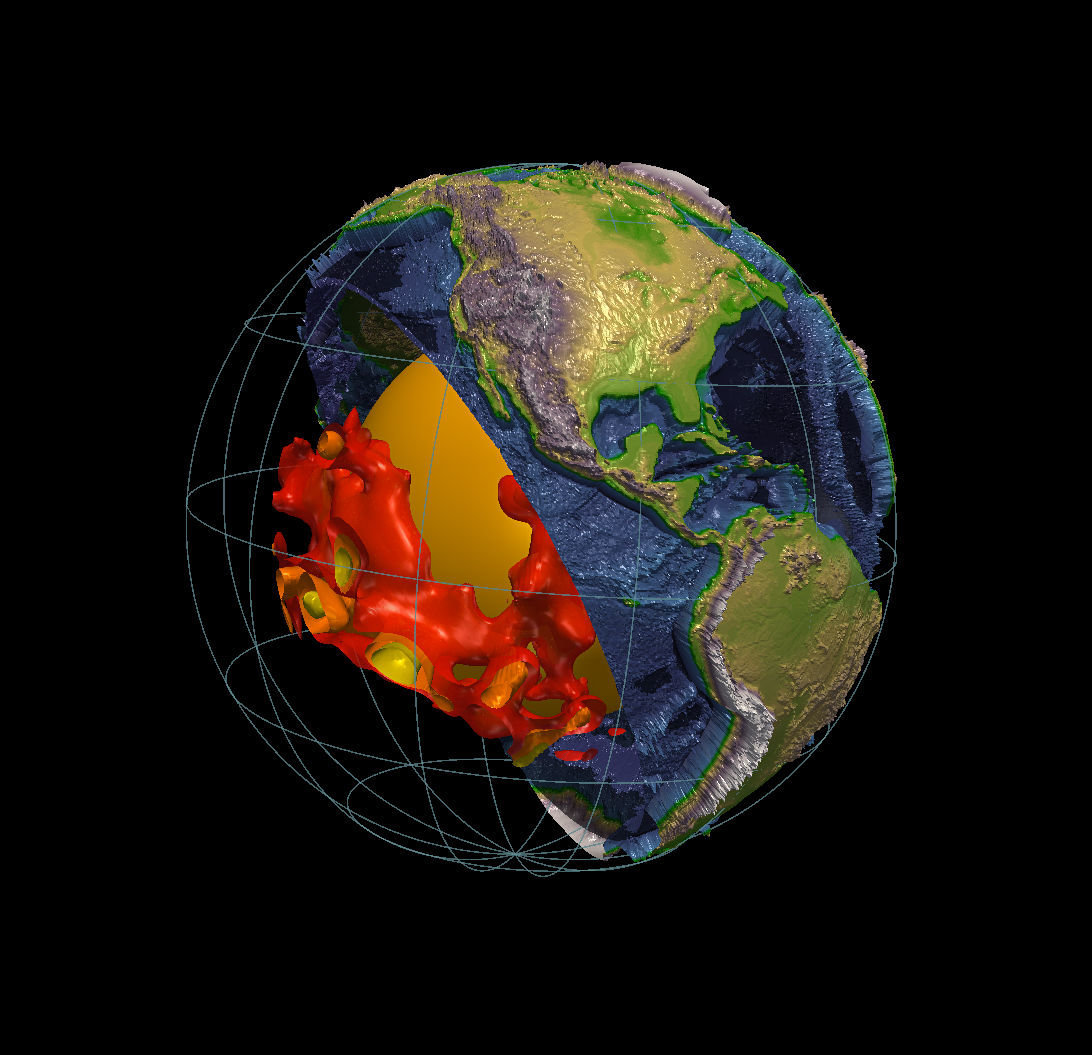
© Ed Garnero, Hongyu Lai, Arizona State UniversityMysterious blobs of distinct rock are imaged using waves from earthquakes (model from French and Romanowicz, 2015, Nature).
Two continent-size blobs of hot — and possibly molten — rock can be found deep underground, about halfway to the center of the Earth, according to a new study. These curious structures — each of which is so large that it would be 100 times taller than Mount Everest — could be made up of materials that may shed light on how the Earth formed, the researchers said.

One of the blobs is located beneath the Pacific Ocean, and the other can be found beneath the Atlantic. These underground structures start where the Earth's mantle meets the core, but they send "plumes" up through the rock like a Lava Lamp, the researchers said.

Scientists now think these masses differ from the surrounding rock in more than just temperature. They're also "compositionally distinct," meaning they could contain materials not typically found in the rest of the Earth's mantle. Yet even some of the most basic information about the blobs is still a mystery.

Comment: Further reading:


Mars

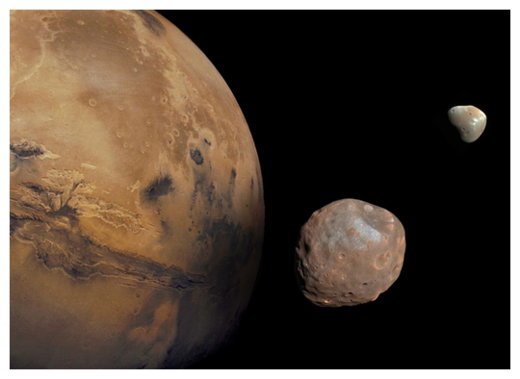
Mars once had 3 moons besides Phobos and Deimos

Mars, Phobos, and Deimos
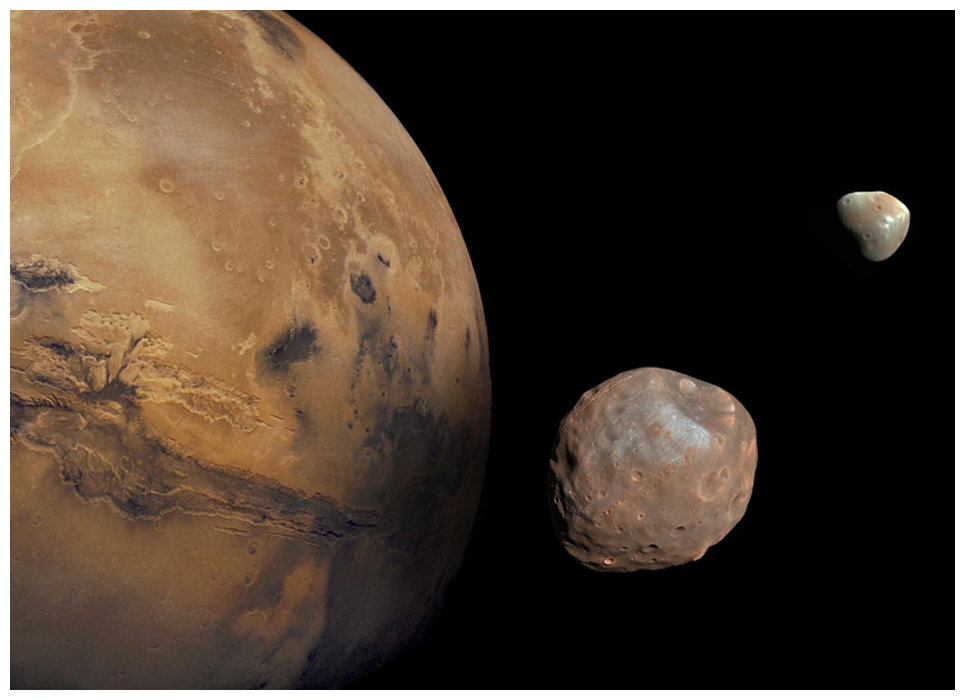
© Tokyo Institute of TechnologyMars, Phobos, and Deimos.
International collaboration finds that two small satellites (Phobos and Deimos) orbiting Mars can also be formed by a giant impact like the origin of our Moon. The research is reported in Nature Geoscience, July 2016.

An international team of researchers from Royal Observatory of Belgium, Institut de Physique du Globe, Universite de Rennes 1, Kobe University, and Tokyo Institute of Technology (Earth-Life Science Institute: ELSI) investigated the formation process of a disk produced by a potential giant impact on Mars, and satellites' formation process from this disk.

A huge satellite is quickly formed from this disk first, and it enhances the accretion of Phobos and Deimos in the outer region. After their formation, the huge satellite falls into Mars due to the strong tidal interaction with Mars, and eventually disappears. Only two tiny satellites, that is, Phobos and Deimos were left behind.

Researchers also found that about a half of the disk produced by a giant impact originally come from Mars, so that Phobos and Deimos should contain Martian materials. Recently, Japan Aerospace Exploration Agency (JAXA) has just started to plan a sample return mission from Martian satellite(s). Returned samples from Martian satellites are expected to have Martian materials.

Enigmatic origin of Martian satellites

Phobos and Deimos are orbiting on the Martian equatorial plane with very circular orbits. They are very small satellites and their masses are less than 10-7 of Mars mass. Because of their irregular shapes and spectral features, many researchers have thought that they were captured objects by Mars coming from the asteroid belt. However, the capture origin cannot easily explain their current circular and coplaner orbits, because captured satellites should have eccentric and randomly oriented orbits like many captured satellites found around Jovian planets.

On the other hand, Mars has the largest crater in our solar system on its northern hemisphere, which is called Borealis. A huge impact can create this crater and also eject a lot of materials around Mars, which may form a disk around Mars. Although formation of Martian satellites from this disk was proposed, little is known about the detailed process of disk formation and satellites' formation.

Bug

Angry bees are the inspiration for autonomous, insect sized drones

mini drone
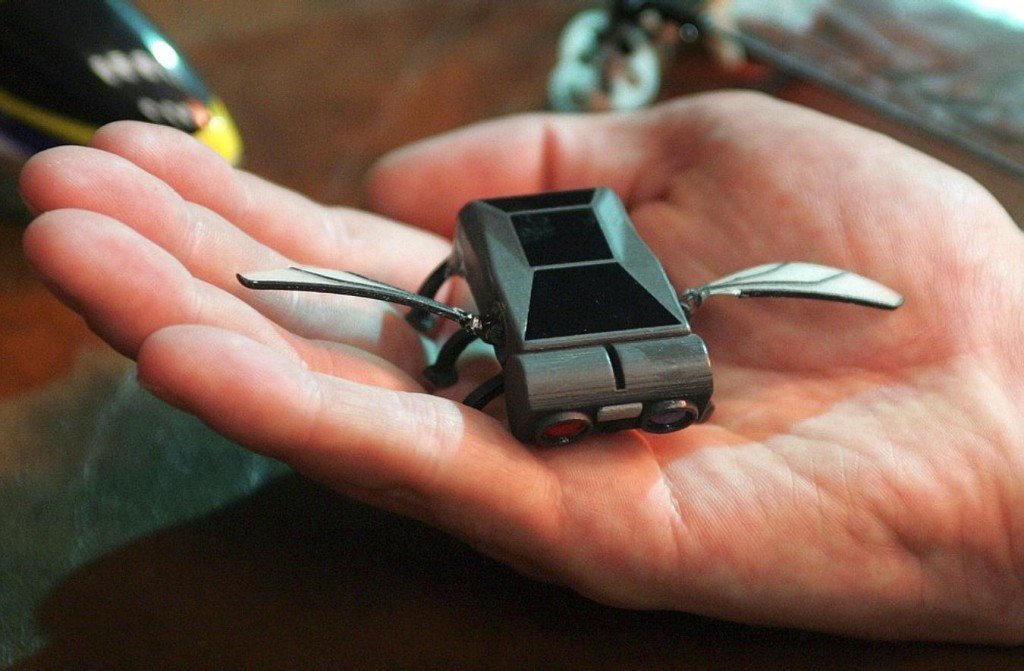
While the use of military drones is rightly criticized as report after report sanitizes death numbers for public consumption, the future is heading toward a miniaturization of drone technology that makes it increasingly likely that they will take on an even greater role in assassinations and widespread surveillance.

At the heart of this initiative is something known as biorobotics, essentially the agenda to mimic nature in order to produce robotic facsimiles. When applied to drones, biorobotics hopes to harness nature's unique ability to fly through all environments while avoiding obstacles, and ultimately untether these micro-drones from human control.

According to the Society for Experimental Biology, the latest research is focusing on the flight patterns of bees and birds such as the budgerigar to study their vision systems and flight intricacies. The following two videos to demonstrate these principles:

Eye 1

Researchers create thought reading technology

mind control
A new study published in the journal Neuroscience suggests that researchers have successfully invented a mind-reading machine that is capable of reading the human thought process.

The research team from the University of Oregon, United States, are said to have developed a system that can read people's thoughts via brain scans, and rebuild the faces they were visualizing in their heads.

Lead researchers, Brice Kuhl and Hongmi Lee reportedly used artificial intelligence (AI) that analyzed brain activity in an attempt to reconstruct one of a series of faces that participants saw. Tech Worm reports that the result was not exact, but the AI got close.

Comment: Next step: Thought control technology.


Comet 2

Comets & Asteroids - Summary for June 2016

During the month of June 2016, 2 new comets were discovered and there was 1 comet recovery. A small asteroid, 2016 HO3, has been discovered in an orbit around the sun that keeps it as a constant companion of Earth, and it will remain so for centuries to come. On June 2nd a small asteroid (1-3 meters wide) hit Earth's atmosphere and exploded over Arizona. Amateur astronomer and comet discoverer Rolf G. Meier died on June 26th, 2016 after a short battle with cancer. "Current comet magnitudes" & "Daily updated asteroid flybys" pages are available at the top of this blog (or just click on the underline text here).
The dates below refer to the date of issuance of CBET (Central Bureau Electronic Telegram) which reported the official news & designations.

Comet Discoveries

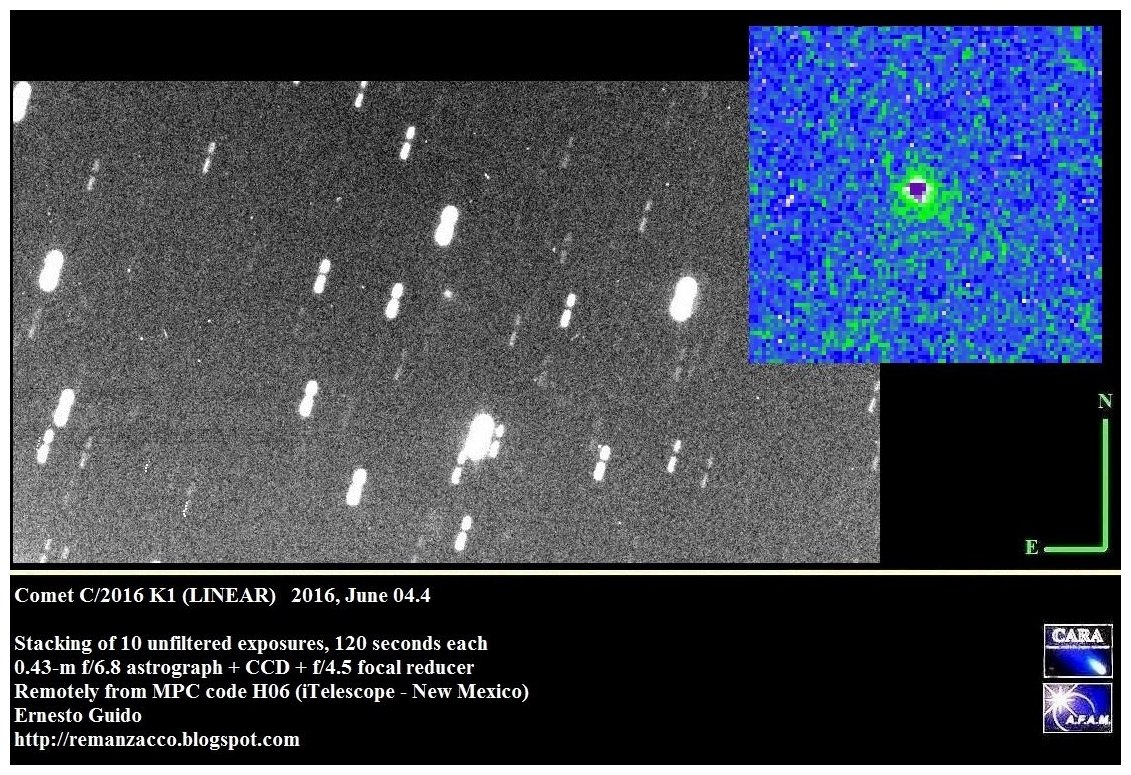
June 05 Discovery of C/2016 K1 (LINEAR)
June 24 Discovery of C/2016 M1 (PANSTARRS)
Comet C/2016 K1 Linear
© Remanzacco Blogspot
Comet Recoveries

June 06 Recovery of P/2010 N1 (WISE) as P/2016 GE_216

Telescope

China set to begin operations of world's largest radio telescope

china fast telescope
© China Daily/Qin GangChina's FAST telescope lies among karst peaks
China on Sunday hoisted the final piece into position on what will be the world's largest radio telescope, which it will use to explore space and help in the hunt for extraterrestrial life, state media said.

The Five-hundred-meter Aperture Spherical Telescope, or FAST, is the size of 30 football fields and has been hewed out of a mountain in the poor southwestern province of Guizhou.

Scientists will now start debugging and trials of the telescope, Zheng Xiaonian, deputy head of the National Astronomical Observation under the Chinese Academy of Sciences, which built the telescope, told the official Xinhua news agency.

"The project has the potential to search for more strange objects to better understand the origin of the universe and boost the global hunt for extraterrestrial life," the report paraphrased Zheng as saying.

Comment: Largest radio telescope being built in China


Bulb

Light pollution may be tricking trees into budding early

chicago lights
© Jim Richardson/National Geographic CreativeThe lights of Chicago shine brightly at night, even under a blanket of clouds. Such light pollution may have a big impact on the planet.
Future springs might arrive earlier than expected.

On Tuesday, scientists in the United Kingdom published a study charting the relationship between light pollution and the timing when trees produce buds. By observing four tree species, they found that on average, artificial light may cause trees to bud more than seven days earlier than their naturally occurring counterparts.

"It's correlative, so we can't prove anything. We can just show that there's a correlation," says Richard Ffrench-Constant, one of the study's authors. The research was published in the Proceedings of the Royal Society B.

Yet the study suggests that light pollution may be causing spring to come earlier. Or, at least, it's tricking plants into thinking that spring is happening earlier.