Science & TechnologyS


Info

Unseen brown dwarfs found lurking deep in the Orion Nebula

The Orion Nebula
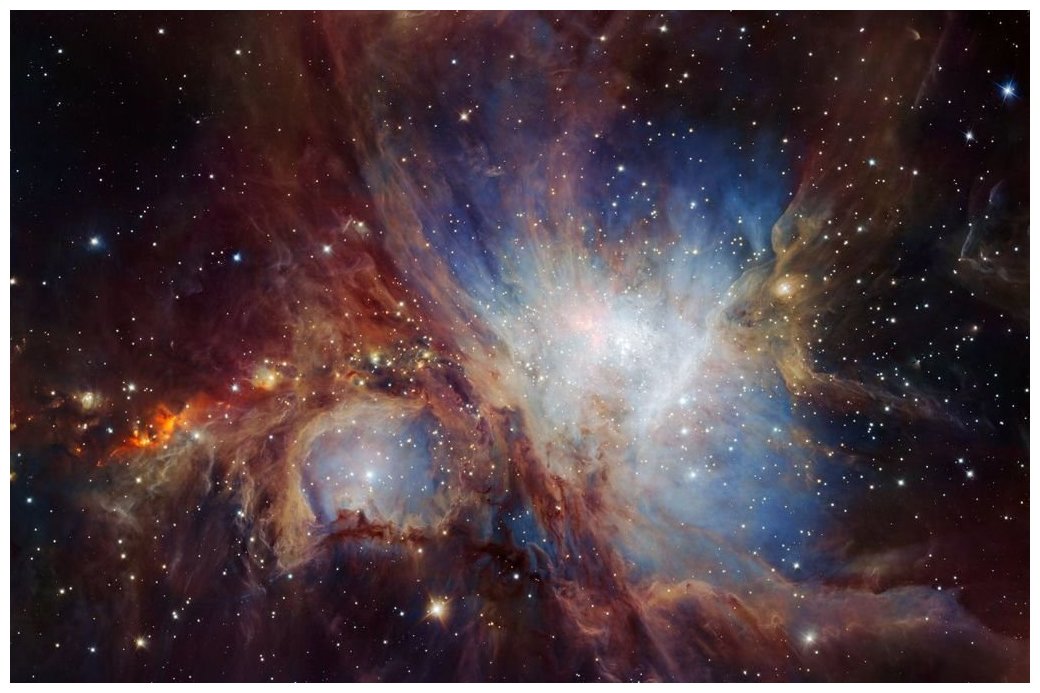
© Eso/H. Drass et alThis image of the Orion Nebula star-formation region was captured by Eso's Very Large Telescope in Chile. It is the deepest view ever seen of this region and reveals more very faint planetary-mass objects than expected.
Hidden deep within the Orion Nebula is a host of previously unseen faint brown dwarfs - planetary bodies that are the missing link between large planets and small stars.

An international team spotted this treasure trove of planetary bodies after capturing the deepest and most comprehensive view of the nebula to date using the Hawk-I infrared instrument on ESO's Very Large Telescope (VLT).

The presence of these low-mass bodies provides an 'exciting insight' into the history of how stars formed within the nebula itself and offers clues to how galaxies and stars of different masses evolve.

The Orion Nebula spans 24 light-years within the constellation Orion. It can be seen from Earth with the naked eye as a 'fuzzy patch' in Orion's 'sword'. Some nebulae, like Orion, are strongly illuminated by ultraviolet radiation from the many hot stars born within them, such that the gas is ionised and glows brightly.


Cassiopaea

Supernova could cause mass extinction on Earth

Cassiopeia A
© NASASupernova remnant Cassiopeia A. A supernova might have occurred around the right time and at the right distance from Earth to contribute to a minor mass extinction several million years ago.
An exploding star hundreds of light-years from Earth may have played a role in a minor mass extinction that happened 2.59 million years ago, new research indicates. Scientists modeled the light and radiation that would have reached Earth from relatively close exploding stars, or supernovae.

The impacts on Earth and its lifeforms could help explain the die-off that happened as the Pliocene Epoch wrapped up and the Pleistocene began, they say.

It's generally accepted that several stars have gone supernova about 300 light years from Earth within the past few million years. Recent evidence for these supernovae comes from two studies published in April. In one, researchers traced the amount of iron-60, a radioactive form of iron, in deep-sea crusts.

Iron-60 is catapulted into space by supernovae or in winds from massive stars; its presence can reveal when a star exploded nearby. Scientists found two influxes of iron-60, one about 1.5 to 3.2 million years ago, another at 6.5 to 8.7 million years ago.

Another group calculated the likely trajectories of recent supernovae, and found that the stars were probably nine times the size of our own sun, and exploded about 300 light years from Earth.

In the new study, scientists were curious about how these recent supernovae might have affected life on Earth, as well as our planet's atmosphere. To cause a truly catastrophic extinction, you'd need a supernova within about 26 light-years from Earth.

"This event is not close enough to have precipitated a major mass extinction, but may have had noticeable effects," wrote the researchers, who recently published the findings in Astrophysical Journal Letters.

Fireball 3

Two meteorites fell at the exact same spot millions of years apart

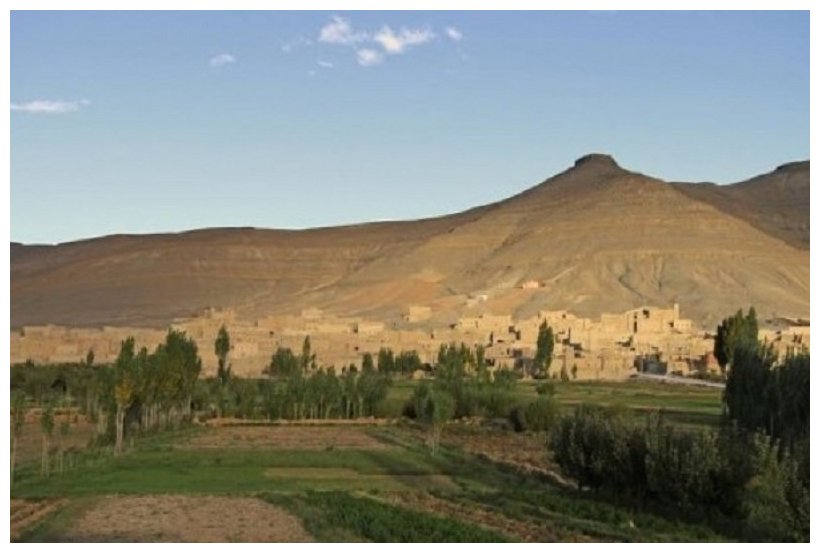
Atlas Mountains
© Morocco World News
Rabat - Evidence found in the High Atlas Mountains suggests that two meteors fell in the exact same place, potentially millions of years apart. Seven scientists from an international team lead by a researcher at the Hassan II University in Casablanca studied the impact site and found that the impact structure is much older than the meteorite fragments found at the site.

Large meteorites are not decelerated by the atmosphere, so may create impact structures or "shatter cones" when they land. Meteorites are not usually found at impact sites because they are molten or vaporized upon impact, and they are rapidly eroded or broken down by Earth's environment.

This particular site, outside the Village of Agoudal in the High Atlas Mountains, had meteorite fragments at the site, and it was assumed that the meteorite fragments created the impact structure. The new research, which was published by Professor Hasnaa Chennaoui Aoudjehane and the research team in the science journal Meteoritics and Planetary Science on June 2016, claims that the impact structure was already present when a second meteor hit the same spot, leaving behind the fragments.

The estimated diameter of the original impact structure is between 1 and 3 km. Scientists used the average rate of erosion in the High Atlas Mountains to estimate how old the structures are. Based on how much the structure wore down over time, the impact structure is probably 1.25 to 3.75 million years old. This makes the impact structure much older than the meteorite fragments found in the same site.

Discoveries like this can help scientists better understand the impact of a meteor falling to Earth. Research will continue to determine how life in the region was affected at the time of the impact.

Health

Scientists create a patch that may make painful insulin injections a thing of the past

insulin patch
Insulin injections are painful, and millions of Americans who suffer from diabetes can attest to that. But this pain may soon be a thing of the past thanks to a new invention from researchers at the University of North Carolina and NC State.

This incredible team of researchers has now created a "smart insulin patch" which detects increases in blood sugar levels and secretes doses of insulin into the bloodstream as needed. The relatively hands-off method is a major breakthrough, as scientists have been trying for decades to make regular insulin injections for diabetics unnecessary.

Covered in natural beta cells, the simple synthetic patch would eliminate the pain of injections, and even take out the worry work of monitoring as well. Though it hasn't been tested on humans as of yet, it's already been shown to safely control the blood sugar levels of mice for at least 10 hours at a time.

Beaker

The dual-use conundrum of gene editing

holding a gene
Dual-use may be best understood by considering the functions of a knife. Used against an enemy, a knife can be deadly. In the hands of a skilled surgeon, a knife may be life-saving, removing a gangrenous appendage or excising a cancerous mass.

Wikipedia defines dual-use this way: "In politics and diplomacy, dual-use is technology that can be used for both peaceful and military aims. More generally speaking, dual-use can also refer to any technology which can satisfy more than one goal at any given time."

Behind the debate over the Iran nuclear deal lurked the dual-use issue. On the one hand, there were those claiming that Iran had every right to develop nuclear power in pursuit of peaceful aims. In the other camp were those who maintained that possession of nuclear technology was a path towards developing nuclear weapons, and in the hands of a regime hostile to America's purported friend and ally, Israel, was too dangerous to be allowed to manifest.

Comment: These mad scientists have no clue as to what they are doing. One shudders to think of the abominations they could bring into being.

See also:
"On the cusp of a new era": The permanent alteration of the human gene pool using new "editing" technology

And:

The overlooked threats of gene editing:
In reality, all genetic editing, especially when it alters the genetic material of subsequent generations, represents a potential threat to the genetic heritage of the entire planet with potential consequences we may still not fully understand. In a world where the "science is final" regarding humanity's impact on the planet's climate, demanding "urgent action" to stop or reverse it, the absence of a similar impetus behind stopping the contamination of our planet's genetic heritage seems suspiciously hypocritical if not utterly reckless and even intentional.


Magnify

More bad science: fMRI bugs could make decades of research worthless

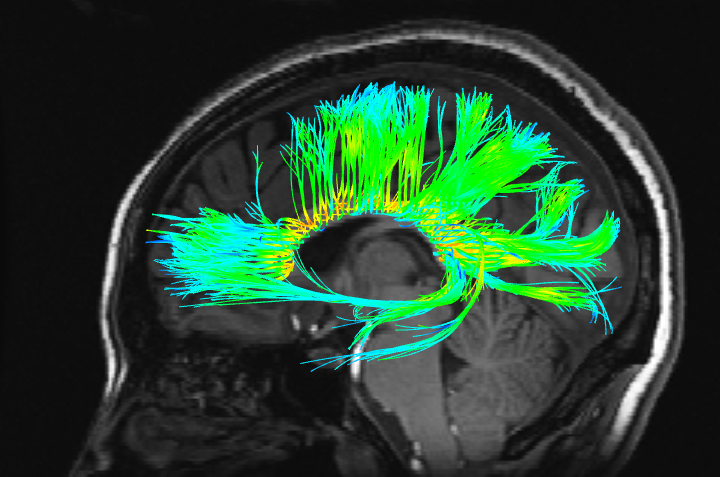
fmri
Art, not quite science.
A whole pile of "this is how your brain looks like" fMRI-based science has been potentially invalidated because someone finally got around to checking the data.

The problem is simple: to get from a high-resolution magnetic resonance imaging scan of the brain to a scientific conclusion, the brain is divided into tiny "voxels". Software, rather than humans, then scans the voxels looking for clusters.

When you see a claim that "scientists know when you're about to move an arm: these images prove it", they're interpreting what they're told by the statistical software.

Now, boffins from Sweden and the UK have cast doubt on the quality of the science, because of problems with the statistical software: it produces way too many false positives.

Comment: Just goes to show: when scientists claim the 'know' certain things about the mind, brain, and consciousness, take what they say with a barrel or two of salt.


Footprints

Company creates power generating floor tiles

floor tile electricity
© Pavegan
British technology company Pavegan has stepped up its energy game by developing tiles that generate kinetic power from footsteps. That's right, just by treading on the tiles - which have already been installed in Brazil, Nigeria, and London, one could help power lights at soccer fields, offices, and even airports.

Huffington Post relays that the innovative tiles have been constructed to harness as much kinetic as possible. Some are triangular-shaped and have a generator at each corner. This ensures that the energy a person's footstep generates is maximized - regardless of where one steps.

Info

New dwarf planet 2015 RR245, discovered beyond Neptune

2015 RR245
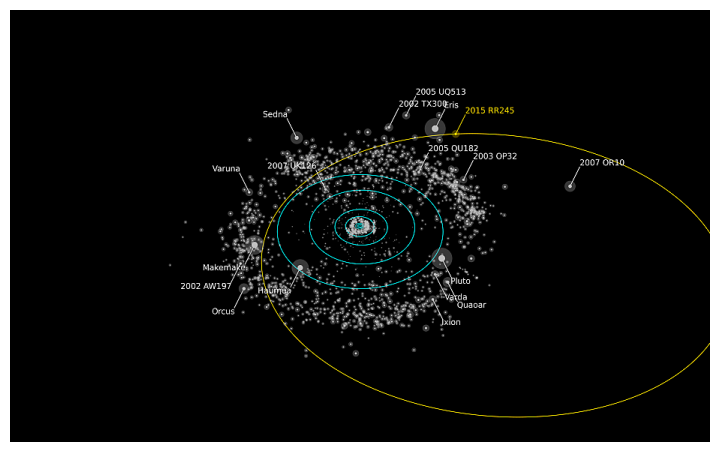
© OSSOS/Alex Parker2015 RR245's orbit takes it 120 times further from the Sun than the Earth is.
A new dwarf planet has been discovered beyond Neptune, in the disk of small icy worlds that resides there. The planet was discovered by an international team of astronomers as part of the Outer Solar Systems Origins Survey (OSSOS). The instrument that found it was the Canada-France Hawaii Telescope at Maunakea, Hawaii.

The planet is about 700 km in size, and has been given the name 2015 RR245. It was first sighted by Dr. JJ Kavelaars, of the National Research Council of Canada, in images taken in 2015. Dwarf planets are notoriously difficult to spot, but they're important pieces of the puzzle in tracing the evolution of our Solar System.

Dr. Michele Bannister, of the University of Victoria in British Columbia, describes the moment when the planet was discovered: "There it was on the screen— this dot of light moving so slowly that it had to be at least twice as far as Neptune from the Sun."

"The icy worlds beyond Neptune trace how the giant planets formed and then moved out from the Sun. They let us piece together the history of our Solar System. But almost all of these icy worlds are painfully small and faint: it's really exciting to find one that's large and bright enough that we can study it in detail." said Bannister.

Bizarro Earth

Hidden fault could trigger cataclysmic megaquake beneath Bangladesh, parts of east India and Myanmar

Subduction zone
© Steckler et al, LDEOA subduction zone lying beneath Bangladesh, Myanmar and eastern India could release a massive magnitude 8.2 to 9.0 earthquake, new research suggests. The red line shows the areas where the fault is likely locked (the solid line showing the more likely location). The glowing city lights in the picture serve as a proxy for population density.
A massive fault could trigger a cataclysmic earthquake beneath Bangladesh, parts of east India and Myanmar, new research suggests.

The hidden fault, which has been buried under miles of river sediment, could release an earthquake of magnitude 8.2 to 9.0 in one of the most densely populated regions of the world, the study found. And because researchers discovered the system relatively recently, they have no estimates for when such a megaquake could occur.

"We don't know if it's tomorrow or if it's not going to be for another 500 years," said study co-author Michael Steckler, a geophysicist at the Lamont-Doherty Earth Observatory at Columbia University in New York City.

Rose

Plants communicate using an internet of fungus, "wood wide web"

Plants communicate
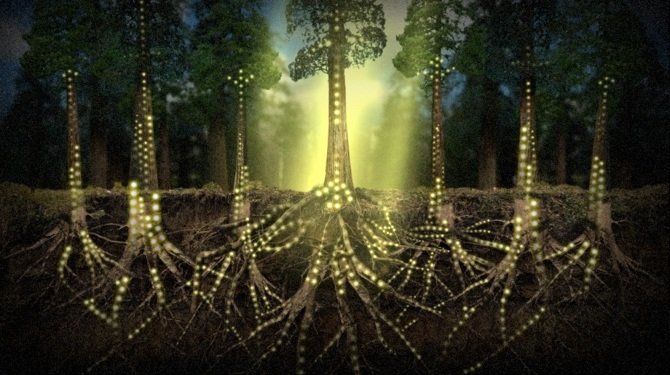
Hidden beneath the surface and entangled in the roots of Earth's astonishing and diverse plant life, there exists a biological superhighway linking together the members of the plant kingdom in what researchers call the "wood wide web". This organic network operates much like our internet, allowing plants to communicate, bestow nutrition, or even harm one another.

The network is comprised of thin threads of fungus known as mycelium that grow outwards underground up to a few meters from its partnering plant, meaning that all of the plant life within a region is likely tapped into the network and connected to one another. The partnership of the roots of plants and the fungi is known as mycorrhiza and is beneficial for both parties involved; plants provide carbohydrates to the fungi and in exchange, the fungi aids in gathering water and providing nutrients such as phosphorus and nitrogen to its partnering plant.

Comment: See also: The secret intelligence of plants
  • Sound garden: Can plants actually talk and hear?