Science & TechnologyS


2 + 2 = 4

Same genes could make us prone to both happiness and depression

happiness and depression
Happy face and sad face. Perhaps some people are just more sensitive to the environment than others.
The same genes that make us prone to depression could also make us prone to positivity, two psychology researchers have suggested.

Professors Elaine Fox, from Oxford University, and Chris Beevers from the University of Texas at Austin reviewed a number of studies for their paper in Molecular Psychiatry. They say that there is a need to combine studies in mental health genetics with those that look at cognitive biases.

Info

New oxygen microparticle designed

Oxygen Particle
© Tech Wench
A team of scientists at the Boston Children's Hospital have invented what is being considered one the greatest medical breakthroughs in recent years.

They have designed a microparticle that can be injected into a person's bloodstream that can quickly oxygenate their blood. This will even work if the ability to breathe has been restricted, or even cut off entirely.

This finding has the potential to save millions of lives every year. The microparticles can keep an object alive for up to 30 min after respiratory failure. This is accomplished through an injection into the patients' veins.

Once injected, the microparticles can oxygenate the blood to near normal levels.

This has countless potential uses as it allows life to continue when oxygen is needed but unavailable. For medical personnel, this is just enough time to avoid risking a heart attack or permanent brain injury when oxygen is restricted or cut off to patients.

Dr. John Kheir, who first began the study, works in the Boston Children's Hospital Department of Cardiology. He found inspiration for the drug in 2006, when he was treating a girl in the ICU who had a severe case of pneumonia. At the time, the girl didn't have a breathing tube, when at the time she suffered from a pulmonary hemorrhage.

This means her lungs had begin to fill up with blood, and she finally went into cardiac arrest. It took doctors about 25 minutes to remove enough blood from her lungs to allow her to breath. Though, the girl's brain was severely injured due to being deprived of oxygen for that long and she eventually died.

Galaxy

Dark matter is still missing in action despite exhaustive search

dark matter detector
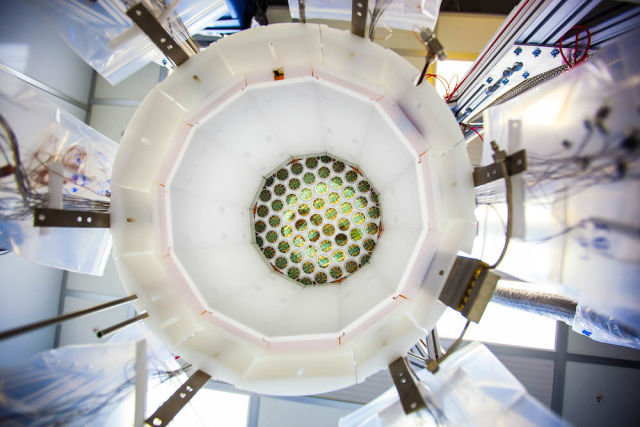
© Lawrence Berkeley LabLux, a xenon-based dark matter detector.
Today, the team behind one of the most sensitive dark matter detectors announced its full experimental run had failed to turn up any of the particles it was looking for. The LUX detector (Large Underground Xenon) is designed to pick up signs of weakly interacting massive particles, or WIMPs, when they engage in one of their rare interactions with normal matter. The null result doesn't rule out the existence of dark matter, but it limits its potential properties.

As their name implies, WIMPs don't interact with normal matter often, but they should on occasion bump into an atom, imparting energy to it. LUX provides a tempting target in the form of 370kg of liquid xenon. The detector is flanked by photodetectors to pick up any stray photons from the interactions, as well as hardware that picks up any stray charges knocked loose.

Comment: The Case of the Missing Dark Matter


Airplane

China builds world's largest amphibious aircraft

China amphibious aircraft
© CCTV News / YouTube
After seven years of construction China has unveiled the AG600, the world's largest amphibious aircraft. Half boat and half airplane, the craft can take off at a staggering weight of 53 tonnes and can pick up 12 tonnes of water in an impressive 20 seconds.

Intended for marine missions and fighting forest fires, the AG600 was unveiled in Zhuhai in the southern Guangdong province on July 23. The plane - which can take off from land or water - is seen as an aviation "milestone" for the country, according to Xinhua News.

Sun

Solar Impulse 2 begins last leg of round-the-world trek

Solar impulse2
© Jean Revillard / ReutersSolar Impulse 2 over the pyramids of Giza.
An airplane which solely relies on solar energy has taken off on the last leg of its round-the-world-trip. It is expected to reach its final destination in some 48 hours, which would make it the first solar-powered aircraft to circle the globe. On Sunday at 1:30am local time, the one-of-a-kind plane took off from Cairo and is now heading towards Abu Dhabi - the city from which it started its long journey last year. It is expected to reach the city within the next 48 hours.

Last week, the aircraft made a landing in Egypt after a flight from Seville, Spain. The pilots were forced to postpone the following takeoff from Cairo to the UAE due to extreme heat in Saudi Arabia. On the Solar Impulse blog, the Mission Control Center team said they "identified a weather window that could allow us to overcome the challenging high temperatures across Saudi Arabia and hopefully land in Abu Dhabi after 48 hours."

"We want to share with you the suspense of an attempted takeoff for this last leg of the round-the-world adventure. If we manage to get Si2 airborne, this will be Solar Impulse's last flight, so come with us!"


Gear

Flashback The Atir-Rosenzweig-Dunning Effect: How being an expert in an area can make one claim knowledge they couldn't possibly know

john cleese quote
© Shutterstock
Remember the Dunning-Kruger Effect? The finding by David Dunning and Justin Kruger that incompetence leads to inflated beliefs of competence. If you need a refresher, the concept is succinctly explained below by John Cleese:


Dunning has now conducted a new study with colleagues Stav Atir and Emily Rosenzweig, finding that expertise has its own pitfalls. In a series of experiments conducted at Cornell University, the researchers found that people with greater knowledge in a particular domain were more likely to claim knowledge that they could not possibly know.

Comment: See also:


Robot

Self-driving shuttle to start operations in Lyon, France in September

Navya Arma self driving shuttle
Just this week a truck driver informed me that autonomous trucks are at least "decades away".

It's 2016, six to eight years away from my target date, and self-driving shuttles will hit Lyon, France this September.

Via translation from LyonMag.Com, please consider Free Autonomous Shuttle Starts September.
It was only a matter of time. And it is now official. Two Navya Arma shuttles arrive in the Confluence district in September.

These shuttles driverless, 100% autonomous and fully electric task will be to carry passengers between the leisure division and Confluence shopping and the tip of the peninsula, up to the GL Events seat.

Navya Arma has "lasers that sweep space, cameras and precise GPS". The Navya should be able to circulate in the Lyon area starting early September, from 7:30 to 18:30. Despite the absence of a driver, the shuttle can reach 25km/hour, safe for passengers or pedestrians.

Cloud Grey

What causes iridescent clouds?

iridescent clouds
Laura Berry caught these iridescent clouds on May 31, 2016. Thanks, Laura!
Sky watchers sometimes report seeing rainbow colors within clouds. These colorful clouds are called iridescent clouds. When you see a cloud like this, you know there are especially tiny ice crystals or water droplets in the air. Larger ice crystals produce solar or lunar halos, but tiny ice crystals or water droplets cause light to be diffracted - spread out - creating this rainbow-like effect in the clouds.

The phenomenon is called cloud iridescence or irisation. The term comes from Iris, the Greek personification of the rainbow.

The images on this page are mostly via EarthSky friends on Facebook and Google+. Our thanks to all who contribute!

Butterfly

Butterfly bacteria creates separate, female only species

butterfly
© University of ExeterTiny microbe turns tropical butterfly into male killer.
They are so beautiful, these man-eaters.

In Nairobi, the heart of Kenya, within what scientists call a hybrid zone for butterflies, two subspecies of the African queen have no males. That's because the females are infected with a bacterium known as Spiroplasma ixodeti that kills 100 percent of their male offspring. The eggs don't hatch.

What's worse, at least for the males, is that the female eggs hatch normally, and their doomed brothers are among their first meals. The Daryl Hall and John Oates lyrics say it best: "Oh-oh here she comes. Watch out, boy, she'll chew you up. ... She's a man-eater."

Don't blame the lovely cannibal butterflies, said Richard ffrench-Constant, a professor of molecular natural history at the University of Exeter in England and the author of a study released Tuesday. Blame nature. "The sisters eating their dead brothers is just a byproduct of the males dying in their eggs," he said very matter-of-factly. "Many caterpillars eat their own eggs after hatching, so it's probably just a by-product of that."

Attention

Newly discovered giant megathrust fault has potential to kill millions

megathrust fault
More than 140 million people live within a 60 mile area of the potential disaster zone in Bangladesh.
A giant fault in the earth's crust covers by millions of tonnes of sediment in one of the world's most densely populated areas could kill tens of millions of people, scientists have claimed.

Researchers placed hundreds of highly accurate GPS receivers in locations across India, Bangladesh and Myanmar and monitored them over a ten year period.

Now the scientists fear the location is home to a megathrust fault which could unleash a 9.0 magnitude earthquake at any minute.

The scientists, led by Dr Michael Steckler from Columbia University published their findings in the journal Nature.

The experts discovered that millions of tonnes of sediment from the Ganges and Brahmaputra rivers has been dumped into the megathrust fault, where one of the earth's plates is being pushed under another.