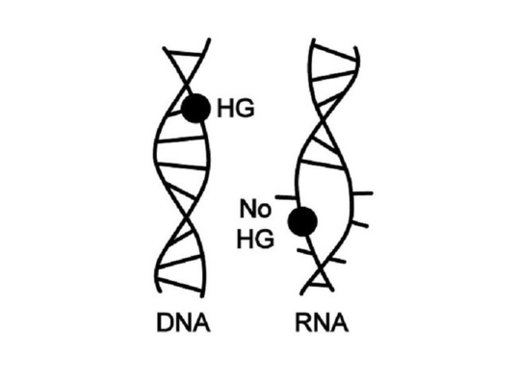
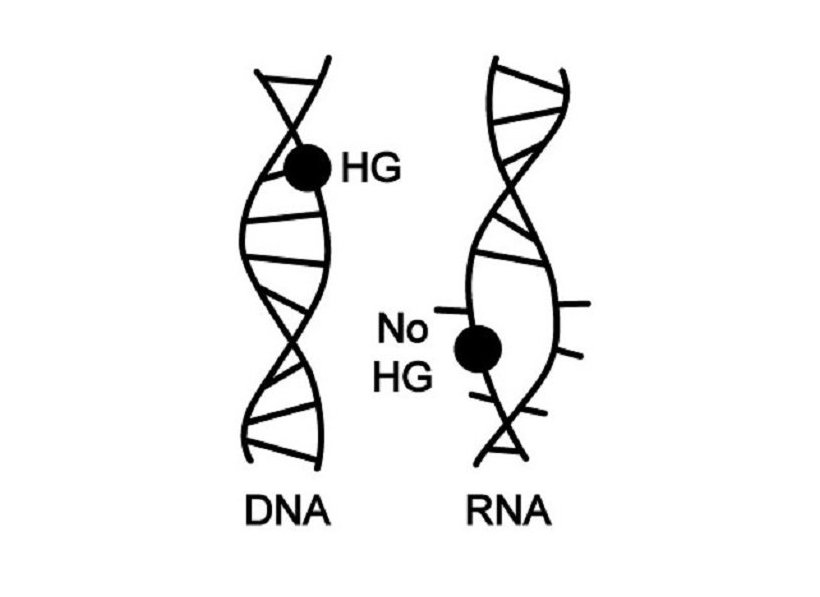
© Huiqing Zhou, Duke University The DNA double helix (shown on the left) can contort itself into different shapes to absorb chemical damage to the basic building blocks (A, G, C and T, depicted by a black dot) of genetic code. In contrast, an RNA double helix (shown on the right) is so rigid and unyielding that rather than accommodating damaged bases, it falls apart completely.
Durham, NC -
A new study could explain why DNA and not RNA, its older chemical cousin, is the main repository of genetic information. The DNA double helix is a more forgiving molecule that can contort itself into different shapes to absorb chemical damage to the basic building blocks -- A, G, C and T -- of genetic code. In contrast, when RNA is in the form of a double helix it is so rigid and unyielding that rather than accommodating damaged bases, it falls apart completely.The research, published August 1, 2016 in the journal
Nature Structural and Molecular Biology, underscores the dynamic nature of the DNA double helix, which is central to maintaining the stability of the genome and warding off ailments like cancer and aging. The finding will likely rewrite textbook coverage of the difference between the two purveyors of genetic information, DNA and RNA.
"There is an amazing complexity built into these simple beautiful structures, whole new layers or dimensions that we have been blinded to because we didn't have the tools to see them, until now," said Hashim M. Al-Hashimi, Ph.D., senior author of the study and professor of biochemistry at Duke University School of Medicine.
DNA's famous double helix is often depicted as a spiral staircase, with two long strands twisted around each other and steps composed of four chemical building blocks called bases.
Each of these bases contain rings of carbon, along with various configurations of nitrogen, oxygen, and hydrogen. The arrangement of these atoms allow G to pair with C and A to pair with T, like interlocking gears in an elegant machine.
When Watson and Crick published their model of the DNA double helix in 1953, they predicted exactly how these pairs would fit together. Yet other researchers struggled to provide evidence of these so-called Watson-Crick base pairs. Then in 1959, a biochemist named Karst Hoogsteen took a picture of an A-T base pair that had a slightly skewed geometry, with one base rotated 180 degrees relative to the other. Since then, both Watson-Crick and Hoogsteen base pairs have been observed in still images of DNA.
Five years ago, Al-Hashimi and his team showed that base pairs constantly morph back and forth between Watson-Crick and the Hoogsteen configurations in the DNA double helix. Al-Hashimi says that Hoogsteen base pairs typically show up when DNA is bound up by a protein or damaged by chemical insults. The DNA goes back to its more straightforward pairing when it is released from the protein or has repaired the damage to its bases.
"DNA seems to use these Hoogsteen base pairs to add another dimension to its structure, morphing into different shapes to achieve added functionality inside the cell," said Al-Hashimi.













Comment: The recent anthrax outbreak occurred in the Yamal peninsula, where massive craters were discovered a few years ago. Could there be a correlation? See also: