Science & TechnologyS


Brain

Mad scientists seek to bypass fertilization process to manufacture human babies

Mouse egg fertilization
© University of Bath
Motherless babies could be a real possibility in the near future, according to scientists who managed to create a litter of mice without fertilizing a female egg. The breakthrough could help infertile women have children. The old-fashioned way of making a baby is quite simple - sperm fertilizes an egg, and a baby is born nine months later. But scientists from the University of Bath are questioning the necessity of an egg in the equation, after successfully producing a litter of mice by bypassing the fertilization process.

The trick lies within something called parthenogenotes - egg cells that have been "tricked" into becoming embryos without being fertilized by sperm. However, scientists had to come up with a way to keep the parthenogenotes alive, as they die by themselves after just a few days. It turned out injecting them with mouse sperm was the answer.

Instead of dying, the embryos developed normally. They were then transferred into female mice, and became perfectly healthy mouse pups. In total, the researchers produced 30 pups, with a success rate up to 24 percent. Some of those pups are now grand-mice and great-grand-mice, as their offspring have gone on to have pups of their own.

Comment: It is the hubris of humans who think we know better than nature. Have these scientists considered that the fertilization process serves a purpose that is unseen and unknown to them? There is more to the human condition and development than just a bag of meat and bones.


Info

Physicists say 'time crystals' may actually be real

Red fluorite crystals
© Patrick Kovarik/AFP/Getty ImagesRed fluorite crystals shown at the Natural history Museum in Paris.
Cutting edge physics research gives us another remarkable idea that sounds like something out of a science fiction novel. In 2012, Nobel-Prize winning Frank Wilzcek and a team of theoretical physicists at MIT came up with an idea that hypothetical structures exist that would appear to move without using energy. He called them "time crystals". While most physicists since then have dismissed the idea as "impossible", a new paper shows how these time crystals could actually exist, possibly changing our understanding of fundamental principles of nature.

What's special about time crystals is that, if they exist, they could break the symmetry of time and space. The way time crystals would move is in a repeating pattern, without using stored energy, in a sort of perpetual motion.
"I was thinking about the classification of crystals, and then it just occurred to me that it's natural to think about space and time together," said Wilczek about his idea. "So if you think about crystals in space, it's very natural also to think about the classification of crystalline behavior in time."
The reason crystals gave Wilczek the idea is because they exhibit unusual growth behavior, with their atoms spontaneously organizing into rows, columns and 3D lattices, without becoming symmetrical like a sphere. This breaks the spatial symmetry of nature, which maintains that all places are equivalent. Knowing this, Professor Wilczek came up with mathematical proof that showed the atoms of crystallizing matter could regularly form repeating lattices in time, but without consuming or producing any energy. They would return to their "ground state" and start the process all over again. Such a system would be breaking time-translational symmetry (TTS), another fundamental symmetry in physics.

Brain

New study shows that neuroplasticity is not a myth, but the later the onset of mild traumatic brain injuries the worse the outcome

neuroplasticity
The theory of neuroplasticity holds that the brain will change and adapt to different conditions including to childhood injuries. This theory is often challenged and sometimes referred to as a "myth." However, a new study by Seena Fazel and colleagues from the Department of Psychiatry at University of Oxford in the United Kingdom delivered data that supports the claims of neuroplasticity theorists. Fazel's conclusions reveal that the later a mild TBI is sustained, the worse the health and social outcome is for the patient. The study also found a causal effect between childhood Traumatic Brain Injuries (TBIs) and the risk of brain impairment and social dysfunction at later stages in life.

Dr. Fazel and colleagues used national registers in Sweden covering 1.1 million individuals born between 1973 and 1985 to determine whether children and adolescents experiencing milder forms of TBI would have significant medical and social problems in adulthood. The researchers identified all those who had sustained at least one traumatic brain injury up to the age of 25 and their unaffected siblings. The data sets used allowed the team "to examine the extent to which injury severity and recurrent injuries predict a range long-term outcomes." The authors wrote about five principal findings.

Comment: For further reading on neuroplasticity:


Butterfly

Placenta plays pivotal "umpire" role to influence pregnancy outcomes

New research provides the first clear evidence that the amount of nutrients transported to the foetus by the placenta adjusts according to both the foetal drive for growth, and the mother's physical ability to provide.

pregnancy
Researchers have shown for the first time how the placenta "umpires" a fight for nutrients between a pregnant mother and her unborn baby. The study suggests that the placenta will adjust the amount of nutrients transported to the foetus for growth in line with the mother's physical ability to supply.

2 + 2 = 4

A nose by any other name would sound the same

Sounds
© pathdoc / FotoliaThis research demonstrates a robust statistical relationship between certain basic concepts -- from body parts to familial relationships and aspects of the natural world -- and the sounds humans around the world use to describe them.
In a study that shatters a cornerstone concept in linguistics, an analysis of nearly two-thirds of the world's languages shows that humans tend to use the same sounds for common objects and ideas, no matter what language they're speaking. Published today in the Proceedings of the National Academy of Sciences, the research demonstrates a robust statistical relationship between certain basic concepts -- from body parts to familial relationships and aspects of the natural world -- and the sounds humans around the world use to describe them.

"These sound symbolic patterns show up again and again across the world, independent of the geographical dispersal of humans and independent of language lineage," said Morten H. Christiansen, professor of psychology and director of Cornell's Cognitive Neuroscience Lab. "There does seem to be something about the human condition that leads to these patterns. We don't know what it is, but we know it's there."

Chess

Study links intelligence and chess skill

chess players
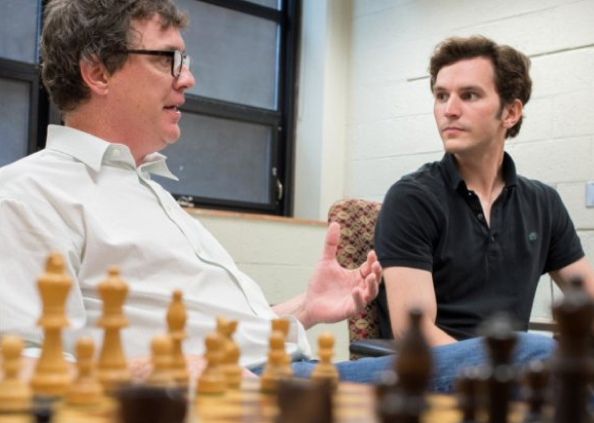
© Michigan State UniversityMichigan State University psychology professor Zach Hambrick, left, and graduate student Alexander Burgoyne discuss their findings that chess skill is related to intelligence.
Intelligence -- and not just relentless practice -- plays a significant role in determining chess skill, indicates a comprehensive new study led by Michigan State University researchers.

The research provides some of the most conclusive evidence to date that cognitive ability is linked to skilled performance -- a hotly debated issue in psychology for decades -- and refutes theories that expertise is based solely on intensive training.

Beaker

Reprogramming life? Scientists close to 'recoding' genome

Bacteria
© Josef Reischig/Wikimedia
Geneticists have made a step forward in 'recoding' the genome as we know it, replacing 62,214 DNA base pairs in a synthetic E. coli genome.

Recoding genomes so extensively could lead to the development of organisms that are resistant to viruses, and could even allowing biologists to code for all-new synthetic amino acids. Essentially, it allows us to reprogram life.

"It's not easy, but we can engineer life at profound scales, even something as fundamental as the genetic code," says Peter Carr, a bioengineer at MIT, not involved with this study, told Science.

To understand what the researchers have done, we first have to have to understand how DNA works. DNA, and its four base pairs, A, T, C, and G, are translated into RNA, where the code is arranged in triplets, that each code for a specific amino acid (the cell's building blocks) the cell should use.

For example, A - G - G codes for the amino acid arginine, and C - C- G codes for proline. "Almost all life shares a common genetic code," one of the researchers, Marc Lajoie, told Popular Mechanics. "For example, the genetic sequence A - G - G means the same thing for almost all organisms, from your cells, to a plant cell, to a yeast cell."

Comment: See also:

Scientists create smallest life form yet, unsure what it is, how little we know about DNA


Robot

Drone armed with claws designed for dangerous ops

2-armed drone
© Prodrone Co., Ltd. 株式会社プロドローン / YouTube
An intimidating robotic-clawed drone whose formidable appearance has sparked comparison with nature's toughest birds of prey has been unveiled in Japan.

The PD6B-AW-ARM, the latest large format drone by ProDrone, comes complete with two 'Transformer' like arms which have made a strong impression on some reviewers.

The device was developed in response to increased demand among drone users for 'hands on operations', according to a company press release, and can carry a diverse range of cargo with its remarkable claws.

Moon

Collision rescaled: "Extremely giant impact' now thought to be the making of Earth's moon

Moon-making collision
© twitter.com
It lights up our sky and has hosted astronauts, but there's still much to learn about the moon. Astronomers have long believed it was formed from a space rock's low-contact collision with Earth, but new research says the impact was far more violent.

Since the 1970s, researchers have settled on a theory which assumes the moon was created when a space rock the size of Mars "lightly" grazed Earth around 4.5 billion years ago. The impact would have scattered debris from both bodies into space, and formed a disk orbiting early Earth. That disk, according to the theory, eventually became the modern-day moon. However, a new study published in Nature says the collision was far stronger and far less friendly than previously believed. The new information comes after researchers studied Apollo-era moon rocks with new technology.

"We're still re-measuring the old Apollo samples from the '70s, because the tech has been developing in recent years. We can measure much smaller differences between Earth and the moon, so we found a lot of things we didn't find in the 1970s," lead author Kun Wang, an assistant professor at Washington University, told Gizmodo. "The old models just could not explain the new observations."

If the theory that the space rock lightly collided with Earth were true, evidence should be available showing that the chemical composition of the moon is distinct from that of the Earth, as the odds that the space rock that struck Earth had the same chemical make-up would be incredibly small, as scientists expected. However, the studied samples of potassium isotopes failed to produce such evidence. Instead, chemical analyses showed isotopic compound readings that were nearly identical.

Intrigued, the researchers conducted increasingly advanced tests in an effort to identify any differences in the signatures. They eventually found one, but it suggested that the samples' origins were even more connected than previously thought.

Bizarro Earth

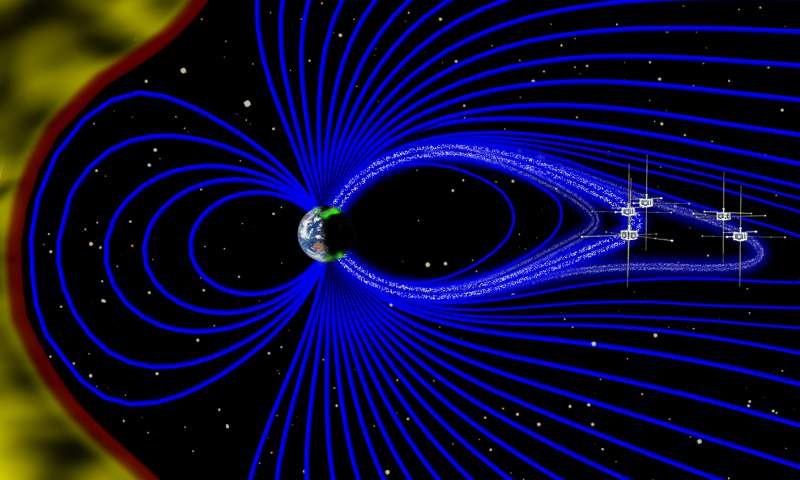
NASA's THEMIS sees Auroras move to the rhythm of Earth's magnetic field

Cross-section of the magnetosphere
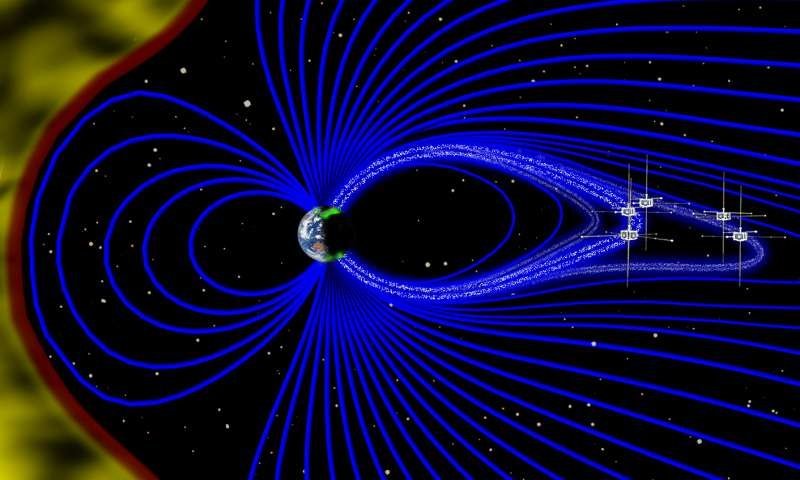
© Emmanuel Masongsong/UCLA EPSS/NASAAn artist's rendering (not to scale) of a cross-section of the magnetosphere, with the solar wind on the left in yellow and magnetic field lines emanating from the Earth in blue. The five THEMIS probes were well-positioned to directly observe one particular magnetic field line as it oscillated back and forth roughly every six minutes. In this unstable environment, electrons in near-Earth space, depicted as white dots, stream rapidly down magnetic field lines towards Earth's poles. There, they interact with oxygen and nitrogen particles in the upper atmosphere, releasing photons and brightening a specific region of the aurora.
The majestic auroras have captivated humans for thousands of years, but their nature—the fact that the lights are electromagnetic and respond to solar activity—was only realized in the last 150 years. Thanks to coordinated multi-satellite observations and a worldwide network of magnetic sensors and cameras, close study of auroras has become possible over recent decades. Yet, auroras continue to mystify, dancing far above the ground to some, thus far, undetected rhythm.

Using data from NASA's Time History of Events and Macroscale Interactions during Substorms, or THEMIS, scientists have observed Earth's vibrating magnetic field in relation to the northern lights dancing in the night sky over Canada. THEMIS is a five-spacecraft mission dedicated to understanding the processes behind auroras, which erupt across the sky in response to changes in Earth's magnetic environment, called the magnetosphere.

These new observations allowed scientists to directly link specific intense disturbances in the magnetosphere to the magnetic response on the ground. A paper on these findings was published in Nature Physics on Sept. 12, 2016.

"We've made similar observations before, but only in one place at a time - on the ground or in space," said David Sibeck, THEMIS project scientist at NASA's Goddard Space Flight Center in Greenbelt, Maryland, who did not participate in the study. "When you have the measurements in both places, you can relate the two things together."

Understanding how and why auroras occur helps us learn more about the complex space environment around our planet. Radiation and energy in near-Earth space can have a variety of effects on our satellites - from disrupting their electronics to increasing frictional drag and interrupting communication or navigation signals. As our dependence on GPS grows and space exploration expands, accurate space weather forecasting becomes ever more important.

The space environment of our entire solar system, both near Earth and far beyond Pluto, is determined by the sun's activity, which cycles and fluctuates through time. The solar system is filled with solar wind, the constant flow of charged particles from the sun. Most of the solar wind is deflected from Earth by our planet's protective magnetosphere.

Comment: See also: Pulsating Auroras