
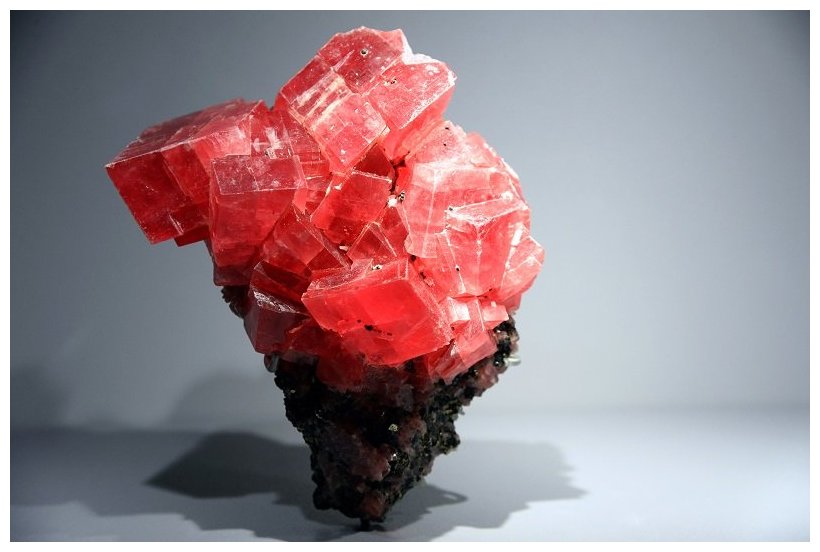
© Patrick Kovarik/AFP/Getty ImagesRed fluorite crystals shown at the Natural history Museum in Paris.
What's special about time crystals is that, if they exist, they could break the symmetry of time and space. The way time crystals would move is in a repeating pattern, without using stored energy, in a sort of perpetual motion.
The reason crystals gave Wilczek the idea is because they exhibit unusual growth behavior, with their atoms spontaneously organizing into rows, columns and 3D lattices, without becoming symmetrical like a sphere. This breaks the spatial symmetry of nature, which maintains that all places are equivalent. Knowing this, Professor Wilczek came up with mathematical proof that showed the atoms of crystallizing matter could regularly form repeating lattices in time, but without consuming or producing any energy. They would return to their "ground state" and start the process all over again. Such a system would be breaking time-translational symmetry (TTS), another fundamental symmetry in physics."I was thinking about the classification of crystals, and then it just occurred to me that it's natural to think about space and time together," said Wilczek about his idea. "So if you think about crystals in space, it's very natural also to think about the classification of crystalline behavior in time."
This idea seemed strange, but because it had peer-reviewed proof, other scientists were compelled to consider it. If experimentalists could make real the ideas that theoretical physicists came up with, the existence of time crystals would shed light on the nature of time itself, possibly reconciling the theory of relativity with quantum mechanics.
Now, experimental scientists from the University of California, Santa Barbara and from Microsoft's research lab Station Q published a paper, explaining how symmetry-breaking time crystals could be possible. They maintain there is a difference between "explicit" and "spontaneous" symmetry breaking.
Basically, nature can choose to make exceptions."If a symmetry is broken explicitly, then the laws of nature do not have the symmetry any more; spontaneous symmetry breaking means that the laws of nature have a symmetry, but nature chooses a state that doesn't," said Dominic Else, co-author of the paper.
The scientists predict that this kind of broken symmetry can happen in quantum systems they called "Floquet-many-body-localized driven systems." And they have an experiment in mind to create these.
They plan to use a large system of trapped atoms, trapped ions or superconducting qubits to create a time crystal, then to observe it and measure its changes over time."In collaboration with experimental research groups, we are exploring the possibility of realizing Floquet time crystals in systems of cold atomic gases," said co-author Chetan Nayak at Microsoft Station Q and UCSB to Phys.org.






my theory about the Magellenic Clouds being a former galaxy is now set in concrete. The Magellenic Galaxy's mazed center retained so much energy under Kate's Cloak that space/time was rifted and the galaxy's solar systems were scattered.