
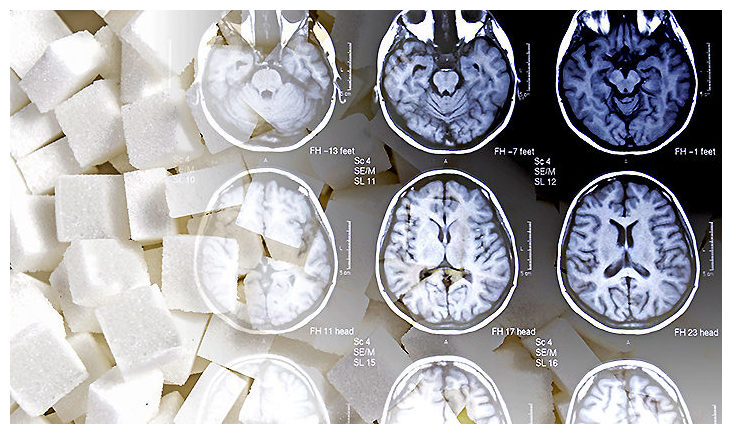
© Yale News
The study was published on Feb. 23 by JCI Insight.
Fructose is a simple sugar found in fruits, vegetables, table sugar, and many processed foods. Excess consumption of fructose contributes to high blood sugar and chronic diseases like obesity. The Yale research team had demonstrated in a prior study that fructose and another simple sugar, glucose, had different effects on brain activity. But it was not known whether fructose was produced in the brain or crossed over from the bloodstream.
To investigate, the research team gave eight healthy, lean individuals infusions of glucose over a four-hour period. They measured sugar concentrations in the brains of the study participants using magnetic resonance spectroscopy, a noninvasive neuroimaging technique. Sugar concentrations in the blood were also assessed.
The researchers found cerebral fructose levels rose significantly in response to a glucose infusion, with minimal changes in fructose levels in the blood. They surmised that the high concentration of fructose in the brain was due to a metabolic pathway called the polyol pathway that converts glucose to fructose.
"In this study, we show for the first time that fructose can be produced in the human brain," said first author Dr. Janice Hwang, assistant professor of medicine.



















Comment: Uhm, didn't they say they were shutting down HAARP in 2014?
So now it's in civilian hands. Or so they say...