Science & TechnologyS


Satellite

China launches first X-ray space telescope to study black holes

China X-ray Telescope
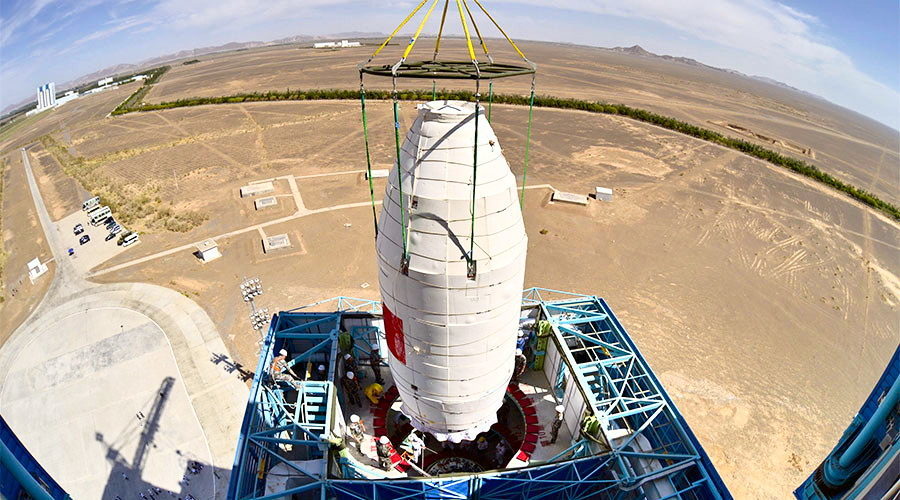
© AFP The Hard X-ray Modulation Telescope (HXMT), being lifted onto a Long March-4B rocket at the Jiuquan Satellite Launch Center, China June 15, 2017.
China has launched its first X-ray space telescope, aimed at studying black holes, pulsars, and gamma ray bursts, state media reported. The launch is expected to bring "new breakthroughs in physics," according to the project's lead scientist. The 2.5-tonne Hard X-ray Modulation Telescope (HXMT), named 'Insight,' was launched on Thursday morning from Jiuquan Satellite Launch Center in northwest China's Gobi desert, Xinhua reported. It was delivered into orbit, 550km (341 miles) above the Earth, by the Long March-4B rocket. Chinese scientists say Insight will allow them to observe magnetic fields and the interiors of pulsars and better understand the evolution of black holes, AFP reported.


Specifically, Insight will seek out new black hole activity by searching the Milky Way for celestial bodies that emit X-rays.Although black holes are usually undetectable, scientists are able to study the X-rays emitted when matter falls into a black hole and is accelerated and heated, lead scientist Zhang Shuangnan said, as quoted by Xinhua. According to Zhang, Insight is more capable of finding black holes and neutron stars that emit bright X-rays than other countries' space telescopes, because it has a larger detection area and a broader energy range which makes it easier to scan the galaxy.

Comment: In 2018 the ambitious Chang'e-4 mission may become the first in the world to land on the far side of the moon.
See also:


Solar Flares

Study: Our sun probably has an evil twin called Nemesis

Nemesis binary star study
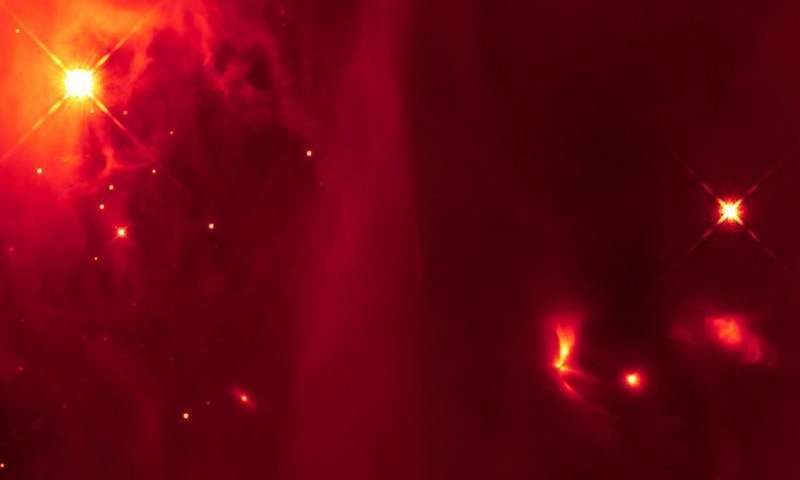
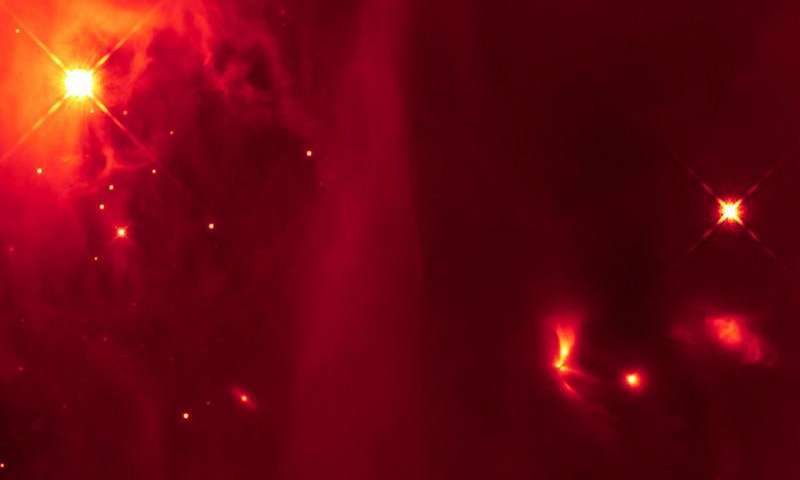
© NASA, ESA and J. Muzerolle, STScIThis infrared image from the Hubble Space Telescope contains a bright, fan-shaped object (lower right quadrant) thought to be a binary star that emits light pulses as the two stars interact. The primitive binary system is located in the IC 348 region of the Perseus molecular cloud and was included in the study by the Berkeley/Harvard team.
Did our sun have a twin when it was born 4.5 billion years ago?

Almost certainly yes—though not an identical twin. And so did every other sunlike star in the universe, according to a new analysis by a theoretical physicist from UC Berkeley and a radio astronomer from the Smithsonian Astrophysical Observatory at Harvard University.

Many stars have companions, including our nearest neighbor, Alpha Centauri, a triplet system. Astronomers have long sought an explanation. Are binary and triplet star systems born that way? Did one star capture another? Do binary stars sometimes split up and become single stars?

Astronomers have even searched for a companion to our sun, a star dubbed Nemesis because it was supposed to have kicked an asteroid into Earth's orbit that collided with our planet and exterminated the dinosaurs. It has never been found.

The new assertion is based on a radio survey of a giant molecular cloud filled with recently formed stars in the constellation Perseus, and a mathematical model that can explain the Perseus observations only if all sunlike stars are born with a companion.

"We are saying, yes, there probably was a Nemesis, a long time ago," said co-author Steven Stahler, a UC Berkeley research astronomer.

"We ran a series of statistical models to see if we could account for the relative populations of young single stars and binaries of all separations in the Perseus molecular cloud, and the only model that could reproduce the data was one in which all stars form initially as wide binaries. These systems then either shrink or break apart within a million years."

In this study, "wide" means that the two stars are separated by more than 500 astronomical units, or AU, where one astronomical unit is the average distance between the sun and Earth (93 million miles). A wide binary companion to our sun would have been 17 times farther from the sun than its most distant planet today, Neptune.

Based on this model, the sun's sibling most likely escaped and mixed with all the other stars in our region of the Milky Way galaxy, never to be seen again.

Comment: For more on Nemesis - Sol's dark companion - see Pierre Lescaudron and Laura Knight-Jadczyk's book, Earth Changes and the Human-Cosmic Connection.

Perhaps 'something wicked this way comes?'


Fireball 4

Mystery solved: Wow! signal from 1977 was generated by a comet

Wow! Signal
© The Ohio State University Radio Observatory and the North American Astrophysical Observatory (NAAPO)
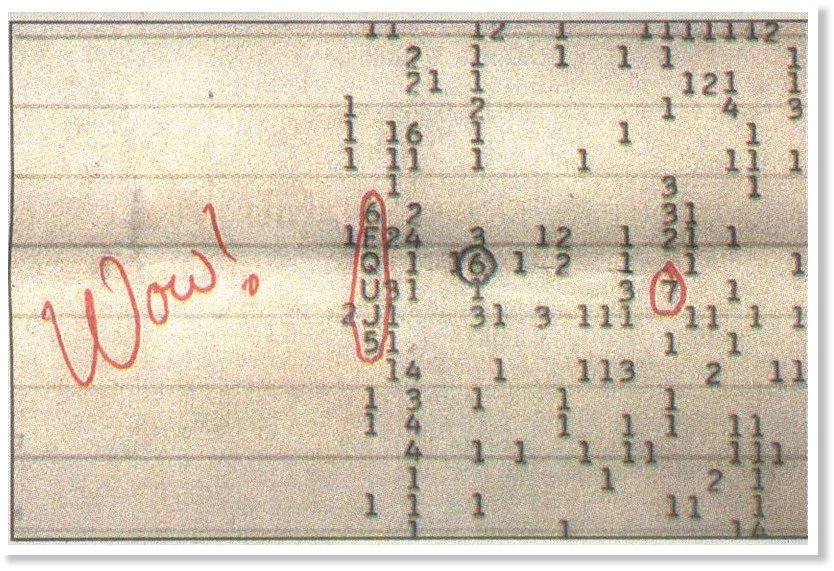
A team of researchers with the Center of Planetary Science (CPS) has finally solved the mystery of the "Wow!" signal from 1977. It was a comet, they report, one that that was unknown at the time of the signal discovery. Lead researcher Antonio Paris describes their theory and how the team proved it in a paper published in the Journal of the Washington Academy of Sciences.

Back in August of 1977, a team of astronomers studying radio transmissions from an observatory at Ohio State called the "Big Ear" recorded an unusual 72-second signal—it was so strong that team member Jerry Ehman scrawled "Wow!" next to the readout. Since that time, numerous scientists have searched for an explanation of the signal, but until now, no one could offer a valid argument. Possible sources such as asteroids, exo-planets, stars and even signals from Earth have all been ruled out. Some outside the science community even suggested that it was proof of aliens. It was noted that the frequency was transmitted at 1,420 MHz, though, which happens to be the same frequency as hydrogen.

Binoculars

Winging it: Ladybugs make complex origami-like folds to stash their wings

ladybugs
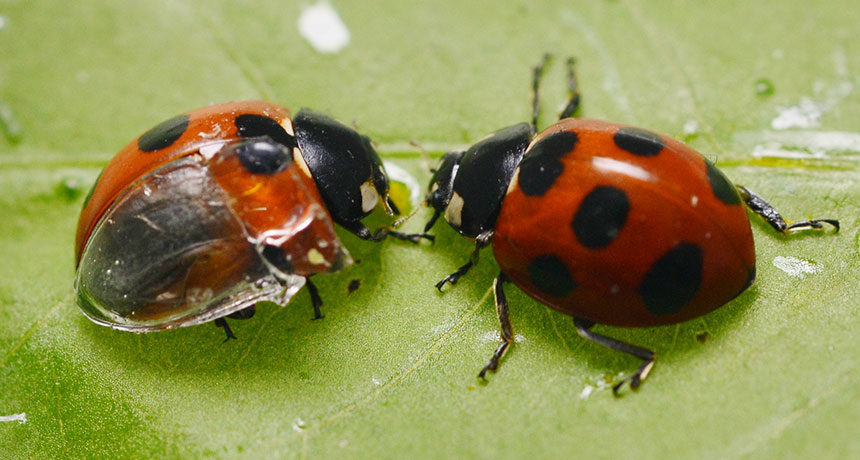
© Kazuya Saito 2017WINGING IT Ladybugs fold up their wings when they land. To view that process, scientists replaced part of a ladybug’s red-and-black wing case with a transparent resin.
Those who struggle to fit a vacation wardrobe into a carry-on might learn from ladybugs. The flying beetles neatly fold up their wings when they land, stashing the delicate appendages underneath their protective red and black forewings.

To learn how one species of ladybug (Coccinella septempunctata) achieves such efficient packing, scientists needed to see under the bug's spotted exterior. So a team from Japan replaced part of a ladybug's forewing with a transparent bit of resin, to get a first-of-its-kind glimpse of the folding.


Propaganda

The Pentagon's new 'kinetic energy projectile' weapon is essentially a weaponized meteor strike

Supersonic weapon
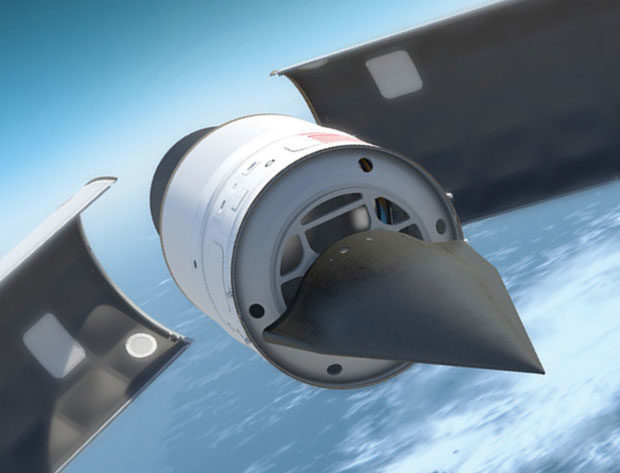
© DARPA/Lawrence Livermore National LabA DARPA rendering depicts a supersonic conventional weapon as it emerges from its rocket nose. Not quite Jerry Pournelle’s ‘Rods From God,’ but just as terrifying.

Comment: Note that nowhere in the article was the word meteor was mentioned. Given the context of the article, we can't help remembering what Victor Clube, author of The Cosmic Serpent and The Cosmic Winter, once said: "We do not need the celestial threat to disguise Cold War intentions; rather we need the Cold War to disguise celestial intentions!"


In the 1950s, Jerry Pournelle imagined the military equivalent of the extinction of the dinosaurs.

Toiling away as a Boeing operations researcher in the afterglow of the Manhattan Project and the Soviet Union's First Lightning nuclear test in 1949, the U.S. Army veteran envisioned a weapons system armed not with munitions and other chemical explosives, but massive rods forged from heavy metals dropped from sub-orbital heights. Those "tungsten thunderbolts," as the New York Times called them, would impact enemy strongholds below with the devastating velocity of a dino-exterminating impact, obliterating highly fortified targets — like, say, Iranian centrifuges or North Korean bunkers — without the mess of nuclear fallout.

Pournelle, whose years of experience in aerospace would fuel a career as a journalist and military science fiction writer, named his superweapon "Project Thor." Others just called it "Rods From God." In reality, weapons researchers refer to it as a "kinetic energy projectile": a super-dense, super-fast projectile that, operating free of complex systems and volatile chemicals, destroys everything in its path.

Comment: See also: Reading Celestial Intentions Through the Wrong End of the Telescope: Missiles, UFOs and the Cold War


Beaker

The very real dangers of CRISPR gene editing technology

gene editing techniques
CRISPR gene-editing technology has been taking the medical world by storm, showing potential for treating diseases ranging from cancer to type 2 diabetes. The technology has been moving full-steam ahead, with a trial in humans already started, even as the repercussions of gene editing remain largely unknown.

A new study has highlighted the uncertainties, showing that unintended mutations may result when you dice and splice the human genome, but it's too soon to say whether the mutations are a cause for alarm.

What Is CRISPR?


Comment: See also:


Bizarro Earth

Signs of past mega-quakes show wide-ranging implications of major rupture on California's San Andreas fault

San Andreas Fault
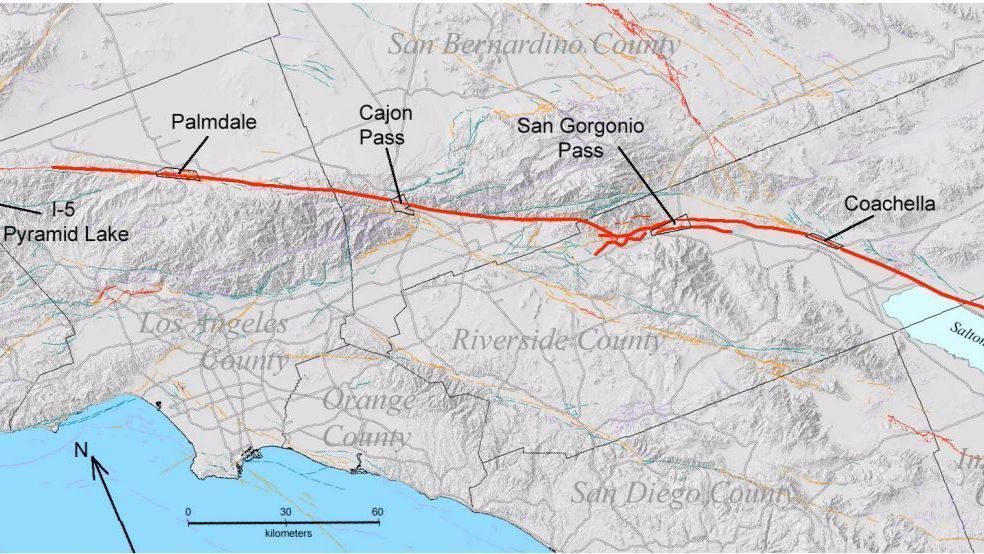
© U.S. Geological Survey)The San Andreas fault, in heavy red, slices through key mountain passes including the San Gorgonio Pass and the Cajon Pass.
As Interstate 10 snakes through the mountains and toward the golf courses, housing tracts and resorts of the Coachella Valley, it crosses the dusty slopes of the San Gorgonio Pass.

The pass is best known for the spinning wind turbines that line it. But for geologists, the narrow desert canyon is something of a canary in the coal mine for what they expect will be a major earthquake coming from the San Andreas fault.

The pass sits at a key geological point, separating the low desert from the Inland Empire, and, beyond that, the Los Angeles Basin.

Through it runs an essential aqueduct that feeds Southern California water from the Colorado River as well as vital transportation links. It's also the path for crucial power transmission lines.

California earthquake experts believe what happens at the San Gorgonio Pass during a major rupture of the San Andreas fault could have wide-ranging implications for the region and beyond.

Comment: New study finds that California's San Andreas Fault could actually rupture along its entire 800-mile length


Book

Long lost diary may hold key to unearthing 'eighth wonder of the world' in New Zealand

Archive illustration of the White Terrace, New Zealand
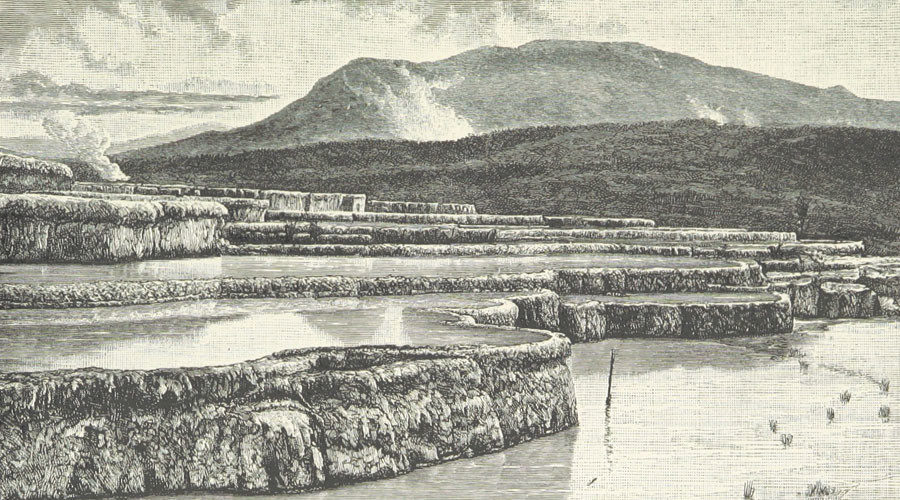
© British Library / Wikipedia Archive illustration of the White Terrace, New Zealand.
In events reminiscent of the plot of an Indiana Jones adventure, two researchers believe the discovery of a historic diary may be the key to finding New Zealand's mysterious Pink and White Terraces - the fabled 'eighth wonder of the world.'

Made up of large mounds of silica deposits, the terraces were once a feature of the Lake Rotomahana region until a massive volcanic eruption at Mount Tarawera in 1886 purportedly changed the area's landscape forever.

Now, the discovery of a field diary belonging to Swiss geologist Ferdinand von Hochstetter may provide a way to uncover the pink hued springs that were once renowned among indigenous people for their healing qualities.

Snowflake Cold

Astrophysicist: "Mini Ice Age is here to stay"

mini ice-age
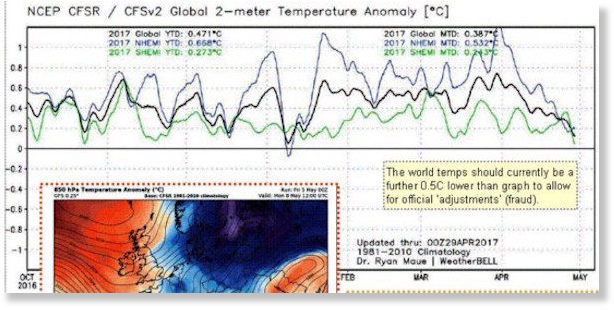
British Physicist and weatheraction.com front man, Piers Corbyn, issues a stark rebuke to climate alarmists who claim the 18-year-old pause in global warming won't last.
"The mini ice age is here to stay!"
Illustrating his analysis of the data with deft graphwork Corbyn shows that in April 2017 temperatures in both the northern and southern hemispheres plunged dramatically last month.
"The mini ice age is in a new phase and is here to stay for at least 20 years."
Corbyn is not alone among respected international scientists who foresee a new era of ice and cold with inherent damaging impacts on world agriculture, disease and political fallout. The really obvious evidence is the dramatic absence of any sun spots in recent weeks.

The daily Berliner Kurier reports solar physicists at the ultra-warmist Potsdam Institute for Climate Impact Research (PIK) are warning that Europe may be facing "a mini ice age" due to a possible protracted solar minimum.

Magnify

Study: RoundUp herbicide caused lab ants to stop digging

ants
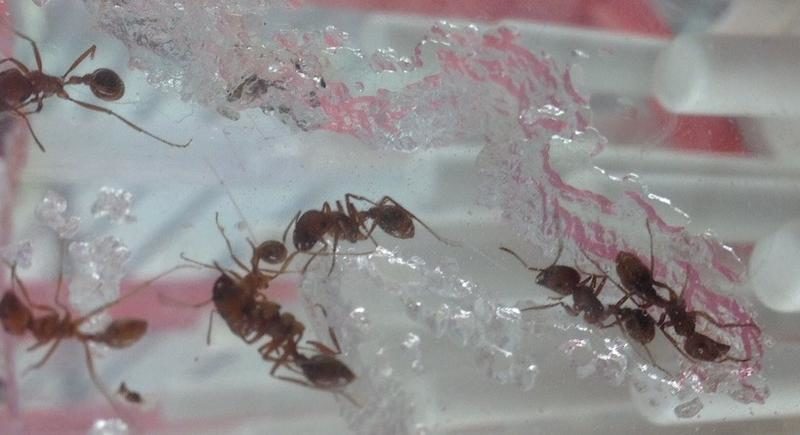
© WEBSTER UNIVERSITYWebster University students dosed western harvester ants with various contaminants, including Roundup, to see how they affect behavior.
A study at Webster University has revealed that Monsanto's weed killer Roundup can significantly change ant behavior.

Researchers began two years ago to study how ants are affected by man-made contaminants, including Roundup. The product has become controversial recently due to allegations that its key ingredient, glyphosate, causes cancer in humans.

The ant study hasn't been published yet, but student researchers noted that the herbicide significantly affected western harvester ants.

"When we put Roundup in the habitat, all digging ceased. I was dumbfounded. I didn't believe it,"said Victoria Brown-Kennerly, a geneticist at Webster University who supervised the project.

"These chemicals are not lethal to the animals, but it's definitely changing their behaviors."Western harvester ants, often used in ant farms, are known to create underground tunnels.