Science & TechnologyS


Blue Planet

What caused the mysterious bend in the Hawaiian-Emperor chain?

Hawaiian volcanic chain
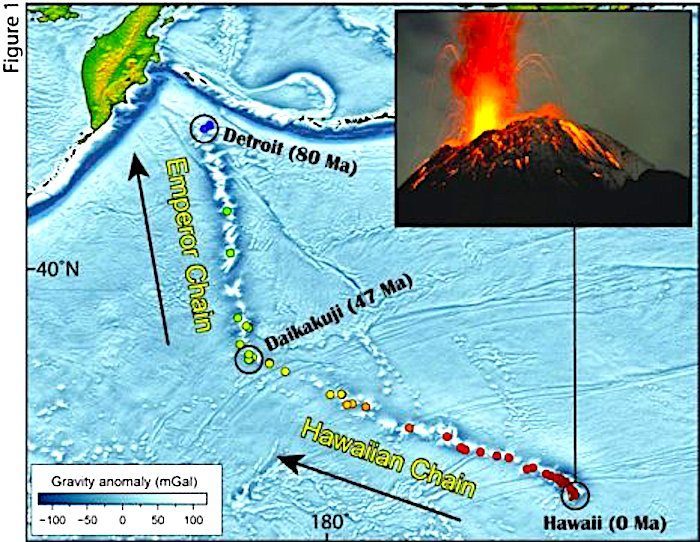
© T. Torsvik et al. (GFZ)The Hawaiian-Emperor Chain is an example of a hotspot track - a trail of volcanic islands and seamounts created on a lithospheric plate as the plate slowly shifts over a spot of localized melting sourced by a jet of hot material rising from the deep mantle (mantle plume).
The volcanic islands of Hawaii represent the youngest end of a 80 million years old and roughly 6,000 kilometres long mountain chain on the ground of the Pacific Ocean. The so-called Hawaiian-Emperor chain consisting of dozens of volcanoes is well known for its peculiar 60 degrees bend.

The cause for this bend has been heavily debated for decades. One explanation is an abrupt change in the motion of the Pacific tectonic plate, the opposite model states southward drift of the mantle plume that has sourced the chain since its beginning 80 million years ago. Apparently both processes play an important role, shows a new study in Nature Communications, published by a group of scientists from the University of Oslo, German Research Centre for Geosciences GFZ Potsdam, and Utrecht University.

Many volcanic ocean islands are created by columnar shaped hot upwellings called mantle plumes that originate near the ~3000 km deep base of Earth's mantle. Mantle plumes are not much influenced by surface motions of the tectonic plates that slowly move over them. Hence, long linear chains of plume-sourced volcanoes that get older and older with increasing distance from active hotspots can be tracked for hundreds to thousands of kilometres.
In the Hawaiian hotspot trail, the Hawaii islands are the youngest in the chain that stretches nearly 6,000 km to Detroit seamount in the northwest Pacific, where volcanism occurred about 80 million years ago. An unprecedented 60 degrees bend characterizes the Hawaiian-Emperor Chain, dividing it into the older Emperor Chain and the younger Hawaiian Chain. The bend has been dated to 47 Ma.


Beaker

Researchers publish how they made the H7N9 virus more transmissable

poison vial
In 2014, a moratorium was placed on federally funded research which involved making flu viruses more lethal. The moratorium was placed after heated debate generated by research published by a Netherlands team, headed up by Ron Fouchier. Fouchier's research had produced a strain of H5N1 which was able to go airborne, thus greatly enhancing its ability to spread. Fouchier focused on the transmission of the disease among ferrets, which are the lab stand-in for people.
Now, scientists in California have published research concerning enabling the human-to-human transmission of the bird flu virus H7N9. This virus strain is of concern to scientists as it has already infected 1500 people and killed 40% of them. H7N9 has not been known, however, to spread easily from human contact.

The article explaining the three genetic changes which need to be made to transform H7N9 into a virtual pandemic agent was published on June 15, 2017 in the journal PLOS Pathogens.

According to Scripps biologist Jim Paulsen, as quoted in an NPR article, "As scientists we're interested in how the virus works.... We're trying to just understand the virus so that we can be prepared."

Comment: Why on earth are scientists trying to make the flu virus or any other virus more lethal? Because the US military is always looking for better and more efficient ways to kill lots of people. What could possibly go wrong?


Alarm Clock

Weaponized plants: Pentagon's synthetic organisms could 'militarize the environment'

weaponized plants
© SeniorJ Deviant Art
What if you were deemed a fugitive 20 years from now, for doing something such as vocally speaking out against the status quo, growing cannabis, or going against the grain of the system. Then one day, you're walking in some rural area you escaped to in order to avoid capture by the state, and the environment recognizes your identity and becomes weaponized to you.

The moss in the woods recognizes your biological footprint and creates a toxin to anesthetize you until authorities arrive to place you under arrest. The trees in this forest are not even equipped with cameras, but engineered, synthetic organisms with a biological code connected to a database that recognizes you are a fugitive and responds by creating toxins.

Although the idea of a fugitive being specifically targeted by intelligent synthetic biology is a particularly far-fetched scenario, fully engineered, synthetic ecosystems weaponized against people are something the Pentagon is actually working on.

DARPA is flirting with creating environments where every organism is engineered to perform biological tasks, from creating chemicals to being weaponized. The trees, moss, grass, insects, bacteria, and soil of an ecosystem could be engineered to release toxins on people, or put people to sleep until the state's forces arrive, or perform any function they can engineer an organism to do.

Info

Deep-space travel, colonization may rely on genetically engineered life forms

Space Colony
© Genetic Literacy Project
Genetic biotechnology is usually discussed in the context of current and emerging applications here on Earth, and rightly so, since we still live exclusively in our planetary cradle. But as humanity looks outward, we ponder what kind of life we ought to take with us to support outposts and eventually colonies off the Earth.

While the International Space Station (ISS) and the various spacecraft that ferry astronauts on short bouts through space depend on consumables brought up from Earth to maintain life support, this approach will not be practical for extensive lunar missions, much less long term occupation of more distant sites. If we're to build permanent bases, and eventually colonies, on the Moon, Mars, asteroids, moons of outer planets or in free space, we'll need recycling life support systems. This means air, water, and food replenished through microorganisms and plants, and it's not a new idea.

Space exploration enthusiasts have been talking about it for decades, and it's the most obvious application of microorganisms and plants transplanted from Earth. What is new, however, is the prospect of a comprehensive use of synthetic biology for a wide range of off-Earth outpost and colonization applications.

To this end, considering human outposts on the Moon and Mars, a study from scientists based at NASA Ames Research Center and the University of California at Berkeley examined the potential of genetic technology, not only to achieve biologically based life support systems, but also to facilitate other activities that must be sustained on colony worlds. Not discussed as often with biotechnology and space exploration in the same conversation, these other activities include creation of rocket propellant, synthesis of polymers, and production of pharmaceuticals. Together with the life support system, they paint a picture of the beckoning era of space activity that puts synthetic biology at center stage.

Although written specifically in the context of lunar and Martian outposts, the proposed biologically based technical infrastructure is just as applicable to a colony on less frequently discussed worlds, such as the dwarf planet Ceres or an outer planet moon, or to a colony that orbits in the Earth moon system.

HAL9000

Facebook designed chatbots developed their own non-human language

HAL 9000, the fictional sentient computer from the 1968 film 2001: A Space Odyssey
© MGM StudiosHAL 9000, the fictional sentient computer from the 1968 film 2001: A Space Odyssey.
When Facebook designed chatbots to negotiate with one another, the bots made up their own way of communicating.

A buried line in a new Facebook report about chatbots' conversations with one another offers a remarkable glimpse at the future of language.

In the report, researchers at the Facebook Artificial Intelligence Research lab describe using machine learning to train their "dialog agents" to negotiate. (And it turns out bots are actually quite good at dealmaking.) At one point, the researchers write, they had to tweak one of their models because otherwise the bot-to-bot conversation "led to divergence from human language as the agents developed their own language for negotiating." They had to use what's called a fixed supervised model instead.

Post-It Note

Michelin's concept airless tire comes wrapped in 'rechargeable' 3D-printed treads

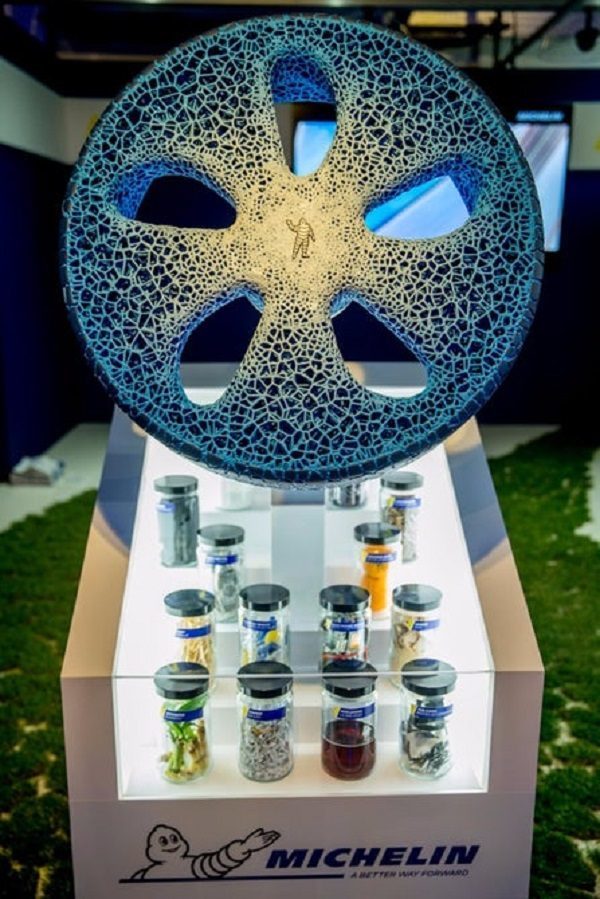
The Vision concept tire and wheel combination envisioned by Michelin
© Jimmy HamelinThe Vision concept tire and wheel combination envisioned by Michelin.
Aside from trotting out a new tread pattern every year or so, you might think there's not a lot manufacturers could do to improve the humble car tire. But advances in materials, sensors and manufacturing techniques are opening up new possibilities. Michelin is exploring this potential with its Vision concept tire that is airless, 3D printed, equipped with sensors, biodegradable, and not just a tire, but a tire and wheel in one.

Unveiled at a global symposium on urban mobility challenges it hosted this week in Montreal, Canada, Michelin's Vision tire is constructed using 3D printing technology. This enables an airless interior architecture that mimics alveolar structures (such as the air sacs of the lungs) that is solid in the center and more flexible on the outside, resulting in a tire that is immune to blowouts or going flat.

Laptop

Latest hacking tool: Experts warn altered E-cigs can allow hackers to attack computers when charged by USB port

E-cig hacking
Electronic cigarettes devices can be modified in a fashion that allows hackers to attack computers when it is plugged into the USB port. Hackers can just add a hardware chip into the area of the battery to turn it into a malicious tool.
Researchers have found more controversy with electronic cigarettes - but this time, it doesn't affect your health.

The vaping devices can be modified in a fashion that allows hackers to attack computers when it is plugged into the USB port.

By adding a hardware chip with a pre-written script, cyberthieves can meddle with traffic or trick the computer into thinking it is a keyboard to carry out commands.

E-cigs are currently caught in the middle of a health debate, as numerous studies have argued that they are either better or worse than traditional tobacco cigarettes - but experts have yet to come to a conclusion.

However, a recent discovery has made one risk of these devices very clear.


Eye 1

Cherry Blossom: How the CIA can hack into your internet router

cyber eye
© Pixabay
Wi-Fi routers typically sit in dusty corners of homes and offices, quietly transmitting internet accessibility to computers, tablets and phones in its immediate vicinity. However, these unpretentious devices are a goldmine for hackers - and were specifically targeted by the US Central Intelligence Agency, the latest Wikileaks release has revealed.

The release is the latest instalment of Wikileaks' "Vault7" series, which the group has been drip-feeding to the public since March. Previous trickles have revealed CIA attempts to hack office computers, televisions and phones, among many other shock exposures.

This time, the documents contain detailed information on the CIA's router hacking "toolkit" — and how the Agency sought to leverage common vulnerabilities in routers sold by companies such as D-Link and Linksys. The techniques range from hacking network passwords to rewriting device firmware to remotely monitor traffic flowing across a target's network.


Jupiter

Electric Jupiter and its many surprises

Electric Jupiter
© YouTube/Thunderbolts Project (screen capture)
The EU2017 Conference: Future Science -- Aug 17 - 20, Phoenix: https://www.thunderbolts.info/wp/2017...

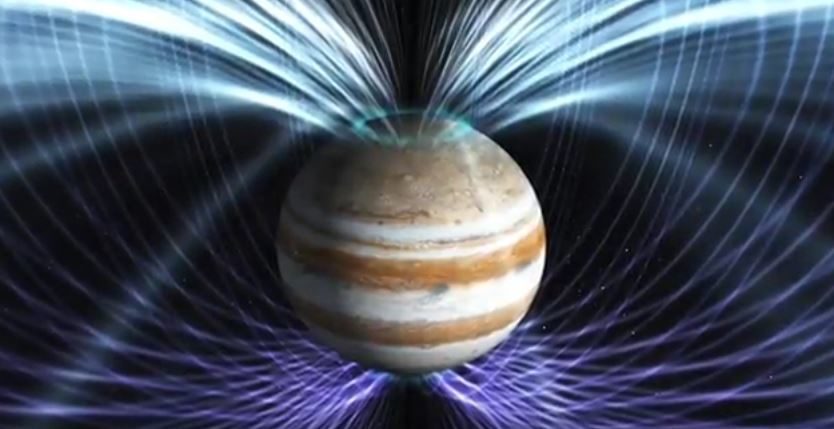
Scientists working on NASA's historic Juno mission to the gas giant Jupiter have recently presented their early findings for the first time. Like so many other recent space missions, what they have discovered is not what they expected. As reported by Newscientist.com, "... the findings are already challenging assumptions about everything from the planet's atmosphere to its interior." In part one of this two-part presentation, physicist and chief science advisor to the Thunderbolts Project begins his in-depth analysis of the Juno data, including the many victories that already seem evident for the Electric Universe theory.


Comment: NASA's Jupiter mission reveals 'brand-new and unexpected' discoveries


Attention

Nemesis - The Sun's long-lost twin

Triple-star system
© Bill Saxton, ALMA (ESO/NAOJ/NRAO), NRAO/AUI/NSFA radio image of a triple-star system forming within a dusty disk in the Perseus molecular cloud obtained by the Atacama Large Millimeter/submillimeter Array in Chile.
Nemesis is apparently real, even if its bad reputation is undeserved.

For decades, some scientists have speculated that the sun has a companion whose gravitational tug periodically jostles comets out of their normal orbits, sending them careening toward Earth. The resulting impacts have caused mass extinctions, the thinking goes, which explains the putative star's nickname: Nemesis.

Now, a new study reports that almost all sun-like stars are likely born with companions, bolstering the case for the existence of Nemesis.
"We are saying, yes, there probably was a Nemesis, a long time ago," study co-author Steven Stahler, a research astronomer at the University of California, Berkeley, said in a statement.

But the new results don't paint Nemesis as a murderer: The sibling star probably broke free of the sun and melted into the Milky Way galaxy's stellar population billions of years ago, study team members said.