
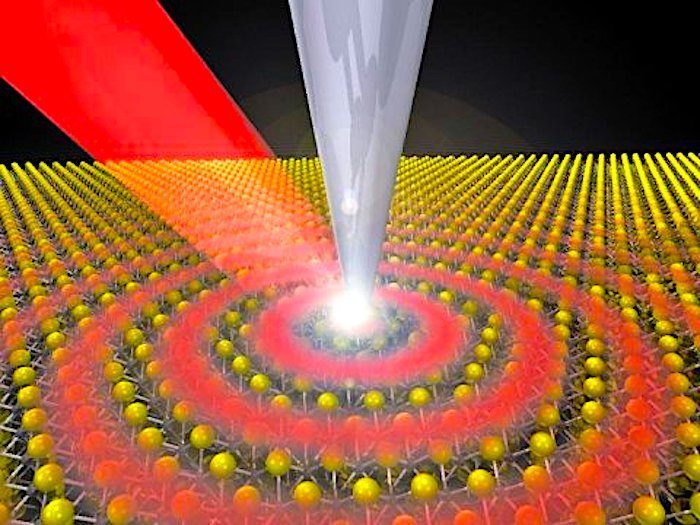
© Zhe Fei/Iowa State UniversityThis image shows how researchers launched and studied half-light, half-matter quasiparticles called exciton-polaritons. A laser from the top left shines on the sharp tip of a nano-imaging system aimed at a flat semiconductor. The red circles inside the semiconductor are the waves associated with the quasiparticles.
"These are waves just like water waves," said Fei, an Iowa State University assistant professor of physics and astronomy and an associate of the U.S. Department of Energy's Ames Laboratory. "It's like dropping a rock on the surface of water and seeing waves. But these waves are exciton-polaritons."
Exciton-polaritons are a combination of light and matter. Like all quasiparticles, they're created within a solid and have physical properties such as energy and momentum. In this study, they were launched by shining a laser on the sharp tip of a nano-imaging system aimed at a thin flake of molybdenum diselenide (MoSe2), a layered semiconductor that supports excitons.
Excitons can form when light is absorbed by a semiconductor. When excitons couple strongly with photons, they create exciton-polaritons.


















Comment: Space weather causes airline pilots, passengers to be exposed to radiation