Science & TechnologyS


Black Cat 2

Cougars fear humans, run away from recorded voices

Puma
Like great white sharks and grizzly bears, mountain lions are one of the most fearsome wild animals for many Americans.

But new research shows that the lions may be more afraid of us than we are of them.

Scientists at UC Santa Cruz placed audio and video equipment in the Santa Cruz Mountains near areas where lions had killed deer and other animals. When a lion came to feed, a motion-activated device broadcast the sounds of people talking and Pacific tree frogs croaking, in addition to turning on a tiny hidden video camera.

In 29 experiments with 17 lions from December 2015 to June 2016, the lions ran away in 83 percent of cases as soon as they heard human voices — and only once when they heard the frog sounds.

Nuke

Russia will deliver test batch of nuclear fuel to US reactor in 2019

JSC Novosibirsk Chemical Concentrate Plant
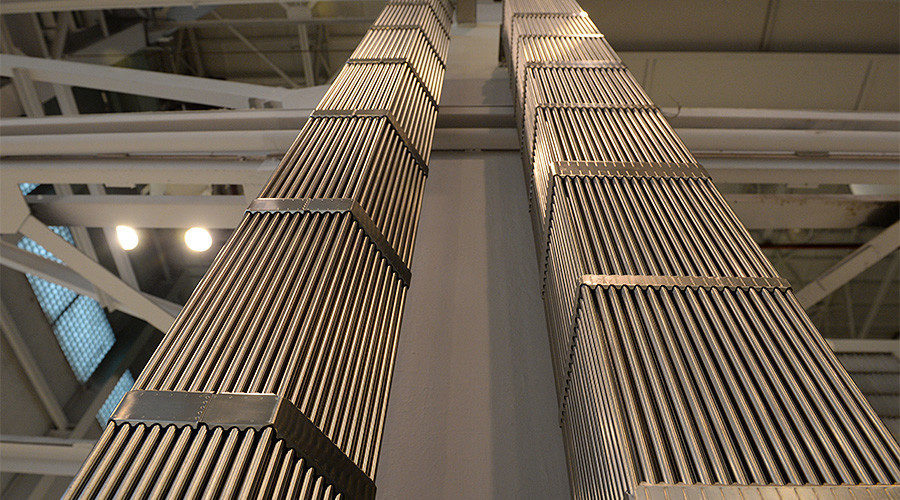
© Alexandr Kryazhev / Sputnik Samples of fuel assemblies (FA) TVS-2M (VVER-1000) and TVS-Kvadrat (PWR-900) manufactured by JSC Novosibirsk Chemical Concentrate Plant.
Russia's nuclear fuel company has launched production of fuel assemblies for a nuclear reactor in the US. The first test batch of fuel assemblies is scheduled to be delivered to the US in 2019, a senior company official has said.

TVEL, the fuel supply wing of the Russian State Atomic Energy Corporation, Rosatom, has begun production of TVS-KVADRAT (FA-SQUARE), the new fuel type designed for PWR (pressurized water reactor) plants of Western design.

"A contract on test-industrial operations with one of the US [nuclear power plants] operators is already signed, and we'll deliver test batch of TVS-KVADRAT fuel assemblies in 2019," TVEL's Senior VP for Commerce and International Business, Oleg Grigoriev, told reporters at a news conference during the Atomexpo-2017 forum on Tuesday.

Brain

Doodling activates the brain's reward pathways

crayons
Your brain's reward pathways become active during art-making activities like doodling, according to a new study from Drexel University.

Girija Kaimal, EdD, assistant professor in the College of Nursing and Health Professions, led a team that used fNIRS (functional near-infrared spectroscopy) technology to measure blood flow in the areas of the brain related to rewards while study participants completed a variety of art-making projects.
"This shows that there might be inherent pleasure in doing art activities independent of the end results. Sometimes, we tend to be very critical of what we do because we have internalized, societal judgements of what is good or bad art and, therefore, who is skilled and who is not," said Kaimal. "We might be reducing or neglecting a simple potential source of rewards perceived by the brain. And this biologocial proof could potentially challenge some of our assumptions about ourselves."
For the study, co-authored by Drexel faculty including Jennifer Nasser, PhD, and Hasan Ayaz, PhD, 26 participants wore fNIRS headbands while they completed three different art activities (each with rest periods between). For three minutes each, the participants colored in a mandala, doodled within or around a circle marked on a paper, and had a free-drawing session.

Attention

A World First: Scientists create 'liquid light' at room temperature

Superfluid light
© Felix Russell-Saw/UnsplashA Frankenstein mash-up of light and matter.
For the first time, physicists have achieved 'liquid light' at room temperature, making this strange form of matter more accessible than ever.

This matter is both a superfluid, which has zero friction and viscosity, and a kind of Bose-Einstein condensate - sometimes described as the fifth state of matter - and it allows light to actually flow around objects and corners.

Regular light behaves like a wave, and sometimes like a particle, always travelling in a straight line. That's why your eyes can't see around corners or objects. But under extreme conditions, light can also act like a liquid, and actually flow around objects.

Bose-Einstein condensates are interesting to physicists because in this state, the rules switch from classical to quantum physics, and matter starts to take on more wave-like properties. They are formed at temperatures close to absolute zero and exist for only fractions of a second.

But in this study, researchers report making a Bose-Einstein condensate at room temperature by using a Frankenstein mash-up of light and matter.
"The extraordinary observation in our work is that we have demonstrated that superfluidity can also occur at room-temperature, under ambient conditions, using light-matter particles called polaritons," says lead researcher Daniele Sanvitto, from the CNR NANOTEC Institute of Nanotechnology in Italy.

Einstein

Were LIGO's gravity wave detections all noise? Independent analysis suggests that may be the case

ligo black holes
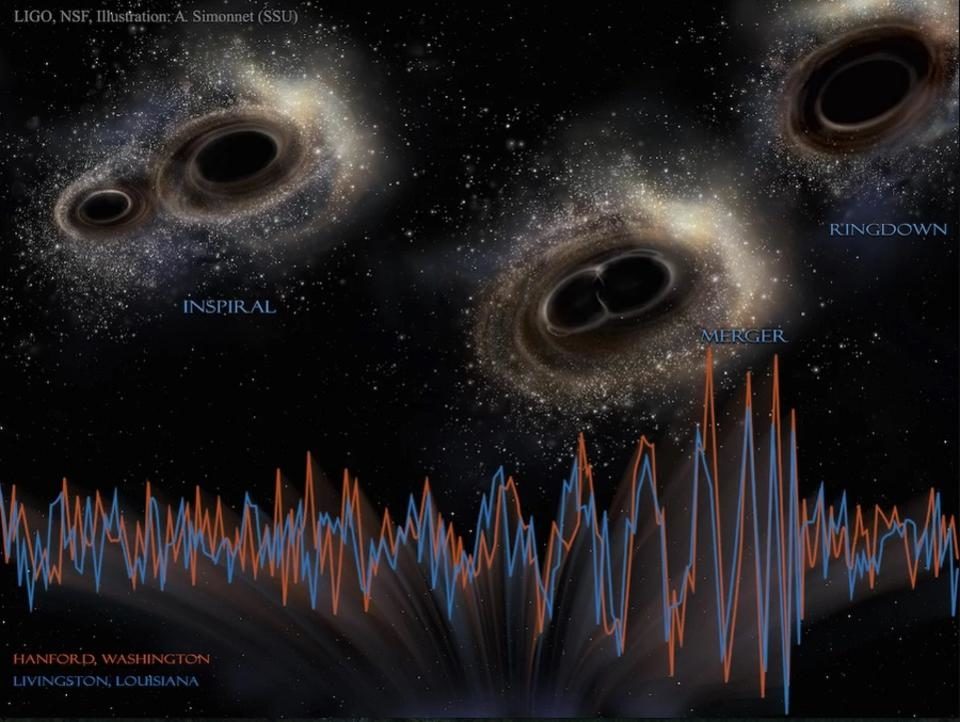
© LIGO, NSF, A. Simonnet (SSU)The 30-ish solar mass binary black holes first observed by LIGO are likely from the merger of direct collapse black holes. But a new publication challenges the analysis of the LIGO collaboration, and the very existence of these mergers.
After an effort of more than 100 years and a collaboration involving over 1,000 scientists, we all celebrated. It was Feb. 11, 2016, and LIGO had just announced their first direct detection of gravitational waves. Analysis of the data attributed the signal to a black hole merger that happened several billion light years away. But what if there wasn't a signal at all, but rather patterns and correlations in the noise that fooled us into believing we were seeing something that wasn't real? A group of Danish researchers just submitted a paper arguing that the celebration might have been premature.

A team of five researchers — James Creswell, Sebastian von Hausegger, Andrew D. Jackson, Hao Liu and Pavel Naselsky — from the Niels Bohr Institute in Copenhagen, presented their own analysis of the openly available LIGO data. And, unlike the LIGO collaboration itself, they come to a disturbing conclusion: that these gravitational waves might not be signals at all, but rather patterns in the noise that have hoodwinked even the best scientists working on this puzzle.

Better Earth

Pacific invasion: Bizarre asexual, glow-in-the-dark sea creatures

 pyrosomes
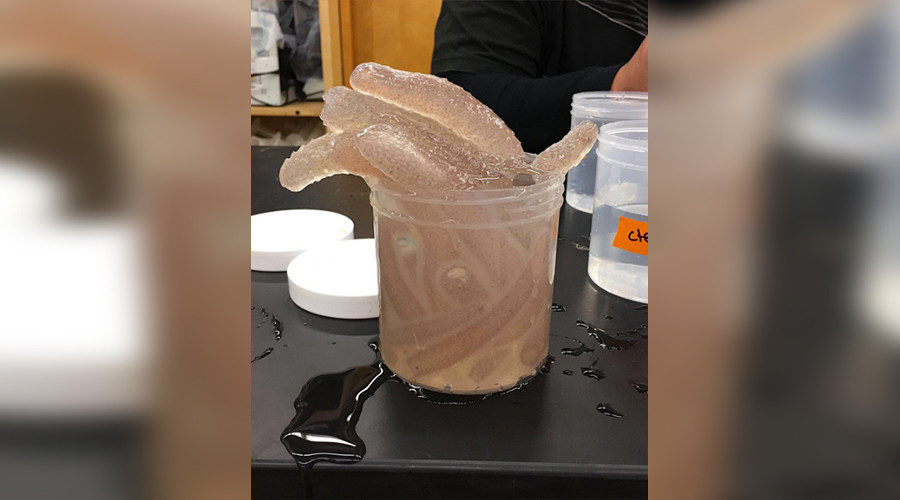
© rowandemboats / InstagramThe creatures can reproduce asexually.
A party of pyrosomes invading the Pacific is causing great concern that the non-native creature could damage the area's food chain. Millions of the translucent, cucumber-shaped species have been spotted much further north than their usual haunts.

Typically found in the Tropics, pyrosomes - meaning 'fire bodies' due to their bioluminescence - have been spotted in the waters off Alaska and British Columbia. One fisherman told National Geographicthat when he dragged up 50 fishing hooks they were on almost every one.

"It got to the point where they couldn't effectively fish," Leon Shaul of the Alaska Department of Fish and Game said.

Magnify

DNA replication filmed for the first time, and it's not what we expected

It undermines a great deal of what's in the textbooks.
dna replication
Here's proof of how far we've come in science - in a world-first, researchers have recorded up-close footage of a single DNA molecule replicating itself, and it's raising questions about how we assumed the process played out.

The real-time footage has revealed that this fundamental part of life incorporates an unexpected amount of 'randomness', and it could force a major rethink into how genetic replication occurs without mutations.

"It's a real paradigm shift, and undermines a great deal of what's in the textbooks," says one of the team, Stephen Kowalczykowski from the University of California, Davis. "It's a different way of thinking about replication that raises new questions."

The DNA double helix consists of two intertwining strands of genetic material made up of four different bases - guanine, thymine, cytosine, and adenine (G, T, C and A). Replication occurs when an enzyme called helicase unwinds and unzips the double helix into two single strands. A second enzyme called primase attaches a 'primer' to each of these unravelled strands, and a third enzyme called DNA polymerase attaches at this primer, and adds additional bases to form a whole new double helix. You can watch that process in the new footage below:


Comment: Perhaps there is a rational design that remains to be learned. For more information, see: The Cs Hit List 09: DNA, Rational Design and the Origins of Life


Seismograph

New study shows shifting water weight can trigger small earthquakes in California

Shifting water weight can trigger earthquakes
© Reuters/Robert Galbreath
Water shapes California powerfully, deluging the state with El Niño - generated rainfalls and drying it out with punishing droughts. Now, a new study suggests that water may play yet another role: triggering earthquakes.

Scientists for decades have tried to understand how different natural forces, pressing on Earth's surface, might help explain changes in earthquake rates, with mixed results. The pulsing of the tides has been one long-standing suspect, but their effect is weak or nonexistent. In the Himalayas, rains from the annual monsoon season have also been found to affect quake frequency. And in California, criss-crossed with faults and at the center of grinding tectonic plates, quake activity seems to increase regularly in the autumn along part of the San Andreas fault—during the driest time of year.

To find out whether precipitation was playing a role, geophysicist Christopher Johnson, a recent Ph.D. graduate from the University of California, Berkeley, set out with colleagues to gather data from a network of 661 GPS sensors scattered around the state. The units are sensitive enough to detect when the ground rises or sinks by a few millimeters because of water weight, groundwater pumping, and tides, among other things.


Cell Phone

Hitachi develops breath analyzer smartphone device with facial recognition

Portable breathalyzer with facial recognition
© Japan Times
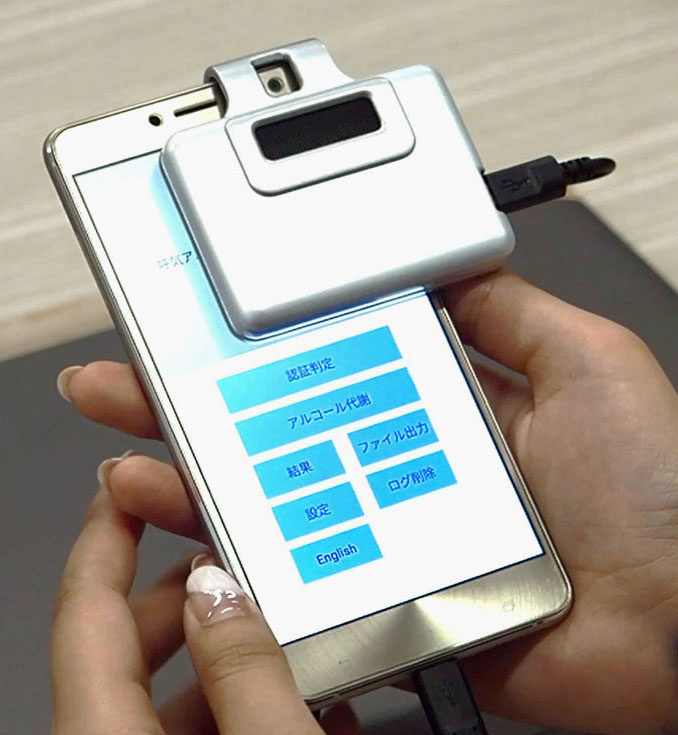
Hitachi Ltd. has developed a smartphone-connected device to prevent drunken driving by detecting alcohol from a person's breath while employing facial recognition technology to prevent the person from using a substitute.

The device will allow taxi and parcel delivery services to make sure their drivers are alcohol-free. Hitachi will begin a field test in August with employees at a subsidiary in preparation for commercialization.

The device, which weighs 20 grams, needs to be attached to a smartphone and is operated through an application on the phone.

When a driver breathes into the device before getting into a vehicle, the smartphone camera takes a photo of the person. The device will confirm if the person who took the breath test is the same as the one driving by having the smartphone take another facial image once the driver is aboard, Hitachi said.

Info

Georgia Tech researchers: 4D printing could hold the key to humanity's future in space

4D printing
© Georgia Tech / YouTube
Innovation over the last decade has seen a massive proliferation of 3D-printing technology, but 4D printing, where time plays a crucial role in the final structure, could be the future of human space exploration and habitation, according to researchers.

The rather unique solution comes courtesy of the Georgia Institute of Technology and may resolve multiple problems plaguing not only the commercial space exploration industry, but also the biomedical and medical instruments industries.

Georgia Tech's method of '4D printing' relies on temperature change over time in order for initially 3D-printed structures to rise and take their final forms.

4D printing relies on a principle known as tensegrity, a system in which the perfect combination of light, strong and collapsible structures can take a robust form based around the perfect balance of tension between their constituent parts. Essentially, it would be flat-pack furniture on a bigger scale - in space.