Science & TechnologyS


Cloud Grey

Jams in the jet stream blamed for abnormal weather patterns, baffle forecasters

jet stream jam
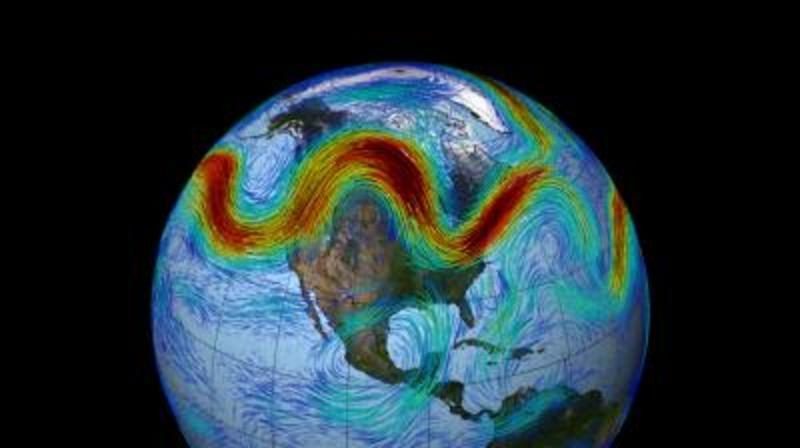
© NASA's Goddard Space Flight CenterThis is an illustration of the Northern Hemisphere's polar jet stream.
The sky sometimes has its limits, according to new research from two University of Chicago atmospheric scientists.

A study published May 24 in Science offers an explanation for a mysterious and sometimes deadly weather pattern in which the jet stream, the global air currents that circle the Earth, stalls out over a region. Much like highways, the jet stream has a capacity, researchers said, and when it's exceeded, blockages form that are remarkably similar to traffic jams-and climate forecasters can use the same math to model them both.

The deadly 2003 European heat wave, California's 2014 drought and the swing of Superstorm Sandy in 2012 that surprised forecasters-all of these were caused by a weather phenomenon known as "blocking," in which the jet stream meanders, stopping weather systems from moving eastward. Scientists have known about it for decades, almost as long as they've known about the jet stream-first discovered by pioneering University of Chicago meteorologist Carl-Gustaf Rossby, in fact-but no one had a good explanation for why it happens.

Comment: Both the jet streams and the gulf streams are showing signs of serious change, and with them, bringing a whole new world of weather: Also check out SOTT's monthly documentary: SOTT Earth Changes Summary - April 2018: Extreme Weather, Planetary Upheaval, Meteor Fireballs


Brain

Why women aren't more like men: Science's reality check on the social construct theory of gender

male vs female brain
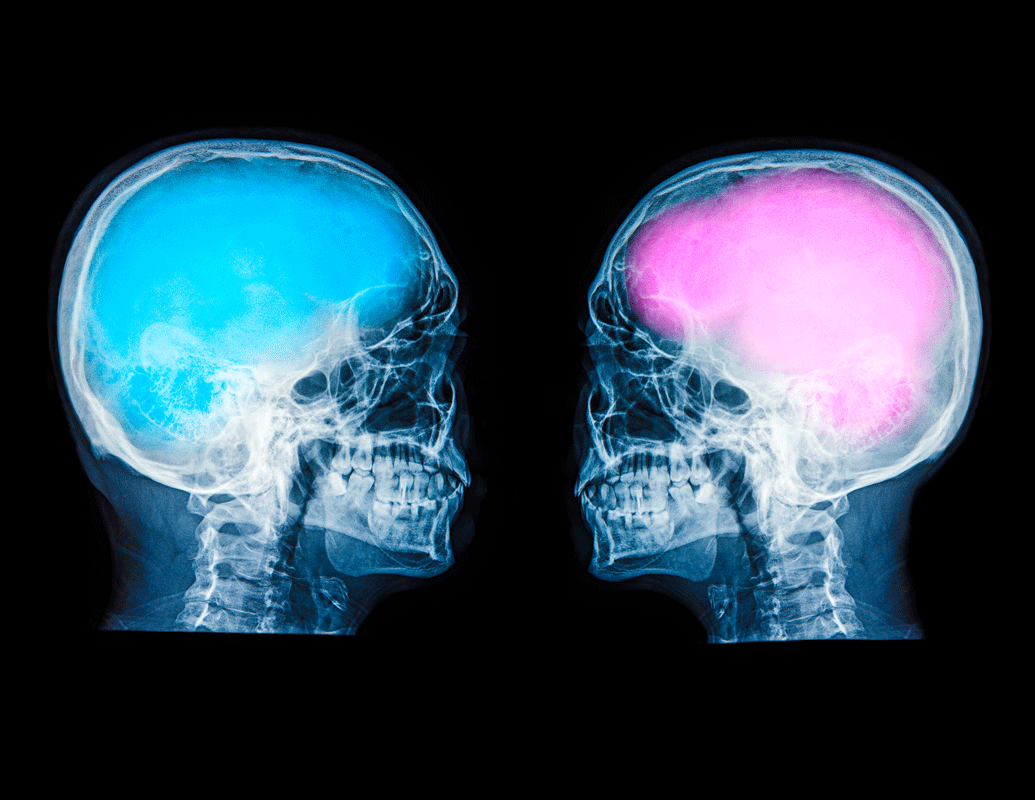
A fascinating paper about sex differences in the human brain was published last week in the scientific journal Cerebral Cortex. It's the largest single-sample study of structural and functional sex differences in the human brain ever undertaken, involving over 5,000 participants (2,466 male and 2,750 female). The study has been attracting attention for more than a year (see this preview in Science, for instance), but only now has it been published in a peer-reviewed journal.

For those who believe that gender is a social construct, and there are no differences between men and women's brains, this paper is something of a reality check. The team of researchers from Edinburgh University, led by Stuart Ritchie, author of Intelligence: All That Matters, found that men's brains are generally larger in volume and surface area, while women's brains, on average, have thicker cortices. 'The differences were substantial: in some cases, such as total brain volume, more than a standard deviation,' they write. This is not a new finding - it has been known for some time that the total volume of men's brains is, in general, larger than that of women's, even when adjusted for men's larger average body size - but all the studies before now have involved much smaller sample sizes.

Does this paper have any implications when it comes to men and women's intellectual abilities? The answer is yes, but they're not clear cut.

On the one hand, feminists won't like this confirmation that men, on average, have bigger brains than women because there's a well-established connection between total brain volume and IQ. That was the conclusion of the authors of a 2015 meta-analysis that looked at 88 studies involving 148 mixed sex samples comparing magnetic resonance images of people's brains with their cognitive test scores. They found that the association between brain volume and cognitive ability was positive in children and adults, applied across a range of different IQ domains (full-scale, performance and verbal IQ) and was true of both men and women. According to another study led by Richard Haier, author of The Neuroscience of Intelligence, total brain volume accounts for about 16 per cent of the variance in IQ.

Comment:


Beaker

Scientists create half human - half chicken embryo in the lab

human chicken hybrid
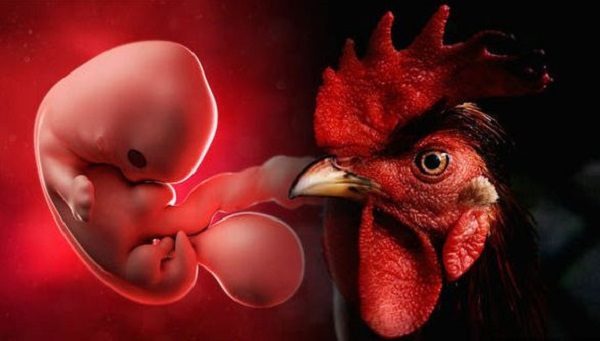
© GettyHuman-chicken hybrid: Scientists successfully planted artificial human cells onto a chicken embryo.
Until now, scientists have been unable to answer how certain cells in a developing embryo decide to become muscles or limbs, while others become bones and nerves.

But now researchers led by Dr Ali Brivanlou, from Rockefeller University in New York, have achieved the unimaginable in a shock experiment.

By grafting petri dish-grown human cells onto the embryo of a chicken the scientists were for the first time ever able to observe how cells organise themselves.

The study was published this week in the science journal Nature where the scientists unveiled the inner machinations of so-called 'organiser cells'.

Ice Cube

Scientists think they've found a million-year-old ice core lurking under Antarctica

Ice light
The history of Earth isn't written in ink, but in ancient ice - buried under places so unforgivingly frozen, they're usually mistaken for wastelands.

And if you extract deep, concealed cores of ice from within these extreme latitudes, you can learn almost anything: about metal workers vanquished by the Black Death, or the rise and fall of the Roman Empire, or even our planet's leaking oxygen supply.

Now, scientists say they have likely found an ice core that's unlike any of these frozen history lessons.

Until now, the oldest continuous core that we knew about is one that stretches back in time some 800,000 years from the present day in an unbroken flow of ice and trapped chemicals, which tell us things about the environmental and atmospheric conditions when the ice formed.

Comment: These scientists are working on the assumption of a solely uniformitarian past and Antarctica being covered with ice for hundreds of thousands of years, but, as Laura Knight-Jadczyk writes in The Golden Age, Psychopathy and the Sixth Extinction:
Allan & Delair bring serious questions to bear on the mainstream interpretation of our reality and history and do it armed to the teeth with science. The case they make for a Golden Age world prior to the Deluge is compelling and quite unique. Wielding hard data from literally every field of science, they demonstrate that hundreds of thousands of years of ice ages may be a myth created to explain many anomalous findings on earth that uniformitarian science had no other way to explain. This data strongly suggests a completely different planet prior to a worldwide cataclysm that they say occurred in 9500 bc, but the latest research puts the most recent major event back at least another thousand years. They refer to it as the 'Phaeton Disaster'.
See also: Also check out SOTT radio's: Behind the Headlines: Earth changes in an electric universe: Is climate change really man-made?


Beaker

Hybrid mutant-chicken-people: 'Human' cells mixed with chicken embryos in bizarre scientific experiment

Rooster
© imagebroker/Armin Floreth / Reuters
US scientists have mixed artificial human cells with the embryos of a chicken in a bizarre experiment that grew bone and nerve structures.

The study into the early forms of human development was carried out by a research team at the Rockefeller University in New York, and made use of embryos from avian test animals and artificial cells designed to replicate human tissue.

Published in the journal Nature, the stem cell research delves into the complex evolution of important human organs like the brain, lungs, liver, as well as bone structure. By understanding the growth of such structures, the defined pathways of certain cells, its hoped scientists can reverse engineer diseases which impact them.

For the study, researchers grafted clusters of human cells onto genuine chicken embryos and found that the mix developed a spinal structure as well as early stages of nerve tissue. It's the first time scientists have achieved such a feat. While it's unlikely that hybrid mutant-chicken-people will now be grown in labs, the study does highlight an interesting reaction of DNA from two entirely different species.

Comment: See also: Biohackers playing God: "We are in the midst of a genetic revolution"


Beaker

Rehabilitating lactate: a cure not a poison

George Brooke
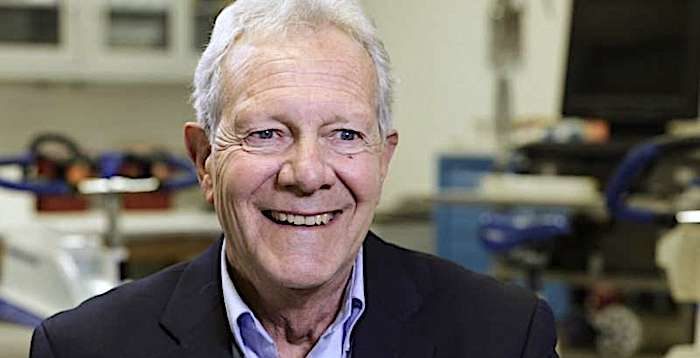
© Stephen McNally,UC BerkeleyGeorge Brooks, professor of integrative biology at the University of California, Berkeley.
George Brooks has been trying to reshape thinking about lactate-in the lab, the clinic and on the training field-for more than 40 years, and finally, it seems, people are listening. Lactate, it's becoming clear, is not a poison, it's the antidote.

In a recent article in the journal Cell Metabolism, Brooks, a professor of integrative biology at the University of California, Berkeley, reviews the history of the misunderstanding of lactate-often called lactic acid-a small molecule that plays a big role in metabolism. Typically labeled a "waste" product produced by muscles because lactate rises to high levels in the blood during extreme exercise, athletic trainers and competitive athletes think of lactate as the cause of muscle fatigue, reduced performance and pain.

Starting in the 1970s, however, Brooks, his students, postdoctoral fellows and staff were the first to show that lactate wasn't waste. It was a fuel produced by muscle cells all the time and often the preferred source of energy in the body: The brain and heart both run more efficiently and more strongly when fueled by lactate than by glucose, another fuel that circulates through the blood.

Brain

Is depression linked to accelerated cognitive aging?

Depression/Aging
© Patty Anne Olson
Depression is associated with an acceleration of the rate at which the brain ages, research by psychologists at the University of Sussex suggests. It has previously been reported that people with depression or anxiety have an increased risk of dementia in later life, but this is the first study that provides comprehensive evidence for the effect of depression on decline in overall cognitive function (also referred to as cognitive state), in a general population.

The researchers conducted a robust systematic review and meta-analysis of 34 longitudinal studies, with the focus on the link between depression or anxiety and decline in cognitive function over time. Evidence from more than 71,000 participants was combined and reviewed.

Including people who presented with symptoms of depression as well as those that were diagnosed as clinically depressed, the study looked at the rate of decline of overall cognitive state - encompassing memory loss, executive function (such as decision making) and information processing speed - in older adults.

Megaphone

Podcast: Riddle of the Younger Dryas, "one of the most unusual periods of great climate change in the ancient world"

Seven Ages Audio Journal Episode Nine: Riddle of the Younger Dryas podcast

Seven Ages Audio Journal Episode Nine: Riddle of the Younger Dryas podcast
I had a blast last week joining the hosts of my favorite new podcast: Seven Ages Audio Journal. Like the Tusk, veteran podcaster Micah Hanks and his science bros Jason Pentrail and James Waldo attempt the difficult balance between hard science, responsible speculation and perhaps some entertainment. I think they recognized me as a "fellow traveler" in this regard, and were kind to invite me on as a non-PhD generalist researcher of the Younger Dryas Event.

Comment: For more information on the activity surrounding the Younger Dryas and other similar period in history, see:


Blue Planet

Study says humans are just 0.01% of all life on Earth but have destroyed 83% of wild mammals

cattle farm Brazil livestock
© Daniel Beltra/GreenpeaceA cattle farm in Mato Grosso, Brazil. 60% of all mammals on Earth are livestock.


Groundbreaking assessment of all life on Earth reveals humanity's surprisingly tiny part in it as well as our disproportionate impact


Humankind is revealed as simultaneously insignificant and utterly dominant in the grand scheme of life on Earth by a groundbreaking new assessment of all life on the planet.

The world's 7.6 billion people represent just 0.01% of all living things, according to the study. Yet since the dawn of civilisation, humanity has caused the loss of 83% of all wild mammals and half of plants, while livestock kept by humans abounds.

The new work is the first comprehensive estimate of the weight of every class of living creature and overturns some long-held assumptions. Bacteria are indeed a major life form - 13% of everything - but plants overshadow everything, representing 82% of all living matter. All other creatures, from insects to fungi, to fish and animals, make up just 5% of the world's biomass.

Another surprise is that the teeming life revealed in the oceans by the recent BBC television series Blue Planet II turns out to represent just 1% of all biomass. The vast majority of life is land-based and a large chunk - an eighth - is bacteria buried deep below the surface.

Bug

Mosquito saliva alone triggers unexpected immune response

Aedes aegypti mosquitoes
© R. Rico-Hesse labAedes aegypti mosquitoes after a blood meal.
Mosquito season is around the corner, bringing with it a higher risk of catching potentially serious diseases transmitted by their bite. Mosquitoes also may increase the severity of the diseases they transmit, and researchers think that mosquito saliva plays an active role in this process. A team of researchers at Baylor College of Medicine has taken a closer look at the effect of mosquito saliva alone and found that it can trigger an unexpected variety of immune responses in an animal model of the human immune system. These results offer an opportunity to develop effective strategies to prevent mosquito-based transmission of disease. The study appears in the journal PLOS Neglected Tropical Diseases.

"Billions of people worldwide are exposed to diseases transmitted by mosquitoes, and many of these conditions do not have effective treatments," said corresponding author Dr. Rebecca Rico-Hesse, professor of molecular virology and microbiology at Baylor College of Medicine. "One of the interests of my lab is to study the development of dengue fever, which is caused by the dengue virus transmitted by mosquito Aedes aegypti."

The World Health Organization has estimated that 100 million dengue virus infections and 22,000 deaths occur yearly worldwide, mostly among children. According to the Centers for Disease Control and Prevention, more than one-third of the world's population lives in areas at risk of infection, making the dengue virus a leading cause of illness and death in the tropics and subtropics.