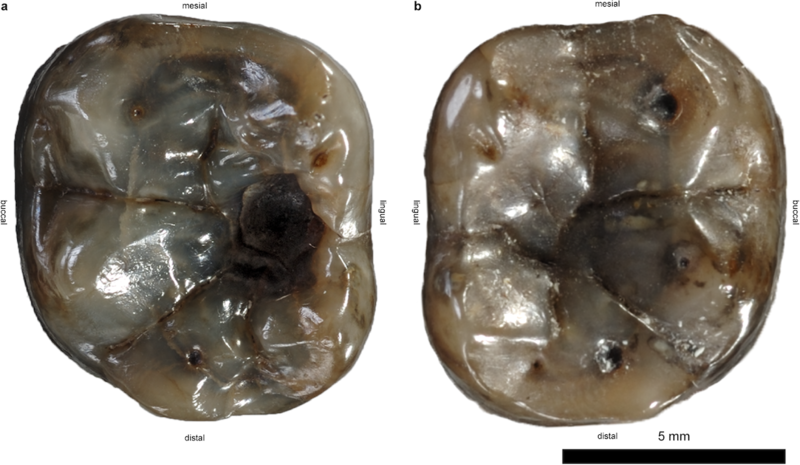
© Fuss J/PLoS ONE
Austria of 12.5 million years ago seems to have been a very hospitable home for
Dryopithecus carinthiacus. The forested landscape treated the now extinct ape, which measured roughly four feet in length and resembled a mix between a monkey and a chimpanzee, to a veritable feast of fruits. For nine to ten months out of the year,
Dryopithecus could gorge on early forms of plums, cherries, grapes, mulberries, strawberries, and various citrus fruits.
But eating all of those sugar-rich fruits may have come with a downside of which modern humans are quite aware: tooth decay.In new
study published in
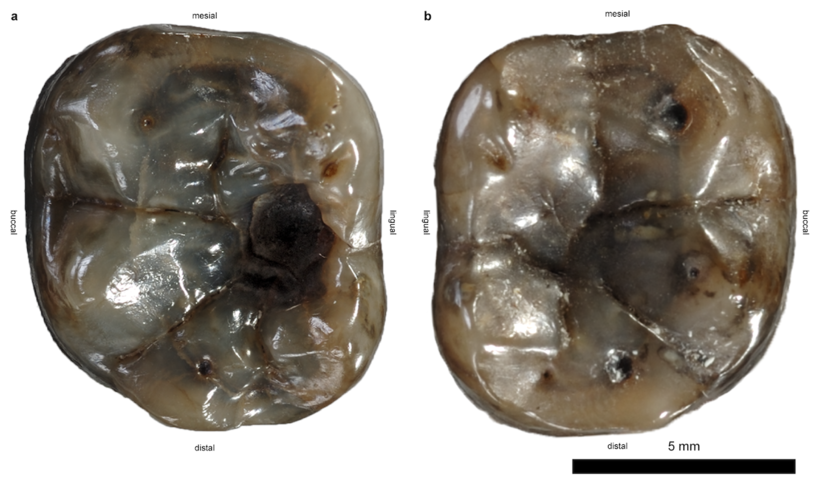
PLoS ONE, German researchers Jochen Fuss, Gregor Uhlig, and Madelaine Böhme revealed the earliest known cavity in hominids, a group which includes modern humans, human ancestors, and many apes. A 12.5 million-year-old
Dryopithecus dubbed LMK-Pal 5508 found near St. Stefan, Austria had deep lesions in its left molars that likely required several years to form (see picture at top). Moreover, signs of wear observed on the right tooth row indicated that the individual likely experienced a painful toothache, the researchers speculated.
While cavities are well known to modern humans, they are quite rare in our ape relatives. Cavities occur in just 1.38% of the permanent teeth of wild chimpanzees, the researchers reported.
According to the National Institute of Dental and Craniofacial Research, 92% of American adults aged 20-64 have had a cavity.


















Comment: Cassini over the years: