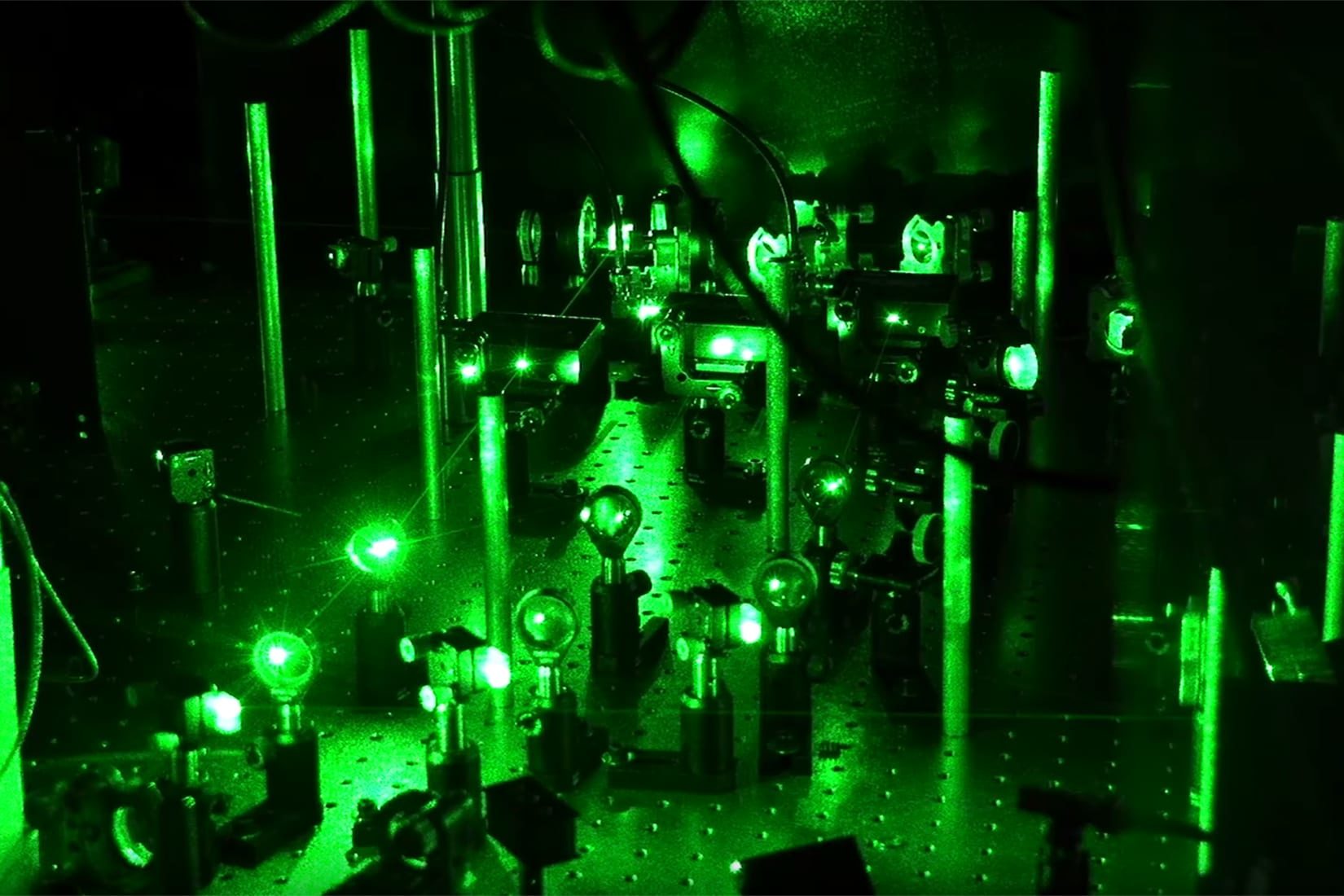
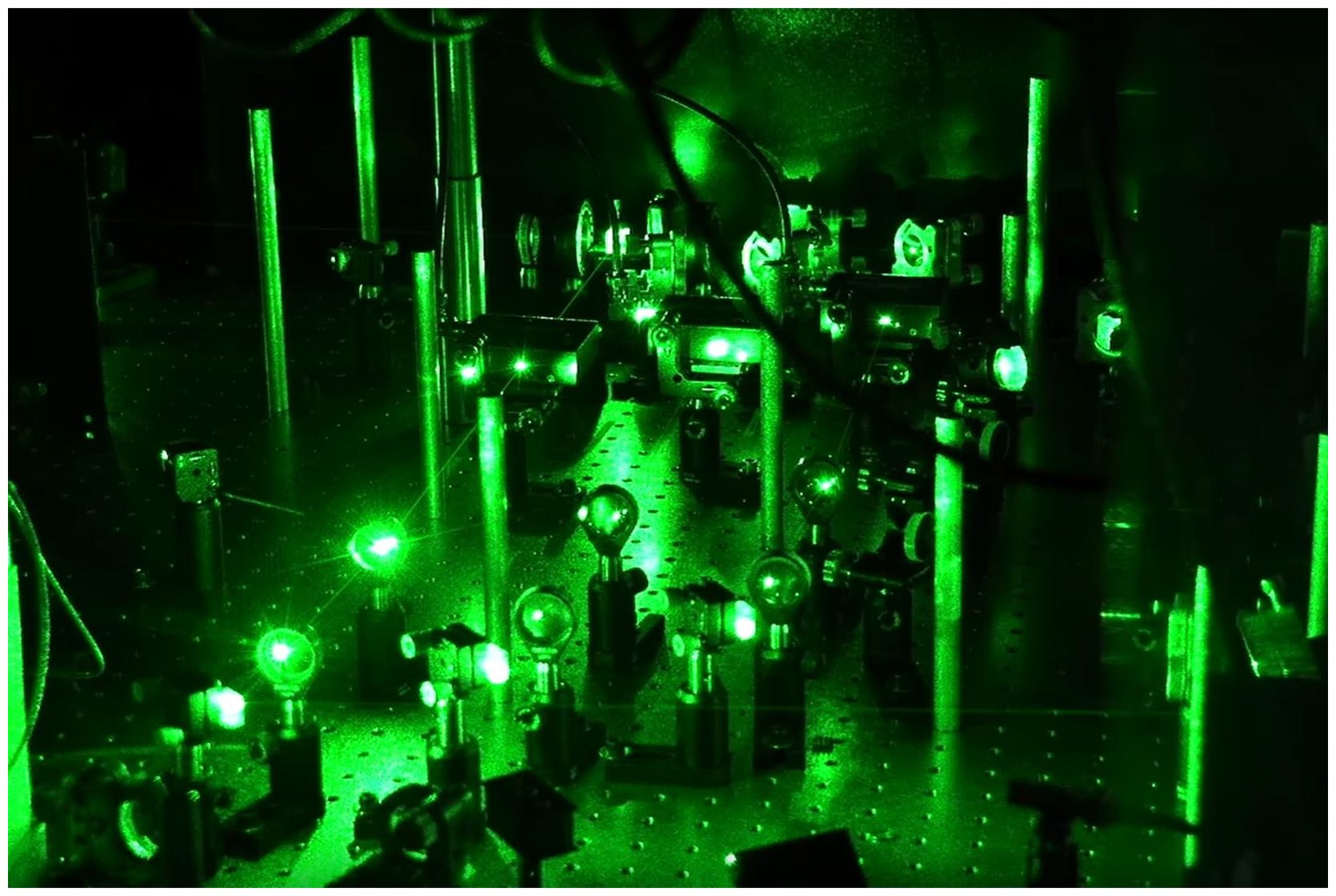
© Jeff Fitlow/Rice UniversitUsing ultracold lithium atoms confined by intersecting laser beams, physicists form Rice University and the University of Geneva confirmed a 1963 prediction that the charge wave from an excited electron moves faster in a one-dimentional electron gas as interaction strenghth between the electrons increases.
"Chipmakers have been shrinking feature sizes on microchips for decades, and device physicists are now exploring the use of nanowires and nanotubes where the channels that electrons pass through are almost one-dimensional," said Rice experimental physicist
Randy Hulet. "That's important because 1D is a different ballgame in terms of electron conductance. You need a new model, a new way of representing reality, to make sense of it."
With
IBM and
others committed to incorporating one-dimensional carbon nanotubes into integrated circuits, chip designs will increasingly need to account for 1D effects that arise from electrons being
fermions, antisocial particles that are
unwilling to share space.
The 1D implications of this standoffishness caught the attention of physicists
Sin-Itiro Tomonaga and
J.M. Luttinger, whose model of 1D electron behavior was published in 1963. A key prediction of
Tomonaga-Luttinger liquid (TLL) theory is that exciting one electron in a 1D wire leads to a collective, organized response from every electron in the wire.
Stranger still, because of this collective behavior, TLL theory predicts that a moving electron in 1D will seemingly split in two and travel at different speeds, despite the fact that electrons are fundamental particles that have no constituent parts. This strange breakup, known as
spin-charge separation, instead involves two inherent properties of the electron - negative charge and angular momentum, or "spin."




















Comment: Proving once again that those possessed by ideology are more interested in preserving their belief system than in uncovering truth.