Science & TechnologyS


Attention

New Webb telescope view shows unexpectedly crowded asteroid belt

A new view of archival Webb telescope data reveals small asteroids in the main asteroid belt are more numerous than we thought.
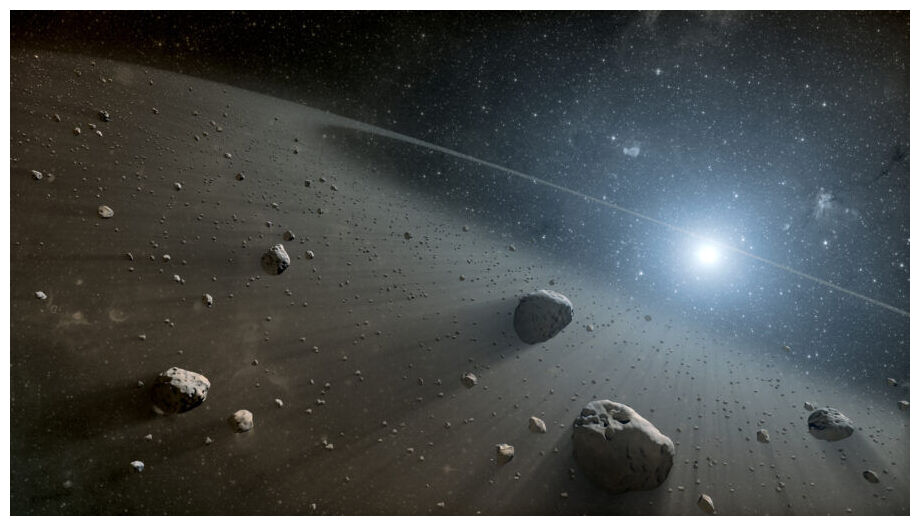
Artist´s impression of an asteroid belt.

Astronomers have uncovered an unexpectedly large population of small main-belt asteroids thanks to a new analysis of images from the James Webb Space Telescope. The finding could change calculations of the impact rate on Earth from such bodies, which range from house-size to the size of a stadium.

These are by far the smallest objects ever imaged so far away. Artem Burdanov (MIT) and colleagues applied a computationally intensive shift-and-stack method to Webb's archival images. From the telescope's sensitive infrared detectors, the team was able to accurately determine the sizes of small objects, ranging from about 10 to 500 meters (30 to 1,600 feet) across. An early release of their results appears in Nature.

Larger main-belt asteroids, whose orbits are between those of Mars and Jupiter, tend to remain in relatively stable orbits. However, gravitational interactions more frequently perturb smaller ones, which may enter the inner solar system to become potential impactors. The high number of small objects now found in the main belt — more than an order of magnitude greater than expected — could affect calculations of the frequency of such impacts.

Galaxy

The Sombrero Galaxy's star-forming days are nearly over — and the James Webb Space Telescope may know why

sombrero galaxy
© NASA/ESA/CSA/STScIA new image of the Sombrero galaxy from NASA’s James Webb Space Telescope/ The galaxy, known as Messier 104 (M104), was discovered in 1781 by French astronomer and comet hunter Pierre Mechain, one of Charles Messier’s colleagues.
The James Webb Space Telescope's brand-new image of the Sombrero Galaxy casts this city of stars in a new light — mid-infrared light, to be precise — and reveals clumps of dust in a mottled outer ring.

The Sombrero galaxy is so named because, in visible light images, lying nearly edge-on to us, it bears an uncanny resemblance to a sombrero hat, with its wide rim and bulging center. In this new image taken by JWST's Mid-Infrared Instrument (MIRI), which can peer through clouds of gas and warm dust, those classic hallmarks of the Sombrero have vanished, replaced by a lumpy ring of dust around a gap that houses the bright core where a supermassive black hole lurks.

Located about 31 million light-years away in the constellation Virgo, the Sombrero (catalogued as Messier 104 and NGC 4594) is the most massive spiral galaxy within 100 million light-years of us. The total mass of all the Sombrero's stars amounts to 260 billion solar masses, nearly five times greater than all the stars in our Milky Way galaxy.

Fireball

Earth's 'mini moon' asteroid escapes after 2 months in orbit

asteroid earth orbit
© buradaki/Getty ImagesAn artist's illustration of an asteroid orbiting Earth.
The mini-moon 2024 PT5, which has been orbiting Earth for two months and is likely a chunk of the moon, will now drift away from our planet in an orbit around the sun.

A mini-moon that has been orbiting Earth for the past two months will peel away from our planet's orbit today (Nov. 25) as it prepares for a decades-long jaunt through the solar system.

The bus-size asteroid, known as 2024 PT5, is currently 2 million miles (3.2 million kilometers) from Earth and has begun to move away from our planet as it is overcome by the sun's gravity.

The space rock was spotted by the Asteroid Terrestrial-Impact Last Alert System (ATLAS) on Aug. 7 and snared by Earth's gravity on Sept. 29, making one complete orbit of our planet before now being snatched away by the sun. Objects that temporarily orbit Earth as natural satellites are known as mini-moons.

Comment: Also see:


Bizarro Earth

Supervolcano in Italy showing signs of waking up

Phlegraean Fields and Solfatara crater
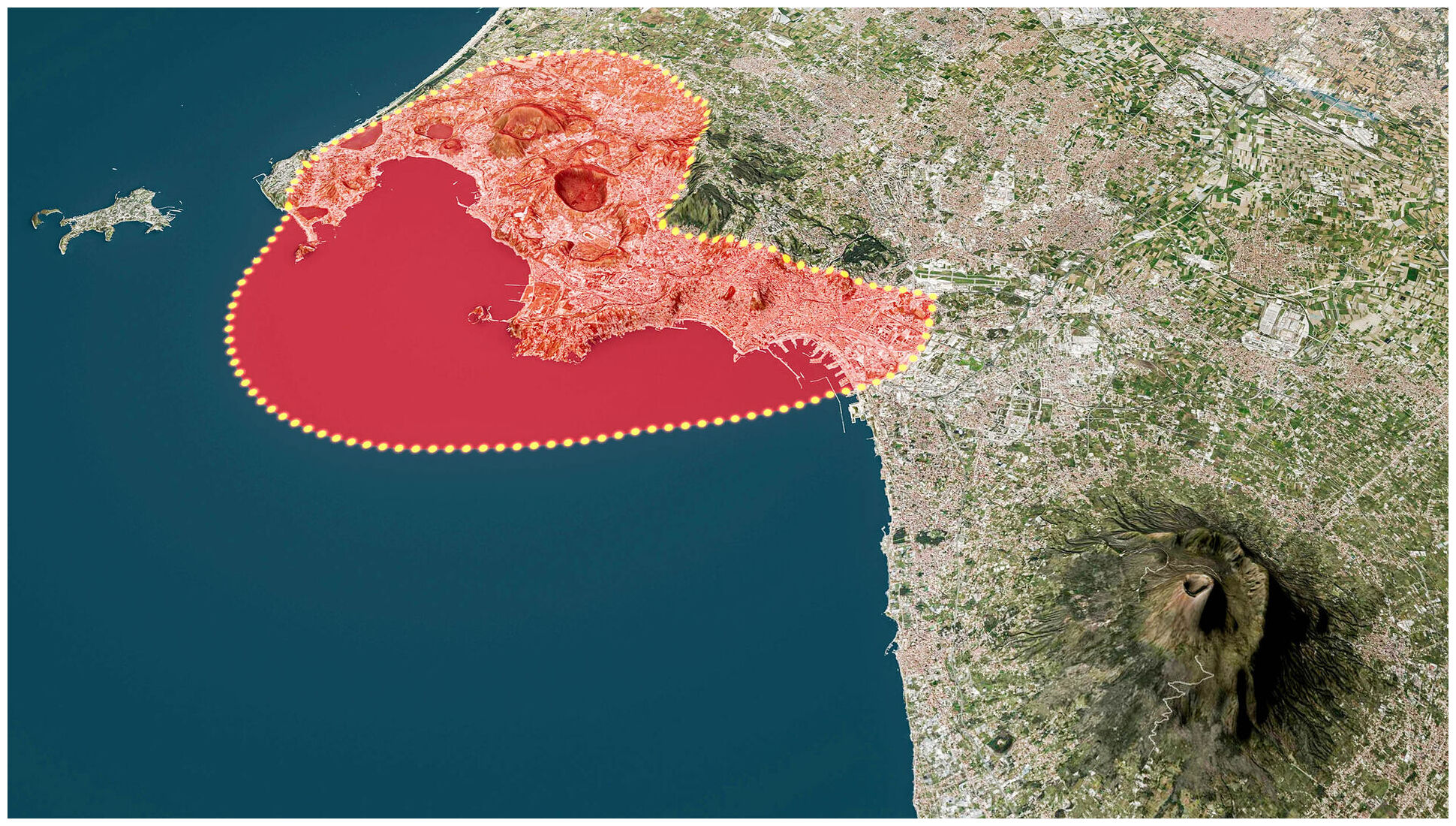
© earth.comSatellite view of Phlegraean Fields and Solfatara crater showing a large caldera supervolcano west of Naples, Italy. It is part of the Campanian volcanic arc, which includes Mount Vesuvius.
The Phlegraean Fields, now considered one massive supervolcano, are beginning to stir, making the scientific community uneasy.

These volcanic fields, nestled just west of Naples, Italy, are among the top eight emitters of volcanic carbon dioxide worldwide.

Since 2005, one spot in particular — the Solfatara crater — has been releasing increased volumes of gas, catching the attention of researchers and locals alike.

Gas emissions at Solfatara crater

Gianmarco Buono, a volcanologist at the Italian National Institute of Geophysics and Volcanology (INGV), is leading a study to understand what's behind this surge in gas emissions.

"Estimating the source of the carbon dioxide is important to properly reconstruct what is happening in the magmatic system and the hydrothermal system," says Buono.

His team aims to provide a tool that can distinguish between carbon dioxide coming from magma and that released by other processes, a method that could be useful in volcanic regions around the world.

Cassiopaea

Scientists detect the most powerful cosmic rays ever: The unknown source could be close to Earth

cosmic rays
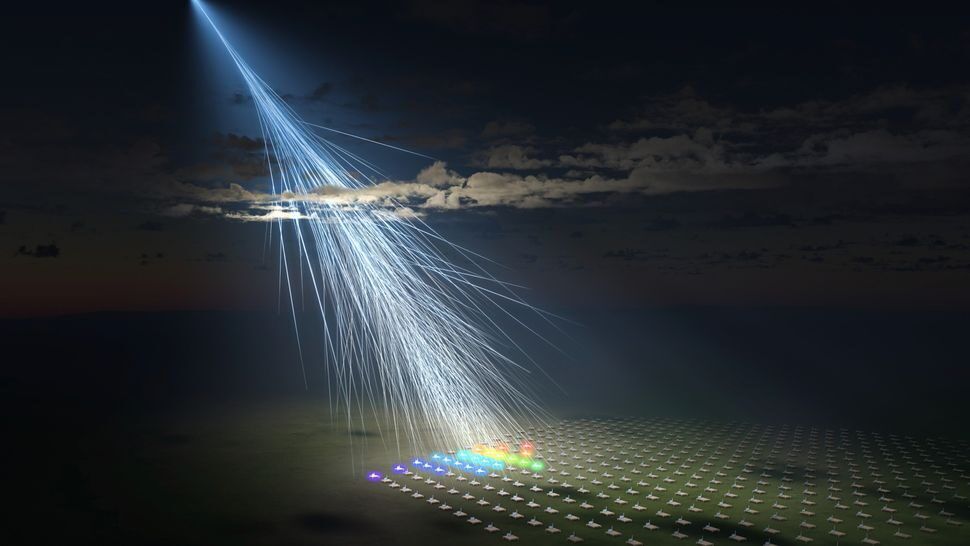
When powerful cosmic rays hit gas molecules in Earth's atmosphere they create a cascade of energetic particles that are detected on the ground. By tracing back these particles to their source, researchers can estimate how powerful the original cosmic ray was.
New research reports the most powerful cosmic rays ever detected. Because the rays lose energy as they travel through space, their detection at high energies means they are likely coming from sources relatively close to Earth.

Scientists have detected the most energetic cosmic rays ever discovered, and they're being produced by mysterious sources relatively close to Earth.

The rays — which consist of electrons and their antimatter counterparts, positrons — were observed at energies all the way up to 40 teraelectronvolts (TeV), or 40,000 times the energy of visible light.

Spotted by the High Energy Stereoscopic System (HESS) observatory in Namibia, the rays lose energy as they travel through space due to their interactions with light and magnetic fields. This means that for rays of this energy to be detected, their sources must be relatively nearby. Yet what, exactly, is producing them remains unknown. The researchers published their findings Nov. 25 in the journal Physical Review Letters.

Comment: Though mainstream science has only made a tenuous connection, cosmic rays have a profound effect on Earth's climate.


Snowflake

Mysterious Blue Avalanche Lights in China

Blue light avalanche
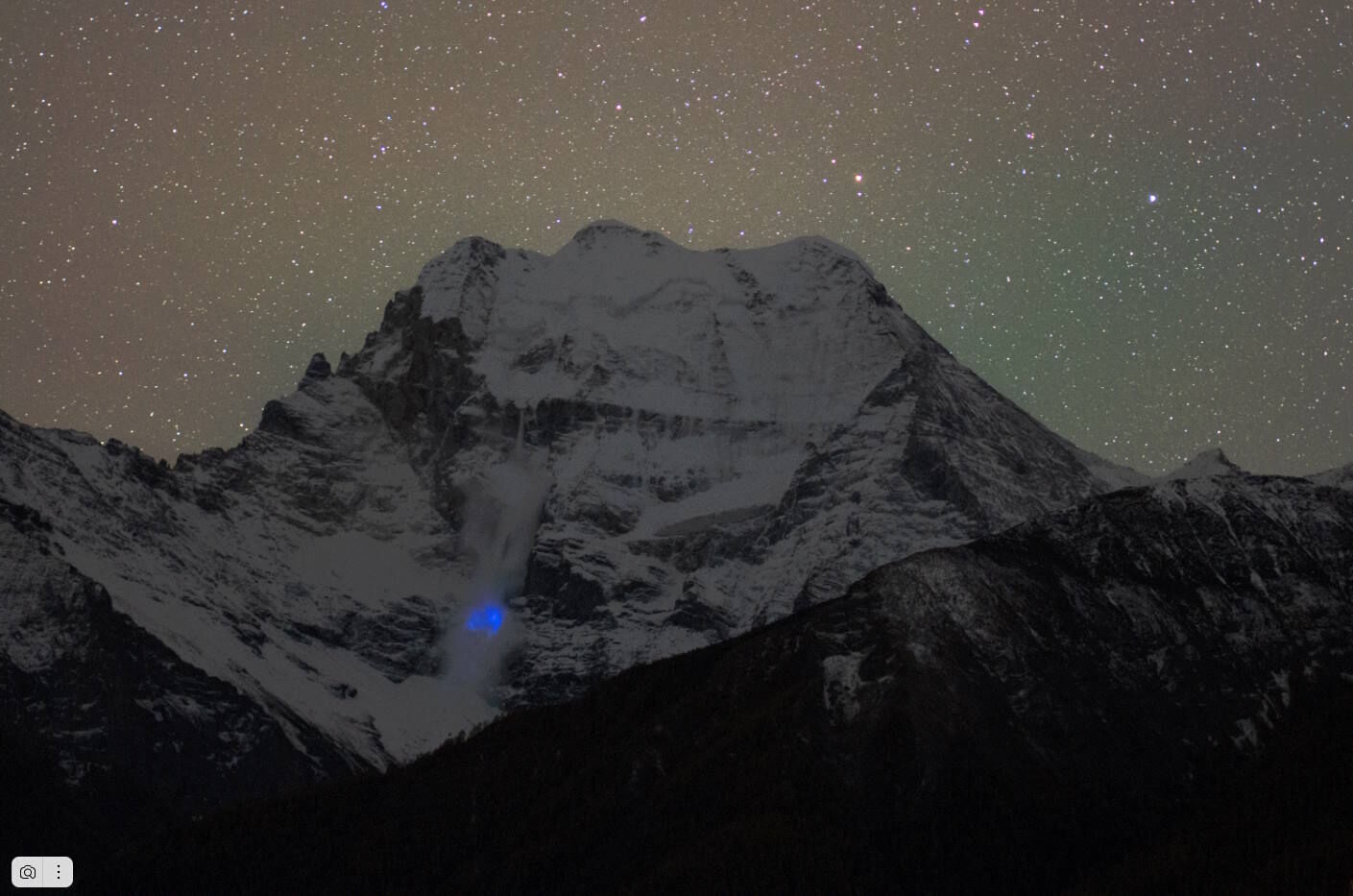
Screen shot from gif.
This might be something new. On the night of Oct. 27th, Chinese astrophotographer Shengyu Li set up his camera to record star trails over Mount Xiannairi in Sichuan, China. The long exposure had just begun when an icy serac broke free from a hanging glacier. Note the blue flashes within the ensuing avalanche:

"We have not found any previously documented cases of such an event, making this discovery both thrilling and intriguing for us," says Li. "Our initial hypothesis is that the luminescence may result from friction-induced lighting during the fragmentation of ice."

The phenomenon is called "triboluminescence." Legendary physicist Richard Feynman explains it best: "When you take a lump of sugar and crush it with a pair of pliers in the dark, you can see a bluish flash. Some other crystals do that too. Nobody knows why." You can create triboluminescent flashes yourself by smashing Lifesavers.

The avalanche Li witnessed was rich in ice. "It started with a blocky serac, which randomly calved from a glacier near the mountain's peak," says Carson Reid, a mountaineer who analyzed Li's movie. "The serac would have fragmented as it tumbled down and smashed into natural obstacles." The most significant "smash points" seem to have produced the most blue light.

Li shared his movie with other astrophographers in China. One of them found a similar blue flash in footage of a completely different mountain in Xinjiang, China three weeks earlier:

"This is a timelapse video taken by Ms. Lu Miao on Oct. 3rd," says Li. "It also shows a blue flash during an avalanche." The mountain is Muztagh Ata, which means "Iceberg Father" in English.


Fireball 5

Earth from space: Wandering sand dunes circle gigantic 'eye' sculpted by meteor in the Sahara

This 2013 astronaut photo shows a giant eye-shaped impact crater in the Sahara Desert that is slowly being circled by migrating sand dunes, helping researchers track how far these dunes can move over time.
Aorounga structure
© NASA/ISS programThe Aorounga structure is a roughly 8-mile-wide impact crater left behind by a "city-killer" asteroid that slammed into Earth.
This striking astronaut photo shows off an "eye-catching" impact crater in the Sahara Desert. The oculus-like structure is surrounded by migrating sand dunes that are capable of traveling more than 100 feet (30 meters) every year.

The Aorounga structure is a 7.8-mile-wide (12.6 kilometers) impact crater located in the southeast Sahara in northern Chad. The crater is made up of two rings that give the structure its eye-like appearance: An inner ring with a central hill, or uplift structure, that looks like a pupil; and an outer ring that looks like an eyelid. The rings rise around 330 feet (100 m) above the surrounding ground but have been heavily eroded over time — similar to other ancient impact craters — and were likely even taller and wider originally.

Experts believe that the structure formed around 345 million years ago and was likely created by a meteor around 2,000 feet (600 m) across, according to estimates from the Lunar and Planetary Institute. An impactor of this size, known as a "city-killer" asteroid, would have caused widespread damage across the north of Africa and may have even triggered climatic effects on a global scale.

The structure also has several dark lines running across both of its rings, which are sections of massive ridges, known as yardangs, according to the U.S. Geological Survey. These ridges, which can reach up to 100 feet (30 m) above ground level, stretch across the surrounding areas for dozens of miles, as you can see in the 2016 astronaut images below.

Ice Cube

Ice Age coming: Key Atlantic current is weakening much faster than scientists had predicted

Ilulissat Icefjord in Greenland atlantic current weakening ice age fresh water
© Ulrik Pedersen/NurPhoto via Getty ImagesThe Ilulissat Icefjord in Greenland on July 3, 2024. The glacier is calving enough ice daily to meet New York City's water needs for an entire year.
A current key to stabilizing climates across the Atlantic and beyond could be one-third weaker by 2040, a new study has revealed.

An essential Atlantic Ocean current that regulates the planet's climate is weakening much faster than previously thought, according to a new study.

The Atlantic Meridional Overturning Circulation (AMOC), which includes the Gulf Stream, stabilizes climates in the Northern Hemisphere and beyond.

But a new climate model that factors in freshwater melt from Greenland's ice sheet has suggested that, at the current rate of global carbon dioxide emissions, the current could weaken by as much as one-third in the next 15 years. The researchers published their findings Nov. 18 in the journal Nature Geoscience.

Galaxy

2 MILLION mph galaxy smash-up captured in unprecedented detail

galaxy collision Stephan's Quintet astronomy
© University of HertfordshireWEAVE data overlaid on a James Webb Space Telescope image of Stephan's Quintet, with green contours showing radio data from the Low Frequency Array (LOFAR) radio telescope. The orange and blue colours follow the brightness of Hydrogen-alpha obtained with the WEAVE LIFU, which trace where the intergalactic gas is ionised. The hexagon denotes the approximate coverage of the new WEAVE observations of the system, which is 36 kpc wide (similar in size to our own galaxy, the Milky Way).
A massive collision of galaxies sparked by one travelling at a scarcely-believable 2 million mph (3.2 million km/h) has been seen in unprecedented detail by one of Earth's most powerful telescopes.

The dramatic impact was observed in Stephan's Quintet, a nearby galaxy group made up of five galaxies first sighted almost 150 years ago.

It sparked an immensely powerful shock akin to a "sonic boom from a jet fighter" - the likes of which are among the most striking phenomena in the Universe.

Robot

'Terminator' robot dog now has amphibious capabilities

robot dog terminator Ghost Robotics V60
The use of robotic dogs on modern battlefields in Eastern Europe and the Middle East has expanded rapidly. Over the past decade, we have thoroughly documented their growing presence and proliferation.

The latest quadruped robot designed for modern warfare is the Ghost Robotics V60. However, this is far from a typical robotic dog. A separate defense firm, Onyx Industries, has equipped the V60 with an autonomous maritime mobility system, enabling it to navigate rough terrain and traverse bodies of water — all while carrying a machine gun.

Last month, Onyx shared a short video on YouTube showcasing the V60's maritime mobility system in action.