Dan Eden
ViewzoneSat, 30 Jun 2007 14:32 UTC
|
| ©n/a
|
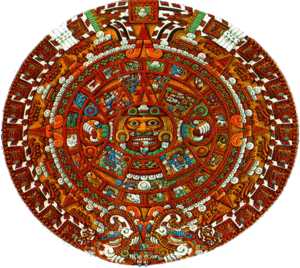
ViewZone asked me to write a story about the Mayan Calendar. There is a common belief that the calendar holds a prophecy that the end of the world will happen in 2012. At the time, I knew very little about the whole topic and when I began doing the research. I like to think I had an open mind. My investigation began with mainstream archaeology and the expert interpretations of the calendar. But it soon took a turn that made my hair literally stand on end. I am now convinced that these prophecies are true.
To understand what is likely to happen to Earth and it's people, you will need to remain calm and try to follow the facts. It's not as simple as some people describe. It requires an understanding of some fairly complicated scientific realities, but I think I can explain them in a way that you will easily understand.
Comment: This all sounds pretty dramatic, however SOTT experts have run several computer simulations and it seems that, because of the vast distances and sizes, the likelihood of "crossing" the galactic plane having any significant meaning is remote. It could be said that we are already there and will be there for some time.
In fact, the coming Winter Solstice of 2007 looks to be far more interesting since Jupiter and the Sun will be almost conjunct on that day.
Jon Cartwright
PhysicsWebSat, 30 Jun 2007 11:32 UTC
Clouds of mercury have been spotted moving across the surface of alpha Andromedae -- a star that astronomers had believed to be too large to support "weather" in its atmosphere. The group, based in Sweden, the US and Canada, have also proposed a new theory suggesting that gravity could be responsible for such weather on large stars, rather than the magnetic fields that shape the surfaces of smaller stars.
Magnetic fields emanating from stars and planets can usually be attributed to convection currents forcing molten metal to shift about in so called "dynamo action", which converts mechanical energy into magnetic energy. In small stars like our Sun, the magnetic field can become so intense in regions on the surface that it traps heat, causing dark sunspots to form. But physicists believe that most larger stars do not have convection currents stretching to their surface and therefore would have a zero - or at least small - magnetic field. This should mean they are devoid of surface structure.
Recently, however, observations of irregular surface distributions of heavy elements on large blue "B-type" stars have swept aside this assumption. In particular, alpha Andromedae, which is 97 light-years from Earth, has a predicted magnetic field less than 10 Gauss, yet appears to have spots of mercury all over its surface.
XinhuaSat, 30 Jun 2007 08:09 UTC
An excavation team has discovered in northern Spain the oldest human fossils confirming mankind's presence in Europe over more than 1 million years ago, local media reported on Friday.
The fossil, discovered in the Atapuerca Sierra in the northern province of Burgos, is a human tooth. Jose Maria Bermudez de Castro, co-director of research at the Atapuerca site, was quoted as saying the tooth could be as old as 1.2 million years.
The fossil, which gives a new perspective to human history, was found in the entry to Sima del Elefante, a pleistocene deposit that was the last to be systematically excavated in Atapuerca.
The differences between dusty Mars and lush, vibrant Earth are more than just skin deep. The two planets are different down to their very core.
Earth contains a heavy version of silicon that is absent from Mars.
The finding, detailed in today's issue of the journal Nature, suggests
Earth's core formed under very different conditions from those on Mars. It also supports the idea that the
moon formed from material torn from early Earth by a collision with a planet-sized rock.
A new hi-tech hospital being built in Scotland will be the first in the UK to use a fleet of robots to take over from humans in tasks such as transporting heavy medical equipment and laundry.
The initiative at the £300 million hospital at Larbert, Stirlingshire, is intended to allow hospital porters to spend more time dealing with patients.
Scientists are slowly waking up to an inconvenient truth - the universe looks suspiciously like a fix. The issue concerns the very laws of nature themselves. For 40 years, physicists and cosmologists have been quietly collecting examples of all too convenient "coincidences" and special features in the underlying laws of the universe that seem to be necessary in order for life, and hence conscious beings, to exist. Change any one of them and the consequences would be lethal. Fred Hoyle, the distinguished cosmologist, once said it was as if "a super- intellect has monkeyed with physics".
RANDOLPH E. SCHMID
APFri, 29 Jun 2007 03:36 UTC
Garfield, Morris and the Aristocats get the fame, but look to the origins of today's furry felines and you find "lybica," a Middle Eastern wildcat. Domestic cats can be traced to wild progenitors that interbred well over 100,000 years ago, new research indicates.
RoboCops and robot soldiers got a little closer to reality Thursday as a maker of floor-cleaning automatons teamed up with a stun-gun manufacturer to arm track-wheeled 'bots for police and the Pentagon.
By adding Tasers to robots it already makes for the military, iRobot Corp. says it hopes to give soldiers and law enforcement a defensive, non-lethal tool.
But some observers fear such developments could ultimately lead to robots capable of deciding on their own when to shoot and kill.
Comment: But questions of moral agency do arise.
What is the difference between a robot and a psychopath taking life or death decisions over others if they are both equally heartless?
A major dust storm has developed on the red planet, blocking sunlight and prompting Mars mission managers to keep a close eye on it, SPACE.com has learned.
It is not known how large the storm might grow, but already it is thousands of miles across. If it balloons, as dust storms have done in the past, it could hamper operations of NASA's Mars rovers Spirit and Opportunity.
Comment: Bad weather on Earth, bad weather on Mars. Coincidence?
Massive Jupiter is undergoing dramatic atmospheric changes that have never been seen before with the keen "eye" of NASA's Hubble Space Telescope.
Jupiter's turbulent clouds are always changing as they encounter atmospheric disturbances while sweeping around the planet at hundreds of miles per hour. But these Hubble images reveal a rapid transformation in the shape and color of Jupiter's clouds near the equator, marking an entire face of the globe.

|
| ©NASA
|
| Between March 25 and June 5, Hubble's Wide Field and Planetary Camera 2 captured entire bands of clouds changing color. Zones have darkened into belts and belts have lightened and transformed into zones. Cloud features have rapidly altered in shape and size.
|





Comment: This all sounds pretty dramatic, however SOTT experts have run several computer simulations and it seems that, because of the vast distances and sizes, the likelihood of "crossing" the galactic plane having any significant meaning is remote. It could be said that we are already there and will be there for some time.
In fact, the coming Winter Solstice of 2007 looks to be far more interesting since Jupiter and the Sun will be almost conjunct on that day.