Physicists in the US have developed a tiny portable device that is sensitive enough to detect the magnetic fields from electrical signals in the brain. Consisting of a cell filled with a vapour of rubidium atoms, the sensor can detect magnetic field changes as small as 70 fT -- about one billionth of Earth's magnetic field.
Although 70 fT is not as good as superconducting quantum interference device (SQUID) magnetometers, which can detect changes as small as 3 fT, the new sensor operates at room temperature. This is an advantage over SQUIDs, which must be cooled to near absolute zero to reach such sensitivity, making them power hungry and expensive.
A bizarre, 3,000-year-old burial site is providing rare insights into the lives of an ancient island culture.
The site in the South Pacific country of Vanuatu includes a skull in a jar and 60 headless skeletons-one of them with three skulls arrayed across its rib cage.
In 2003 construction workers at Teouma, an archaeological site on Éfaté Island, unearthed 60 skeletons. Their skulls had been taken away by mourners some time after burial.
But a new isotope analysis of teeth left behind has given researchers new clues to the lifestyle and origins of the mysterious Lapita people, ancestors of today's Polynesians and Melanesians-roughly the peoples of the central and southeastern Pacific north and east of Australia.
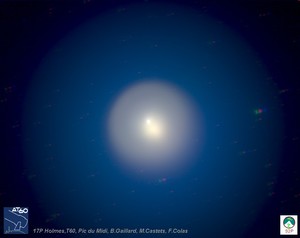
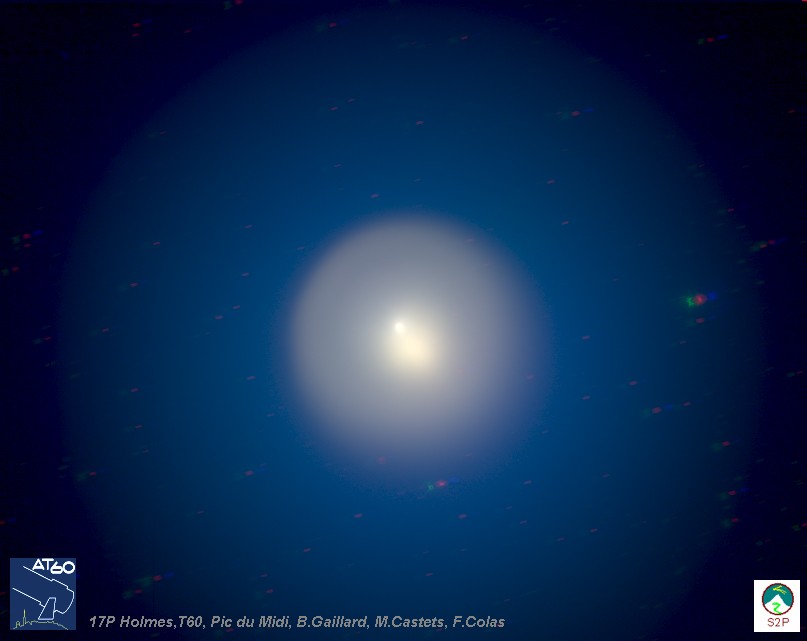
Comet 17P/Holmes has certainly given sky-watchers - backyard and professional astronomers alike - a thrilling chance to see a cometary outburst on a grand scale. After we posted
my story about on-going speculation about what could have caused this outburst (and the one 115 years ago), many readers posted comments related to two questions:
Could this have been triggered by a collision with an object in the main asteroid belt? And why can't we see more of a tail on this comet?
|
| ©Pic du Midi Observatory/Francois Colas/Jean Lecacheux/Boris Baillard
|
| Holmes
|
NASA's Orion spacecraft now in development is America's first new manned spacecraft since development of the space shuttle 30 years ago. It's the centerpiece of NASA's Constellation program, which aims to take the next generation of human explorers to the moon and beyond. Orion's launch abort system, a "rocket on top of the rocket," is designed to ensure the safety of its astronaut crew by pulling the crew module away from it's booster rocket in the event of a booster malfunction, either while on the launch pad or during ascent to orbit.

|
| ©NASA photo by Tom Tschida.
|
| NASA Dryden's mockup Orion crew module is located in Dryden's former Shuttle hangar.
|
A US defence department advisory board has warned of the danger that American war robots scheduled for delivery within a decade might be riddled with malicious code. The kill machines will use software largely written overseas, and it is feared that sinister forces might meddle with it in production, thus gaining control of the future mechanoid military.
Leon Engelbrecht
ItWebTue, 16 Oct 2007 22:31 UTC
The National Defence Force is probing whether a software glitch led to an antiaircraft cannon malfunction that killed nine soldiers and seriously injured 14 others during a shooting exercisSA National Defence Force spokesman brigadier general Kwena Mangope says the cause of the malfunction is not yet known and will be determined by a Board of Inquiry. The police are conducting a separate investigation into the incident.
Media reports say the shooting exercise, using live ammunition, took place at the SA Army's Combat Training Centre, at Lohatlha, in the Northern Cape, as part of an annual force preparation endeavour.
e on Friday.
Comment: Giving soldiers computer-controlled guns that go on random autonomous rampages with no explanation as to the cause somehow gives the term "cannon-fodder" a whole new meaning!
Astronomers have discovered a record-breaking fifth planet around the nearby star 55 Cancri, making it the only star aside from the sun known to have five planets.
The discovery comes after 19 years of observations of 55 Cancri and represents a milestone for the California and Carnegie Planet Search team, which this year celebrates the 20th anniversary of its first attempts to find extrasolar planets by analyzing the wobbles they cause in their host star.
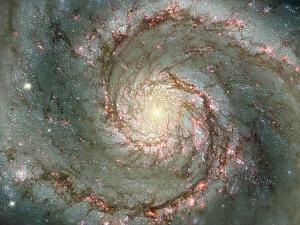
Not only has a large chunk of the universe thought to have been found in 2002 apparently gone missing again but it is taking some friends with it, according to new research at The University of Alabama in Huntsville (UAH). The new calculations might leave the mass of the universe as much as ten to 20 percent lighter than previously calculated.
|
| ©NASA and The Hubble Heritage Team (STScI/AURA) Acknowledgment: N. Scoville (Caltech) and T. Rector (NOAO))
|
| The Whirlpool Galaxy in dust and stars. Astronomers have discovered that some x-rays thought to come from intergalactic clouds of "warm" gas are instead probably caused by lightweight electrons. New calculations might leave the mass of the universe as much as ten to 20 percent lighter than previously calculated
|
Rare is the scientific paper today written by a single author. With research being conducted by teams of scientists, most studies now boast a half-dozen or so authors. According to a new study led by a scientist at the Oklahoma Medical Research Foundation, credit for those papers is far from evenly distributed, and the order in which the authors' names are listed makes a big difference.
Software which links ordinary mobile phones into a smart camera surveillance network has been developed by Swiss researchers.
The software, named Facet, was conceived at the Institute of Pervasive Computing in Zurich by three researchers: Phillip Bolliger, Moritz Köhler and Kay Römer.











Comment: Giving soldiers computer-controlled guns that go on random autonomous rampages with no explanation as to the cause somehow gives the term "cannon-fodder" a whole new meaning!