An international team of researchers has taken a key step in figuring out the source of cosmic rays that have puzzled scientists for decades.
Cosmic rays are protons or whole atomic nuclei that have been flung into space to travel at near the speed of light. They come in different varieties, with low- and medium-energy rays produced by exploding stars, or even by our own sun.
African farmers have tried everything to stop errant elephants from trampling over their land and crops: from burning tyres and shining torches, to erecting physical barriers. Now, it seems, bees could be the answer to their prayers.
Experiments carried out by Lucy King of the University of Oxford and colleagues suggest that even the sound of bees is enough to send elephants scampering away instantly.
"They really bolted," says King, who played 4-minute recordings of bees to 17 herds of elephants in Kenya's Buffalo Springs and Samburo National Reserves. "One herd even ran across a river to get away," she adds.
Time ain't what it used to be.
A hundred years or so ago, we thought that the seconds ticked away predictably. Tick followed tock, followed tick.
And clocks ran...well, like clockwork. Then along came Einstein and everything changed.
His theories of relativity dealt a blow to our naive ideas about time. Hitch a ride on a rocket travelling close to the speed of light, and time slows to a virtual standstill. The same happens if you park near a black hole and feel its awesome gravity. Even worse, space-time becomes so warped inside a black hole that space and time actually switch places.
Now just as we're getting to grips with time's weirdness, one daring physicist has dropped another bombshell. "There isn't just one dimension of time," says Itzhak Bars of the University of Southern California in Los Angeles. "There are two. One whole dimension has until now gone entirely unnoticed by us."
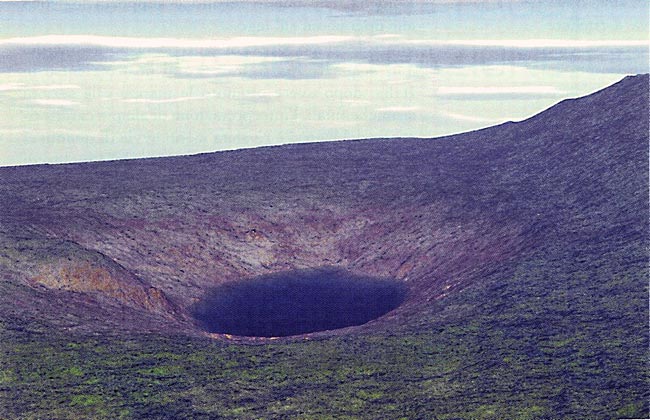
Almost a century after a mysterious explosion in Russia flattened a huge swath of Siberian forest, scientists have found what they believe is a crater made by the cosmic object that made the blast.
The crater was discovered under a lake near the Podkamennaya Tunguska River in western Siberia, where the cataclysm, known as the Tunguska event, took place.
|
| ©www-th.bo.infn.it/tunguska / University of Bologna
|
| A three-dimensional rendering of Lake Cheko in Tunguska, Siberia. The level of the lake is lowered 40 meters (131 feet) to emphasize its cone-like shape.
|
For half a century, social psychologists have been trying to figure out the human gift for rationalizing irrational behavior. Why did we evolve with brains that salute our shrewdness for buying the neon yellow car with bad gas mileage? The brain keeps sending one message - Yesss! Genius! - while our friends and family are saying, "Well... "
This self-delusion, the result of what's called cognitive dissonance, has been demonstrated over and over by researchers who have come up with increasingly elaborate explanations for it. Psychologists have suggested we hone our skills of rationalization in order to impress others, reaffirm our "moral integrity" and protect our "self-concept" and feeling of "global self-worth."
Tessa Dunlop
ReutersThu, 08 Nov 2007 01:36 UTC
Australian scientists studying humpback whales sounds say they have begun to decode the whale's mysterious communication system, identifying male pick-up lines and motherly warnings.

|
| ©REUTERS/Russell Boyce
|
| A humpback whale performs a "tail slap" by slapping its tail flukes on the surface of the water in Hervey Bay off the east coast of Australia in this file photo from Aug. 7, 2006.
|
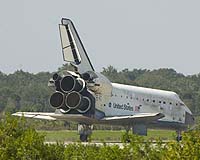
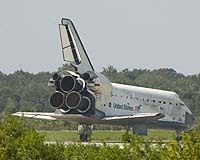
Space Shuttle Discovery landed in Cape Canaveral, Florida this evening at 19:01 CET (18:01 UT), completing one of the most complex assembly missions to the International Space Station to date, bringing back seven crew members, including ESA astronaut Paolo Nespoli.
|
| ©ESA - S. Corvaja 2007
|
| Space shuttle Discovery
|
Researchers at Harvard University and Pennsylvania State University have invented a technology, inspired by nature, to reduce the accumulation of atmospheric carbon dioxide (CO2) caused by human emissions. By electrochemically removing hydrochloric acid from the ocean and then neutralizing the acid by reaction with silicate (volcanic) rocks, the researchers say they can accelerate natural chemical weathering, permanently transferring CO2 from the atmosphere to the ocean.
|
| ©Unknown
|
| As weathering dissolves more continental rock, more carbon is permanently transferred from the atmosphere to the ocean and ultimately to the sediments.
|
A stray bullet rips through the command center, blowing holes in vital equipment and damaging the data archives. Repair teams spring into action. The damage must be patched up quickly or the control systems could go haywire. It's literally a matter of life or death, and a decision must be made: try to fix the damage in place, or move the broken parts to the repair shop.
This is a drama that unfolds every day in the microscopic world inside the cells of astronauts. High-speed particles of space radiation zip through an astronaut's body. Occasionally, one of these particles will strike and break a strand of DNA. Because DNA carries a cell's genetic information and directs its behavior, broken DNA can make a cell grow out of control and even lead to cancer.
Tired of Windows? The next generation of laptops may let you jump from one operating system to another to play movies, surf the Web or read e-mail.
Phoenix Technologies Ltd., a leading maker of the software that controls Windows computers most basic workings, announced this week that it will offer a feature it calls HyperSpace to laptop manufacturers.
Woody Hobbs, the Milpitas, Calif.-based company's chief executive, said the first application of the technology probably will show up next summer in the shape of laptops that can play DVDs outside Windows.
User will be able to boot in a few seconds straight into the DVD player, skipping the longer Windows startup, or switch to the DVD player from Windows. If Windows is running at the same time, it can be put in sleep mode, prolonging battery life.