The carnivorous pitcher plants that feed on insects in the Asian tropics may not snap shut like Venus flytraps, but they are smarter than they look.
Rather than being passive pitfall traps, the tube-like pitchers of Nepenthes plants actually contain a clever slimy fluid -- similar to mucus -- that produces powerful filaments to snare prey, French researchers said on Wednesday.
NEW YORK - Scientists have created the equivalent of embryonic stem cells from ordinary skin cells, a breakthrough that could someday produce new treatments for disease without the explosive moral questions of embyro cloning.
LONDON - This was a bug you couldn't swat and definitely couldn't step on. British scientists have stumbled across a fossilized claw, part of an ancient sea scorpion, that is of such large proportion it would make the entire creature the biggest bug ever. How big? Bigger than you, and at 8 feet long as big as some Smart cars.
This is a computer generated image issued by the University of Bristol in England released on Tuesday Nov. 20, 2007 showing a size comparison between a human an ancient sea scorpion. A fossil found in Germany indicates the ancient sea scorpion was once 2.5 metres (8 feet) long, making it the biggest bug ever known to have existed.
Wine made some 2,400 years ago was found last Thursday in an ancient tomb in Baishui County, Shaanxi Province.
Local archaeologists said they unearthed a sealed bronze pot containing 2 kg of red liquid during an excavation of an ancient tomb built in the Warring States Period (475 BC - 221 BC). Wafts of the ancient vintage greeted the archaeologists after they opened the pot.
Kenneth Chang and John Schwartz The New York Times Tue, 20 Nov 2007 04:57 UTC
Many a mother has said, with a sigh, "If your friends jumped off a cliff, would you jump, too?"
The answer, for cockroaches at least, may well be yes. Researchers using robotic roaches were able to persuade real cockroaches to do things that their instincts told them were not the best idea.
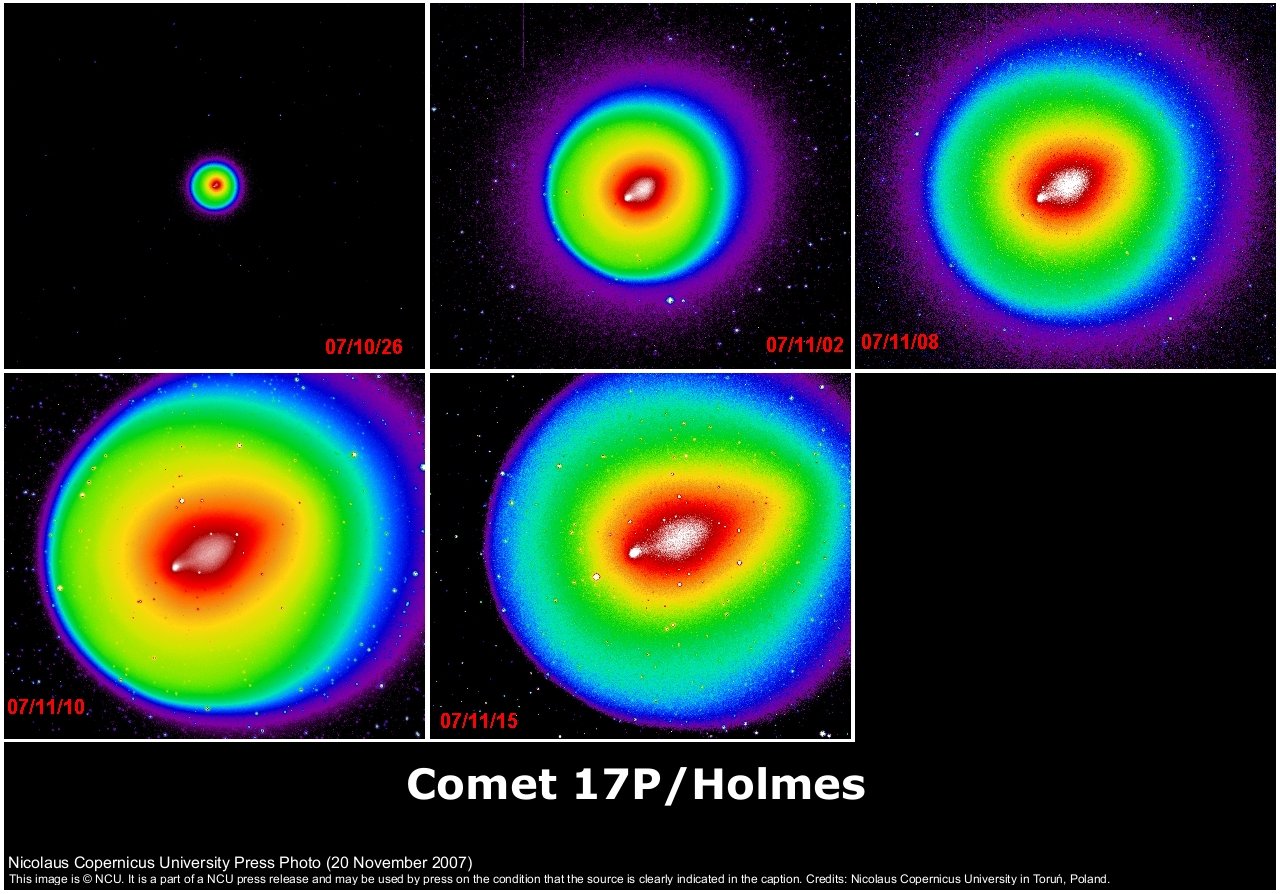
NASA's Hubble Space Telescope has probed the bright core of Comet 17P/Holmes, which, to the delight of sky watchers, mysteriously brightened by nearly a millionfold in a 24-hour period beginning Oct. 23, 2007.
Over 100 ancient jade artifacts in museums across southeast Asia have been traced back to Taiwan, shedding new light on sea trade patterns dating back 5,000 years, researchers said.
A Hubble image (R), taken November 4, 2007, shows the heart of Comet 17P/Holmes. The central portion of the image has been specially processed to highlight variations in the dust distribution near the nucleus. About twice as much dust lies along the east-west direction (the horizontal direction) as along the north-south direction (the vertical direction), giving the comet a "bow tie" appearance. The composite color image at left, taken on November 1, 2007, by an amateur astronomer shows the complex structure of the entire coma, consisting of concentric shells of dust and a faint tail emanating from the comet's right side. The normally sedate Comet Holmes made a bright splash in the sky about two weeks ago, unexpectedly becoming a million times brighter than normal overnight and causing a stir among astronomers.
High-energy cosmic rays might not be from active galactic nuclei after all.
The origin of ultra-high-energy cosmic rays is one of the great mysteries of cosmology. Last week a team reported that they thought they had tracked down the source. But the first check on that answer, by another team with different data, has failed to support it.
Comment: Enjoy our latest Forum's Topic:
Speculations about the Comet 17P/Holmes