
Science & TechnologyS


Info

Deeper Impact: Did Mega-Meteors Rattle Our Planet?

Smashing Time
© Jayme McGowanA smashing time.
On the west coast of India, near the city of Mumbai, lies a tortured landscape. Faults score the ground, earthquakes are rife, and boiling water oozes up from below forming countless hot springs.

These are testaments to a traumatic history. Further inland, stark mountains of volcanic basalt provide compelling evidence that this entire region - an area of some 500,000 square kilometres known as the Deccan traps - underwent bouts of volcanic activity between 68 and 64 million years ago.

We don't know why. The Deccan traps lie far away from any tectonic plate boundaries, those fractures in Earth's crust through which lava usually forces its way up from the planet's interior. No volcanism on the scale implied by the Deccan traps occurs on Earth now. However, smaller, equally mysterious "hotspots" dot the globe away from plate boundaries - the smoking volcanoes of the Hawaiian islands, for example, or the bubbling geysers of Yellowstone National Park in Wyoming.

Geologists have generally thought that the history of such features can be traced through the slow churnings and contortions of rock under pressure in Earth's mantle. But it seems there is more to it than that. Sometimes volcanic activity needs - and gets - a helping hand from above.

Compass

Mapping Project Consistent With Huge Historic Seas On Mars

Image
© Unknown
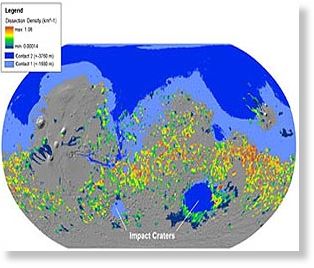
A geologic mapping project using NASA spacecraft data offers new evidence that expansive lakes existed long ago on Mars. The research points to a series of sedimentary deposits consistent with what would relate to large standing bodies of water in Hellas Planitia located in the southern hemisphere of Mars, said by Dr.Leslie Bleamaster, research scientist at the Planetary Science Institute.

Fine-layered outcrops around the eastern rim of Hellas have been interpreted as a series of sedimentary deposits resulting from erosion and transport of highland rim materials into a basin-wide standing body of water, Bleamaster said.

Hellas basin, more than 2,000 km across and 8 km deep, is the largest recognized impact structure on the Martian surface, he said.

The mapping project reinforces earlier research that initially proposed Hellas-wide lakes citing different evidence in the west, he said. "This mapping makes geologic interpretations consistent with previous studies, and constrains the timing of these putative lakes to the early-middle Noachian period on Mars, between 4.5 and 3.5 billion years ago," he said.

Laptop

Hackers Plant Malware on Jerusalem Post Website

Scattergun opportunists

Hackers compromised the website of the Jerusalem Post on Monday so that it served up malware.

The attack relied on planting scripts on the site itself, rather than the more common tactic of compromising its ad-serving system to serve tainted ads. The attack ultimately attempted to dump Windows-based malware on the Windows PCs of visiting surfers.

Sophos - which was among the first to document the attack - defines this strain of malware as Behav-290.

Info

First Video: Australian Deep Sea Canyon

A deep sea canyon off the coast of Western Australia has been filmed for the first time, revealing the habitat of some of Australia's rarest marine life, including the blue whale and a fish that lives for 70 years.

The Perth Canyon is roughly the same size as the Grand Canyon in the US, and is Australia's largest deep-sea canyon at 15 km wide and 1500 m at its deepest point. It was videoed in March by scientists from the University of Western Australia (UWA) and the CSIRO who released the footage today. The team lowered robotic cameras hundreds of metres below sea level to produce the stunning images.

Deep-sea canyons, immense valleys carved over great period of time by erosion, are generally areas that contain an abundance of varied marine life. Professor Jessica Meeuwig, from the UWA's Centre for Marine Futures, says visual documentation of life in the Perth Canyon - which is 22 km west of Rottnest Island and was carved by erosion from Perth's Swan River - is both very exciting and fundamentally important in understanding the entire region of the west coast.

Display

"Imaginary" Interface Could Replace Screens and Keyboards

Image
© Hasso Plattner Institute A user draws an imaginary line in the operating plane of the Imaginary Interfaces device.
Researchers are experimenting with a new interface system for mobile devices that could replace the screen and even the keyboard with gestures supported by our visual memory.

Called Imaginary Interfaces, the German project uses a small, chest-mounted computer and camera to detect hand movements. Unlike Tony Stark in Iron Man, who manipulates holographic elements in his lab with his hands, users conjure up their own imaginary set of graphical interfaces.

For example, people can manually draw shapes and select points in space that have programmed functions, such as a power switch or a "send" key, for example.

Info

Ancient manuscript found in library cellar

Stockholm, Sweden, -- A library in northern Sweden has found in its cellars a rare volume of hand-written German legal code from the 15th century, authorities say.

Officials at the Sundsvall library say they believe the Sachsenspiegel (Saxon mirror) from 1481 is the second existing copy of a law book written by hand in low German in the early 1200s by the Saxon nobleman Eike von Repgau, The Local reported Monday.

Magnify

A Graveyard For Roman Gladiators -- In England?

Image
© Press Association via AP ImagesThe skeletons at this site in York, England, are decapitated -- a key clue to archaeologists that this might be a cemetery for Roman gladiators.
Ancient skeletons excavated under the city of York in northern England have archaeologists wondering whether they've discovered a well-preserved cemetery full of fallen Roman gladiators. The first of the skeletons was discovered in 2003, and since then, more than 80 have been identified.

The remains date between the 2nd and 3rd centuries, the period during which the Romans occupied northern England. The skeletons had been decapitated - and that was a key reason researchers thought they had been gladiators, says John Walker, chief executive of the York Archaeological Trust, which conducted the research.

Info

Man-made aurora to help predict space weather

For more than 25 years, our understanding of terrestrial space weather has been partly based on incorrect assumptions about how nitrogen, the most abundant gas in our atmosphere, reacts when it collides with electrons produced by energetic ultraviolet sunlight and "solar wind."

New research published today, Tuesday 8 June, in IOP Publishing's Journal of Physics B: Atomic, Molecular and Optical Physics describes how scientists from NASA's Jet Propulsion Laboratory (JPL) at the California Institute of Technology have fired electrons of differing energies through a cloud of nitrogen gas to measure the ultraviolet light emitted by this collision.

Info

The Earth and Moon Formed Later Than Previously Thought

Worlds in Collision
© Insciences.org
The Earth and Moon were created as the result of a giant collision between two planets the size of Mars and Venus. Until now it was thought to have happened when the solar system was 30 million years old or approx. 4,537 million years ago. But new research from the Niels Bohr Institute shows that the Earth and Moon must have formed much later - perhaps up to 150 million years after the formation of the solar system. The research results have been published in the scientific journal, Earth and Planetary Science Letters.

"We have determined the ages of the Earth and the Moon using tungsten isotopes, which can reveal whether the iron cores and their stone surfaces have been mixed together during the collision", explains Tais W. Dahl, who did the research as his thesis project in geophysics at the Niels Bohr Institute at the University of Copenhagen in collaboration with professor David J. Stevenson from the California Institute of Technology (Caltech).

Pharoah

Lord mayor of Memphis

Image
© UnknownWorkers removing the sand off Djehuty's statue
A colossus of an ancient Egyptian deity in Luxor, an Umayyad coin in Wadi Al-Natroun and the tomb of a 19th-Dynasty mayor of Memphis at Saqqara are the most recent discoveries in Egypt.

At the end of the winter archaeological season the announcement of new discoveries are helping specialists to decipher more chapters in Egypt's ancient history. The most recent discoveries were carried out by Egyptian missions from the Supreme Council of Antiquities (SCA) and Cairo University in Luxor, Wadi Al-Natroun and Saqqara.